
Updated 10 October 2026. This is a Council recommendation, not yet law.
A Hyderabad supplier sends a consignment to Chennai. On the way the truck is stopped in a State it only passes through, and the goods are held. Will that still be possible?
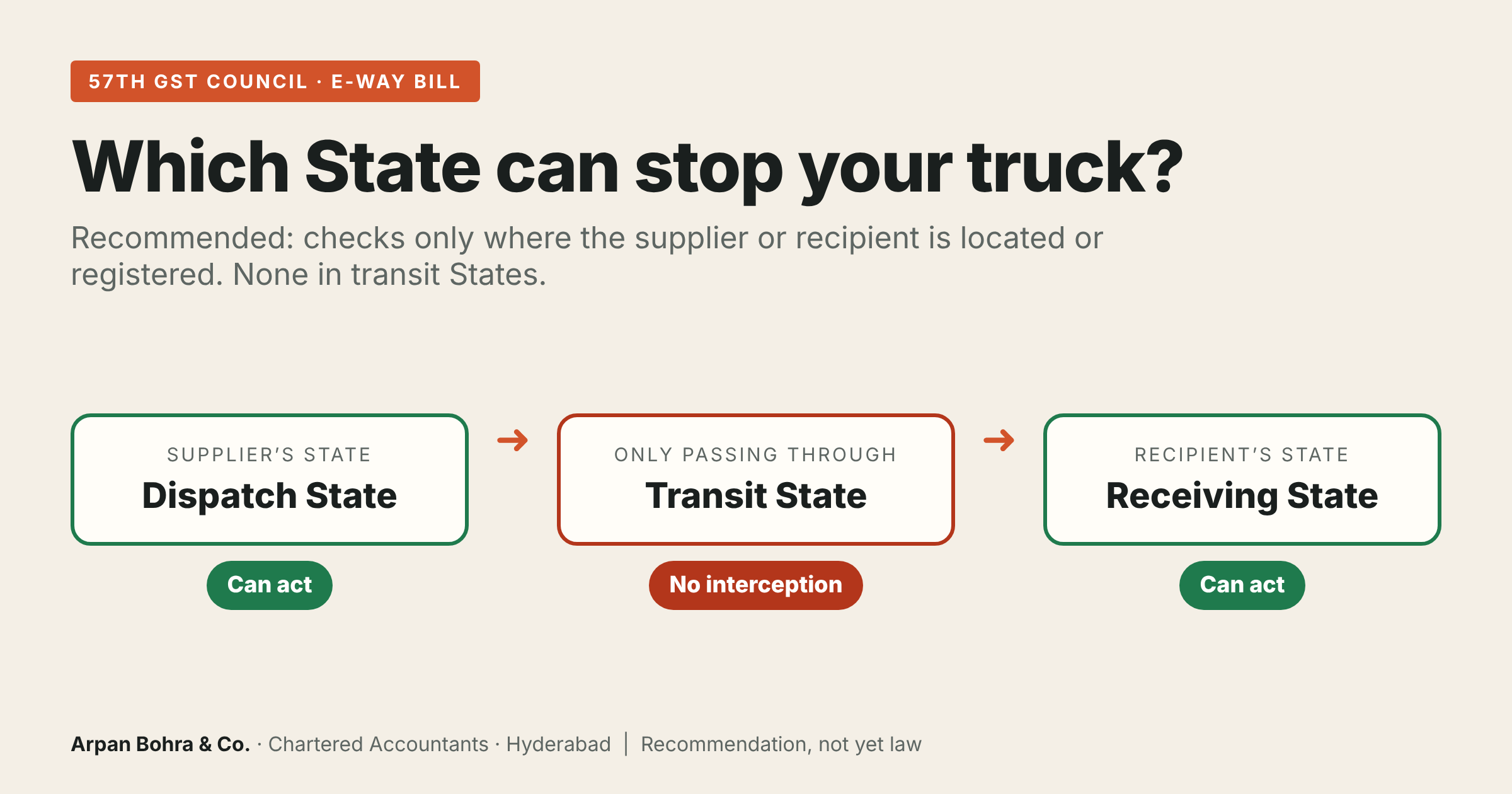
The 57th GST Council has recommended that it should not be. Interception would be allowed only where the supplier or the recipient is located or registered, that is, the dispatch State or the receiving State. There would be no interception in transit States. But the recommendation has no force of law until the CGST Act is amended.
The recommendation in one table
| Point | As recommended by the Council (8 October 2026) |
|---|---|
| Provisions to be amended | Sections 68, 129 and 130 of the CGST Act, 2017 |
| When can a vehicle be intercepted? | Only on specific intelligence |
| Who authorises? | An officer not below the rank of Joint Commissioner |
| Which State can act? | The State where the supplier or the recipient is located or registered |
| Transit States | No interception |
| No e-way bill, or no document showing origin or destination | Inspection, detention or seizure irrespective of jurisdiction |
| Section 130 confiscation | Not to apply to goods or conveyances in transit |
| Effective date | None stated. To be given effect through circulars, notifications or law amendments |
Dispatch State, receiving State, transit State
The release speaks of the State where the supplier or recipient is “located or registered”. In plain terms, these are the dispatch State (supplier’s State) and the receiving State (recipient’s State). Any other State on the route is a transit State.
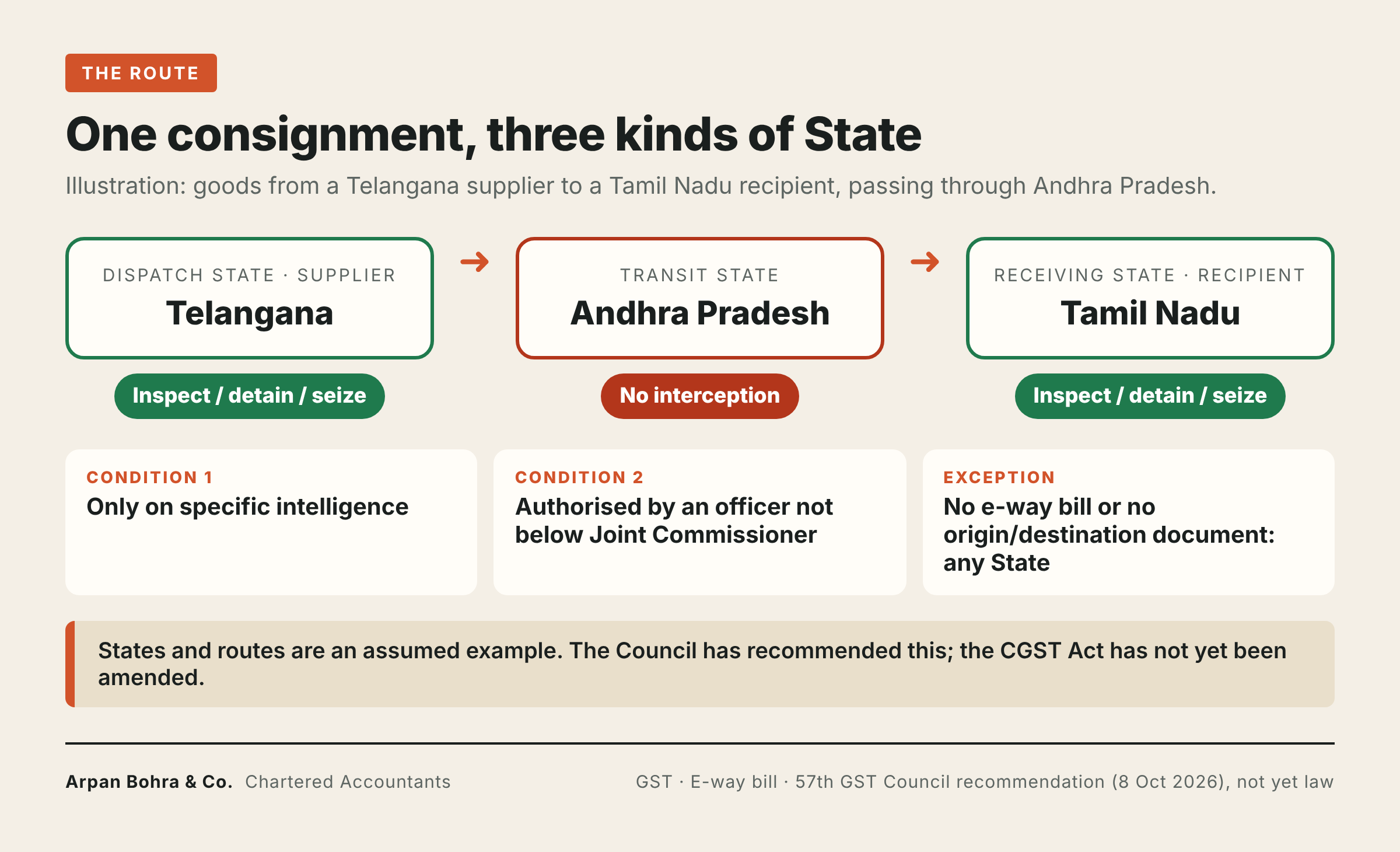
The States above are an assumed example only.
Can the officer stop the vehicle? Three questions
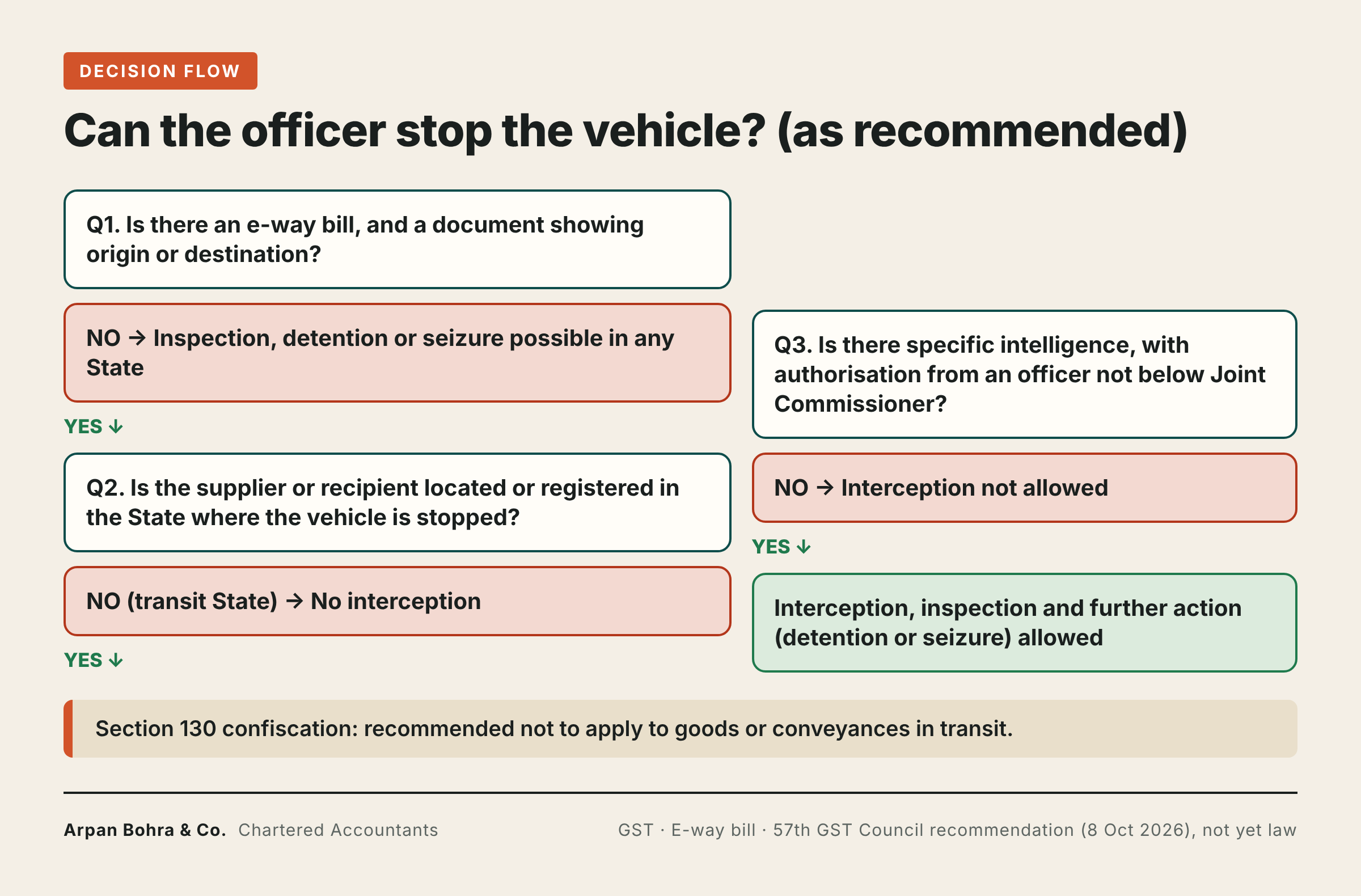
| # | Question | If the answer is no |
|---|---|---|
| 1 | Is there an e-way bill and a document showing origin or destination? | Inspection, detention or seizure possible in any State |
| 2 | Is the supplier or recipient located or registered in the State of interception? | No interception (transit State) |
| 3 | Is there specific intelligence and authorisation from an officer not below Joint Commissioner? | Interception not allowed |
Current law vs the recommendation
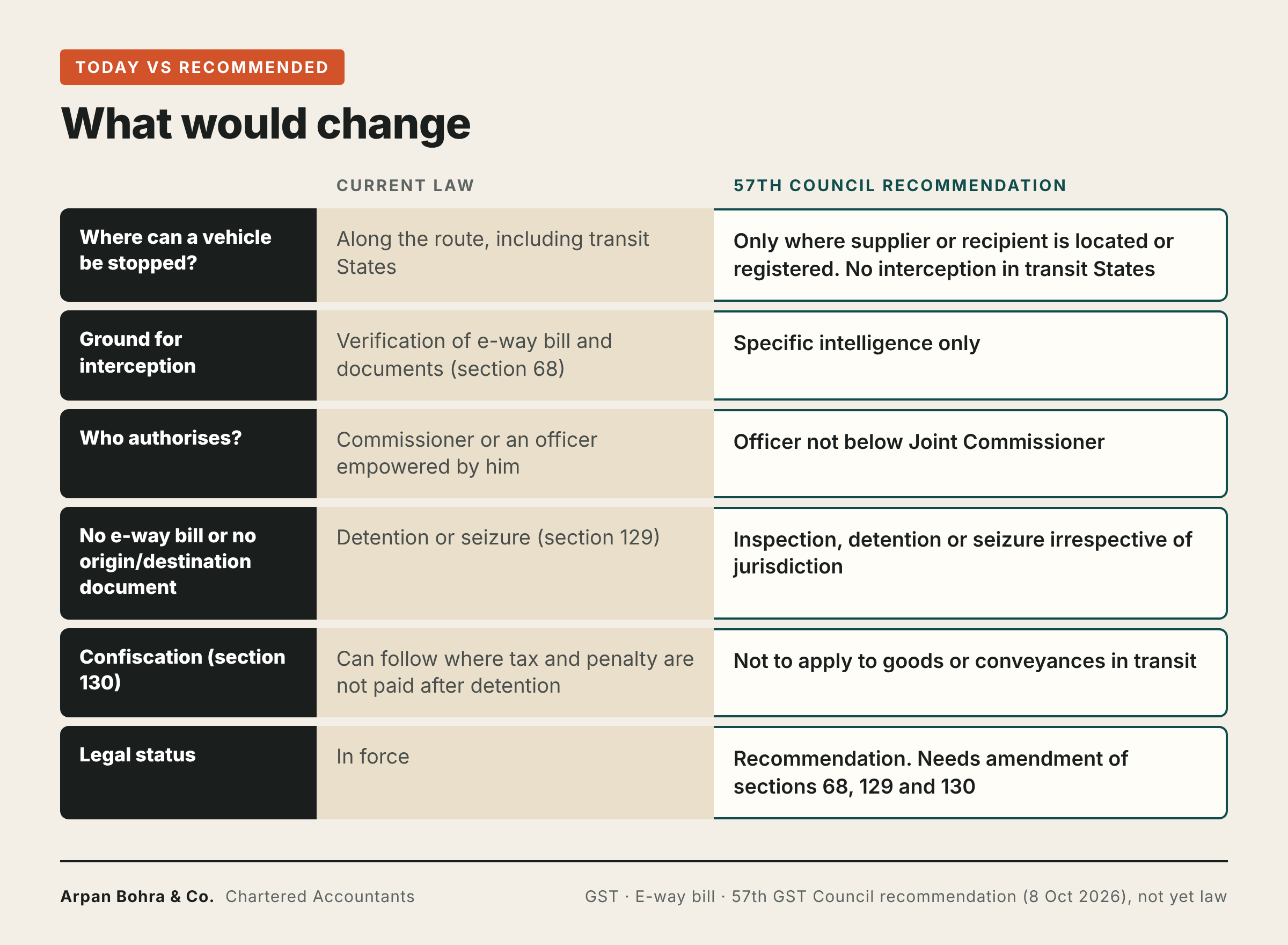
| Point | Current law | Recommended |
|---|---|---|
| Where a vehicle can be stopped | Along the route, including transit States | Only in the supplier’s or recipient’s State |
| Ground | Verification of e-way bill and documents (section 68) | Specific intelligence only |
| Authorising officer | Commissioner or an officer empowered by him | Not below Joint Commissioner |
| No e-way bill or document | Detention or seizure (section 129) | Inspection, detention or seizure irrespective of jurisdiction |
| Confiscation | Can follow where tax and penalty are not paid after detention (section 130) | Not to apply in transit |
| Status | In force | Needs amendment of sections 68, 129 and 130 |
Already in the rules: once a conveyance has been physically verified in transit, repeat physical verification is restricted unless specific information of evasion emerges. The recommendation goes further: it limits interception itself by State.
Six situations
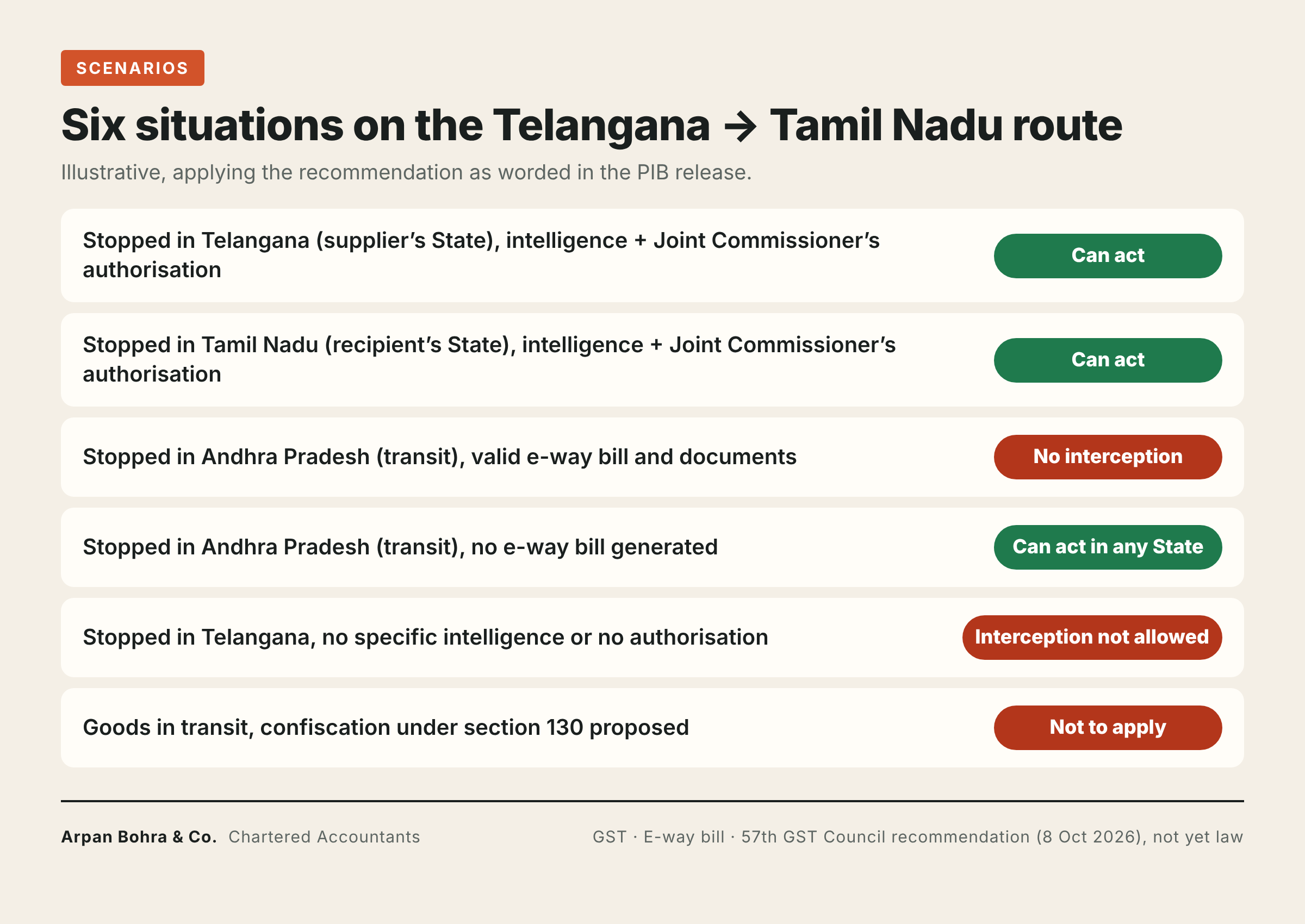
| Where stopped | Facts | Under the recommendation |
|---|---|---|
| Telangana (supplier’s State) | Specific intelligence, Joint Commissioner’s authorisation | Can act |
| Tamil Nadu (recipient’s State) | Specific intelligence, Joint Commissioner’s authorisation | Can act |
| Andhra Pradesh (transit) | Valid e-way bill and documents | No interception |
| Andhra Pradesh (transit) | No e-way bill generated | Can act, irrespective of jurisdiction |
| Telangana | No specific intelligence or no authorisation | Interception not allowed |
| Any State, goods in transit | Confiscation under section 130 | Not to apply |
Litigation view: what is settled and what is not
| Issue | Position | Risk | Practical course |
|---|---|---|---|
| Relying on the recommendation today | Not enforceable. The release itself says only the circulars, notifications or amendments carry the force of law | High, if relied on | Comply with current law in full |
| “Located or registered” | Not defined in the release. Supplier’s or recipient’s State may differ from the actual place of dispatch or delivery (for example, ship-to arrangements or branches). Litigative once enacted | Moderate | Align registrations, invoices and e-way bill State details |
| “Specific intelligence” | Not defined. What must be recorded, and whether it can be tested, is unclear | Moderate | Ask for the written authorisation; record place, time and officer |
| Transit-State action after amendment | Would be open to challenge for want of jurisdiction, subject to the no-document exception | Low to moderate | Keep e-way bill and origin/destination papers with the vehicle |
| State GST Acts | Whether State laws will mirror the CGST amendments is for confirmation | Moderate | Track State notifications for your dispatch and delivery States |
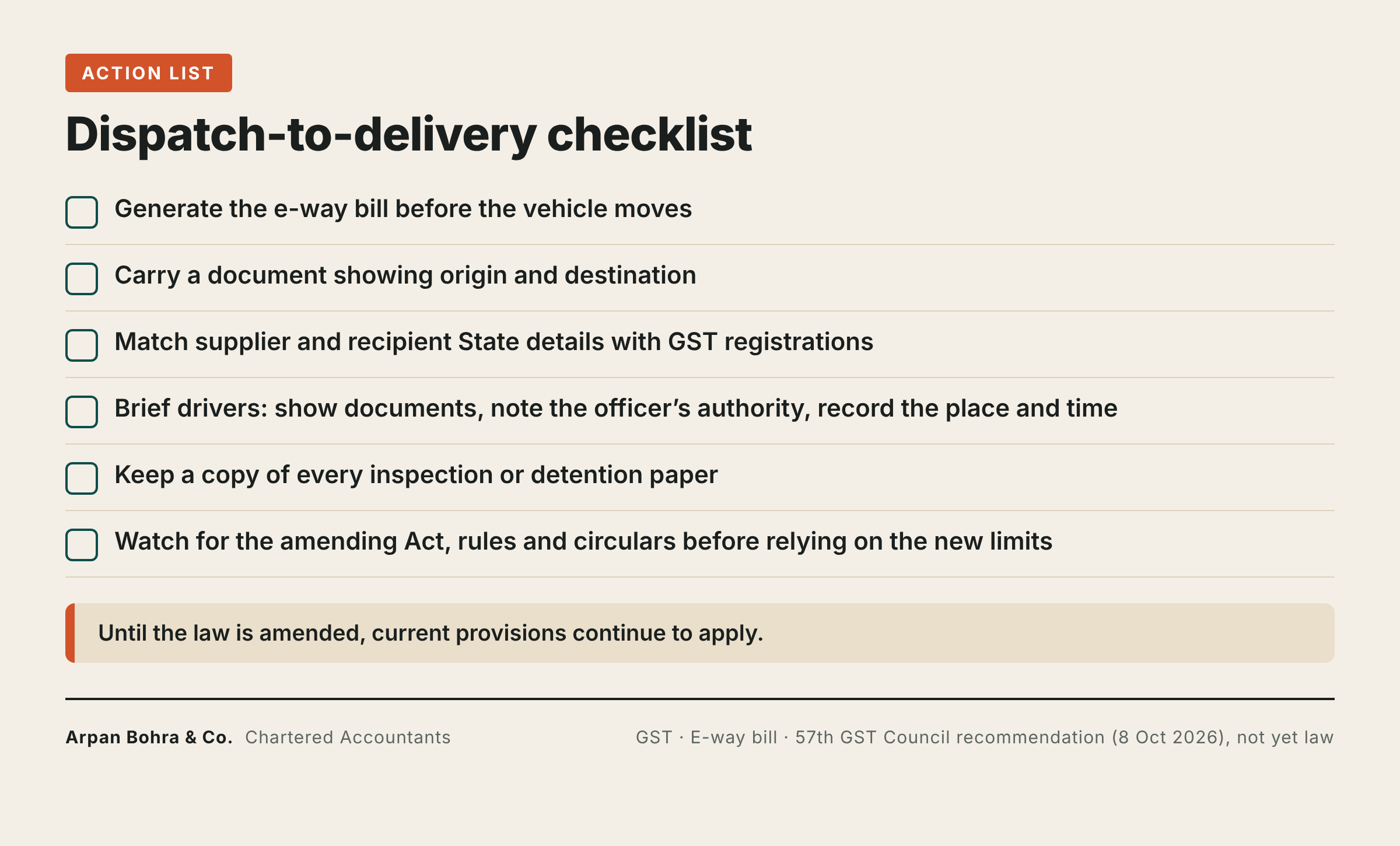
What to do now
Hyderabad context
Many consignments from Hyderabad, including those from industrial belts around Patancheru and the outer ring road, to southern and eastern markets cross at least one other State. For such movements the transit-State point matters most. Dispatchers, transporters and recipients in Hyderabad should treat the recommendation as a development to watch, and the e-way bill and origin/destination documents as the protection that remains essential.
Frequently asked questions
Is the dispatch State and receiving State rule in force?
No. It is a recommendation of the 57th GST Council. It will take effect only through amendments, notifications or circulars.
Can a transit State still stop my vehicle?
Under current law, checks along the route are possible. Under the recommendation, a transit State could not intercept, except where no e-way bill is generated or no document shows origin or destination.
Who must authorise interception under the recommendation?
An officer not below the rank of Joint Commissioner, and only on specific intelligence.
What happens to confiscation under section 130?
The Council recommended that section 130 confiscation should not apply to goods or conveyances in transit.
Do I still need an e-way bill?
Yes. The recommendation does not remove the e-way bill requirement, and the absence of an e-way bill or origin/destination document takes the protection away.
Takeaway
The proposal ties interception to the dispatch State and the receiving State, and takes transit States out of the picture, but only the amending law will settle how far that goes. Until then, current provisions apply.
This article is for general information and is not advice on any specific matter. Please verify the position against the official text.
Arpan Bohra & Co., Chartered Accountants
Himayat Nagar, Hyderabad
Website: www.arpanbohra.co.in
GST queries: gst@arpanbohra.co.in | Telephone: 9010558981
Related reading: 57th GST Council meeting highlights · E-way bill FAQs · GST refund reforms