
Picture this. You pay Rs 20 lakh for a flat in Hyderabad. The brochure promises possession in 2024. Two years later, the site is half-built, the builder has launched a new project across town, and your calls go unanswered.
Before 2016, that story usually ended in a shrug. Today it can end in a refund with interest. The reason is one law: the Real Estate (Regulation and Development) Act, 2016 (RERA).
The answer in 30 seconds: RERA forces builders (called “promoters”) to register projects, disclose facts, keep 70% of buyer money in a separate project account, and answer to a State regulator. Buyers get enforceable rights, including a refund with interest or monthly interest when possession is late.
This is Part 1 of a 5-part series by Arpan Bohra & Co., Chartered Accountants. Read all five and you will know RERA from A to Z.
Why did India need RERA?
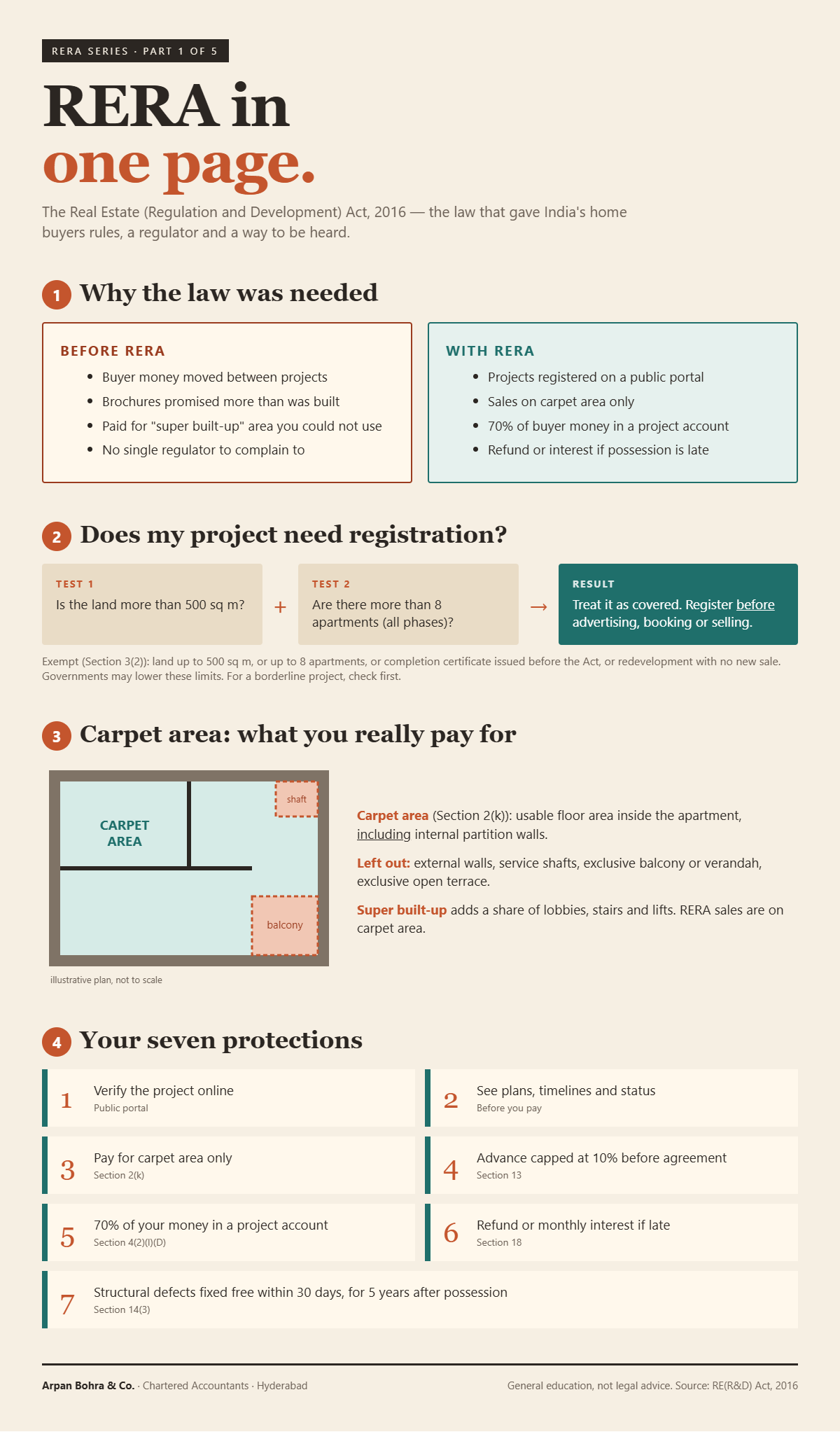
Before the Act, three things went wrong again and again. Buyer money moved between projects. Brochures promised more than was built. And the area you paid for (“super built-up”) was bigger than the area you could actually use. RERA tackles all three in one statute.
RERA at a glance
| Question | Answer |
|---|---|
| Full name | Real Estate (Regulation and Development) Act, 2016 |
| Who enforces it | A Real Estate Regulatory Authority in each State/UT (Telangana: TG-RERA) |
| Where appeals go | The Real Estate Appellate Tribunal (REAT) |
| Who must register | Promoters of covered projects, and real estate agents |
| What buyers get | Disclosure, carpet-area pricing, escrow protection, refund or interest on delay |
Does my project need RERA registration? (Section 3)
A promoter must register before advertising, marketing, booking or selling in a covered project. Registration is not needed in these cases (Section 3(2)):
- The land to be developed does not exceed 500 square metres, or
- The number of apartments proposed, across all phases, does not exceed eight, or
- The project already had a completion certificate before the Act began, or
- It is renovation, repair or redevelopment with no new marketing, advertising, sale or allotment.
Governments can lower these thresholds. Telangana’s own FAQ reads the test as “more than 500 sq m or more than eight apartments”. If your project sits on the border, assume registration is required until a lawyer says otherwise.
Carpet area: the number that decides what you pay for
Carpet area (Section 2(k)) is the net usable floor area inside the apartment. It excludes external walls, service shafts, exclusive balconies or verandahs and exclusive open terraces, but includes internal partition walls. RERA requires sales on carpet area. “Super built-up” adds a share of lobbies, stairs and lifts, which you cannot use as your own.
RERA jargon, decoded
- Promoter: the builder or developer who constructs or sells apartments or plots.
- Allottee: you, the buyer.
- Real estate agent: someone who facilitates sale or purchase for a fee. Agents must register too (Section 9).
- Escrow / separate account: a dedicated scheduled-bank account for project money (see Part 2).
- Authority: the State regulator. Adjudicating Officer: decides compensation. Appellate Tribunal: hears appeals.
Your 7 RERA protections
- Verify the project is registered on a public portal.
- See sanctioned plans, layout, timelines and status before you pay.
- Pay for carpet area, not an inflated area.
- An advance of more than 10% of the cost needs a signed, registered agreement for sale first (Section 13).
- Seventy per cent of what you pay stays in a separate project account (Section 4(2)(l)(D)).
- If possession is late, choose a refund with interest, or stay and get interest for every month of delay (Section 18).
- Structural defects reported within five years of possession must be fixed within 30 days at no charge (Section 14(3)).
Does RERA cover my Hyderabad project?
If you are buying around Hitech City, Gachibowli, Kondapur or Kokapet, the State authority is TG-RERA, working under the Telangana Rules notified by G.O.Ms.No.202 dated 31 July 2017. Older, “ongoing” projects are covered depending on their permissions and completion status, so check the project page on the TG-RERA portal instead of assuming. Part 5 shows exactly how.
Next: Part 2 turns every builder duty into a question you can ask before you pay.
RERA FAQs
Is RERA the same in every State? The central Act is the same. Each State makes its own Rules and runs its own Authority, so fees, forms and procedure differ.
Does RERA cover plots? Yes. It covers apartments, plots and buildings in a registered project, including plotted development.
Can I buy in an unregistered project? A promoter cannot advertise, market, book or sell in a project that needs registration but has none. Buy there and you lose RERA protection, so verify first.
How much advance can a builder take? Not more than 10% of the apartment’s cost before a written agreement for sale is signed and registered (Section 13(1)).
Where do I complain? To the State RERA Authority or its adjudicating officer under Section 31. Part 3 explains how.
Sources
- Real Estate (Regulation and Development) Act, 2016 (text hosted by TG-RERA)
- Telangana Real Estate (Regulation and Development) Rules, 2017
- TG-RERA FAQ
General education, not legal advice. Please read the Act and your State Rules, or consult a professional, for your facts.
Arpan Bohra & Co., Chartered Accountants · Website: arpanbohra.co.in · Email: ab@arpanbohra.co.in