
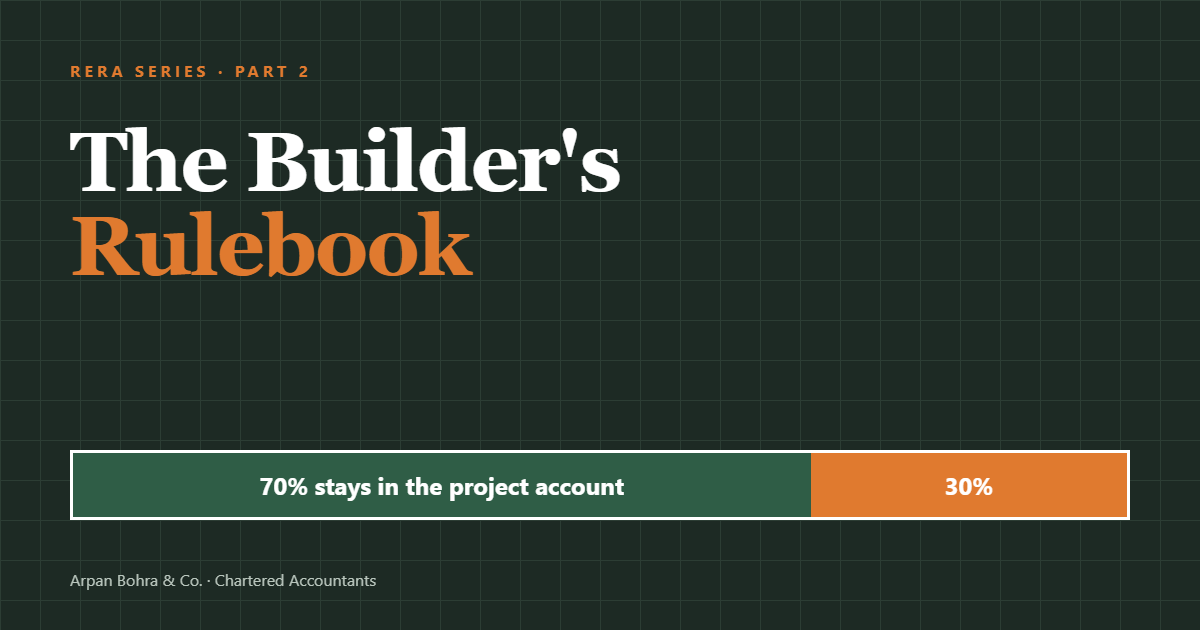
Your money is not the builder’s piggy bank. That is the idea behind RERA’s promoter rules. Every duty the Act places on a builder is also a question you can ask before you pay.
The answer in 30 seconds: A promoter must register first, tell the truth in ads and filings, keep 70% of buyer money in a separate bank account, update the public portal every quarter, build as per the sanctioned plan, and fix structural defects for five years.
Part 2 of 5. New here? Start with Part 1: RERA Explained.
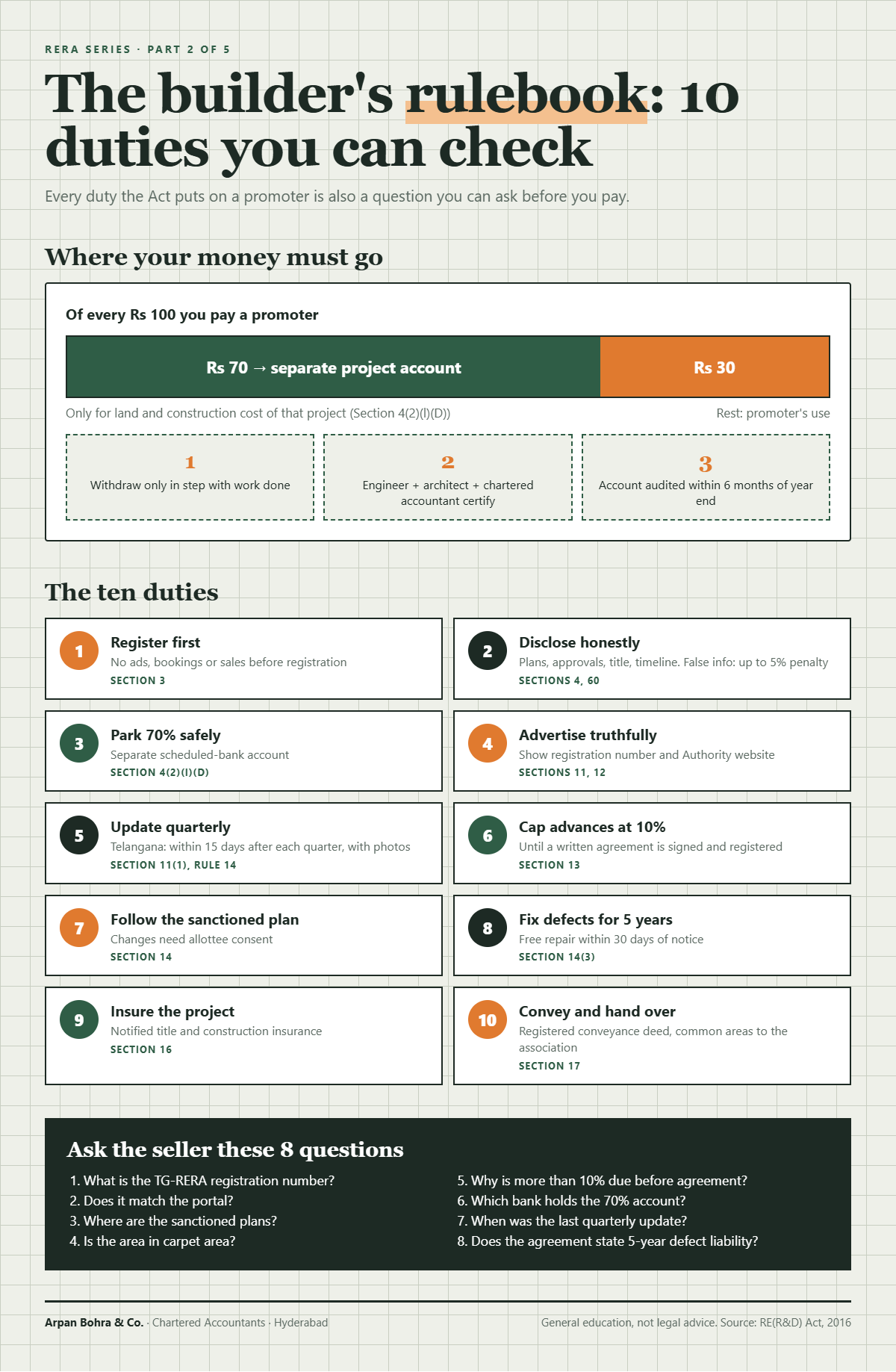
The 10 duties of a RERA promoter
| # | Duty | Section | What it means for you |
|---|---|---|---|
| 1 | Register before selling | 3 | Ask for the TG-RERA registration number |
| 2 | Disclose project details | 4 | Plans, layout, timelines and approvals belong on the portal |
| 3 | Keep 70% in a separate account | 4(2)(l)(D) | Your money cannot be freely moved to other projects |
| 4 | Advertise truthfully | 11, 12 | Ads must carry the registration number and the Authority’s website |
| 5 | Update quarterly | 11(1) | Construction status and photos must be refreshed |
| 6 | Limit advance to 10% before agreement | 13(1) | No big payment before a registered agreement |
| 7 | Follow the sanctioned plan | 14 | No changes without allottee consent |
| 8 | Fix defects for 5 years | 14(3) | Free repair within 30 days of notice |
| 9 | Insure the project | 16 | Title and construction insurance as notified |
| 10 | Hand over and convey | 17 | Registered conveyance deed and common areas |
1. Register first (Section 3)
No advertising, marketing, booking or sale in a covered project until it is registered. If the Authority sends no deficiency notice within 30 days of a complete application, registration is deemed granted (Section 5, as explained in the TG-RERA FAQ). Extending a registration needs a fresh application: in Telangana, Form E, filed within three months before expiry, with half the registration fee and no fee in force majeure cases.
Telangana charges registration fees per square metre of land, with caps. For group housing the Rules prescribe Rs 5 per sq m up to 1,000 sq m and Rs 10 above that, capped at Rs 5 lakh. Other project types have other rates and caps, so confirm the current Rules before relying on a figure.
2. Disclose (Section 4)
The application must carry real information: land title, approvals, sanctioned plans, layout, the proposed timeline and the declared end date. False information is penalised (Section 60: up to 5% of the estimated project cost).
3. The 70% rule (Section 4(2)(l)(D)): the buyer’s strongest shield
Seventy per cent of the money collected from allottees must go into a separate account in a scheduled bank, to be used only for the project’s construction and land cost. Withdrawals must match the percentage of work completed and be certified by an engineer, an architect and a chartered accountant. The account must be audited within six months after each financial year ends.
What that means in practice: instead of your Rs 20 lakh funding a new launch, most of it stays tied to your own project.
4. Advertise honestly (Sections 11 and 12)
Ads and prospectuses must show the registration number and the Authority’s website. If you lose money because of a false statement in an advertisement or prospectus, the promoter must compensate you. If you choose to withdraw, you get your investment back with interest at the prescribed rate.
5. Quarterly updates (Section 11(1))
Promoters must update the portal on bookings, approvals, parking and construction status. Under the Telangana Rules, updates are due within fifteen days after each quarter ends and include construction photographs.
6. The 10% advance cap (Section 13)
A promoter cannot take more than 10% of an apartment’s cost as an advance or application fee unless a written agreement for sale is signed and registered. A bigger demand before the agreement is a red flag.
7. Stick to the plan (Section 14)
The promoter must build as per the sanctioned plans, layout and specifications. Changes affecting an allottee need that allottee’s consent. Other major changes need the consent of at least two-thirds of the allottees.
8. Five-year defect liability (Section 14(3))
Structural or workmanship defects you report within five years of possession must be fixed free of charge within 30 days. If they are not, you are entitled to compensation.
9 and 10. Insurance, conveyance and handover (Sections 16 and 17)
The promoter must take the notified insurance. Absent local law, the conveyance deed must be executed within three months of the occupancy certificate, and documents handed over within thirty days of it. Common areas pass to the association of allottees.
Can a builder sell the project to someone else? (Section 15)
Transferring majority rights needs prior written consent of two-thirds of the allottees and the Authority’s approval. The new promoter inherits the old deadlines.
Your 8-minute pre-payment checklist
- Does the ad show the TG-RERA registration number?
- Does that number match this promoter and project on the portal?
- Are the sanctioned plans and completion date on the portal?
- Is the area in the agreement carpet area?
- Is more than 10% being asked before a registered agreement?
- Is the 70% account disclosed, and does the bank match?
- Have quarterly updates been uploaded?
- Does the agreement mention the 5-year defect liability?
Buying in Kondapur, Gachibowli or Kokapet? Run this list for every project, however well known the builder.
Next: Part 3 shows what you can do when a builder breaks these rules.
Builder duties under RERA: FAQs
Can a builder use my money for another project? The Act requires 70% of amounts received from allottees to sit in a separate project account, withdrawn in proportion to the work completed and certified by an engineer, an architect and a chartered accountant.
What is the maximum advance before an agreement? 10% of the apartment’s cost (Section 13(1)).
How long does defect liability last? Five years from possession; free repair within 30 days of notice (Section 14(3)).
Can the builder change the plan after I book? Not without your consent for changes affecting your unit, and not without two-thirds of allottees for other major changes (Section 14).
Can the builder transfer the project? Only with two-thirds of allottees’ written consent and the Authority’s approval (Section 15).
Sources
- Real Estate (Regulation and Development) Act, 2016 (text hosted by TG-RERA)
- Telangana RE(R&D) Rules, 2017
- TG-RERA FAQ
General education, not legal advice.
Arpan Bohra & Co., Chartered Accountants · Website: arpanbohra.co.in · Email: ab@arpanbohra.co.in