
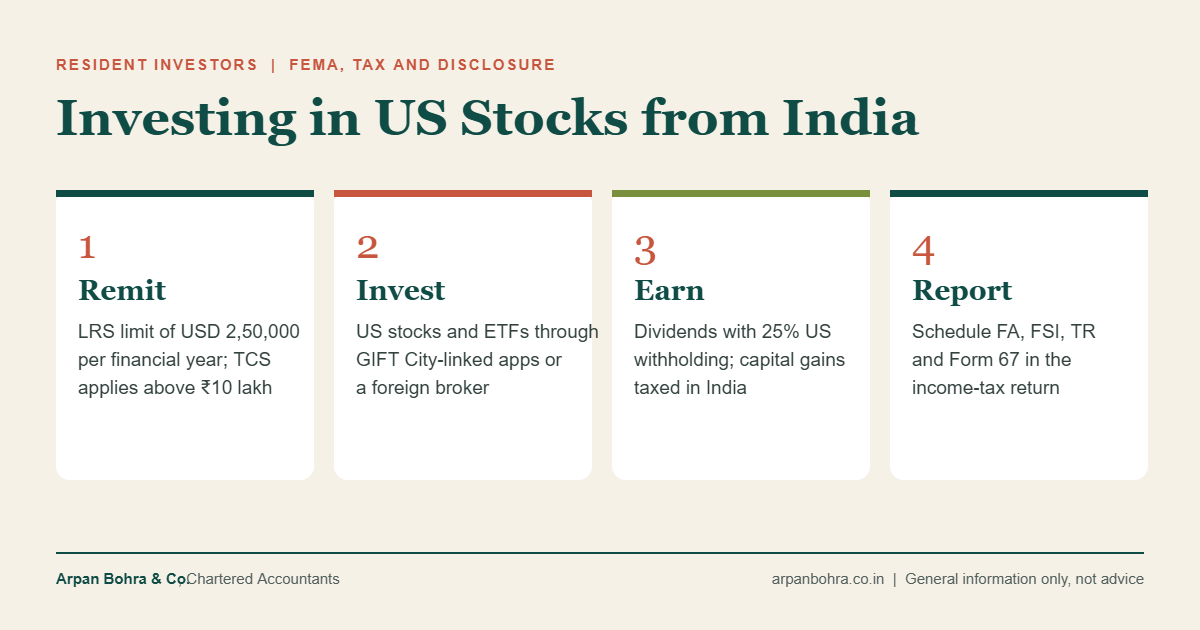
The short answer: a resident individual can invest in US stocks through the Liberalised Remittance Scheme (LRS) up to USD 2,50,000 per financial year. Remittances above ₹10 lakh in a year attract 20% TCS (credit is available). Gains on holdings over 24 months are taxed at 12.5%; shorter holdings at slab rates; US dividends bear 25% US withholding and are taxable in India with a foreign tax credit. All holdings must be disclosed – even loss-making ones.
A software professional in Hyderabad buys fractional shares of a US technology company through an app, earns a small dividend, and sells after a year. Everything feels like a domestic trade – until the return is filed, and Schedule FA, Schedule FSI and Form 67 appear.
Key terms in this guide: Liberalised Remittance Scheme (LRS), Tax Collected at Source (TCS), US-listed stocks and ETFs on NYSE and NASDAQ, fractional shares, GIFT City and IFSCA, Form W-8BEN, India-US double taxation avoidance agreement (DTAA), foreign tax credit, Schedule FA, Schedule FSI, Schedule TR, Form 67, FEMA Overseas Investment Rules, and the Black Money Act.
1. How to invest in US stocks from India: routes for resident Indians
| Route | How it works | Key compliance point |
|---|---|---|
| GIFT City-linked broker apps | Indian apps route orders through IFSC entities to US brokers. Zerodha’s US stocks segment, reported on 19 October 2026 as launched in beta, routes through BSE’s India INX Global Access at GIFT City with IFSCA approval (June 2026), offering up to about 2,000 US companies and around 1,000 ETFs. Groww offers a similar route. | Funded under LRS; TCS and reporting apply |
| Direct foreign brokerage account | Account opened with an overseas broker; funds remitted through an authorised dealer bank | Foreign tax forms (W-8BEN); full self-reporting |
| Indian feeder funds / fund-of-funds | Invest in rupees in funds holding US stocks | No LRS or TCS; taxed as per fund rules; fresh inflows in some funds have been restricted |
Zerodha’s page states that joint accounts, HUFs, companies, LLPs, firms and NRIs are not eligible for its US stocks offering. LRS itself is available to resident individuals.
Costs (Zerodha, as published): brokerage of 0.1% of trade value or USD 10 per order, whichever is lower, plus 18% GST on brokerage; IFSCA turnover fee of 0.005%; US regulatory fees on sells; and a currency conversion mark-up of 0.5%–1.2% over the RBI reference rate (as reported by Inc42). Only delivery orders are available and funding is by net banking. Charges differ by platform and should be read before investing.
2. FEMA: the LRS framework
Residents may remit up to USD 2,50,000 per financial year under LRS for permitted current or capital account transactions, including overseas portfolio investment. The limit is aggregate across all LRS uses and is tracked against PAN. Overseas investment is governed by the Foreign Exchange Management (Overseas Investment) Rules, 2022 and the RBI Master Direction on Overseas Investment.
- Remit only through an authorised dealer bank, declaring the purpose correctly.
- Do not route funds through third parties or mis-declare the purpose; the declaration forms part of the FEMA record.
- Retain remittance advices, contract notes and statements – they support both FEMA and tax reporting.
3. TCS on LRS remittance for US stock investment
For LRS remittances for investment (an “other purpose”), TCS is nil up to ₹10 lakh per financial year per individual and 20% on the excess, collected by the bank under section 394(1) of the Income-tax Act, 2025 (earlier section 206C(1G)). The Budget 2026 reductions to 2% apply to overseas tour packages, self-funded education and medical treatment – not to investments.
Illustration: a remittance of ₹15 lakh in a year attracts TCS of 20% × ₹5 lakh = ₹1 lakh. The threshold applies to aggregate eligible remittances, not each transfer. TCS is not an additional tax: it appears in Form 26AS/AIS and can be set off against tax liability or claimed as refund in the return. Several broker pages do not mention TCS, so the investor should confirm the amount collected by the bank at the time of remittance.
4. Tax on US stocks in India: capital gains rates (LTCG and STCG)
Shares of foreign companies are not listed on an Indian recognised stock exchange and are treated as unlisted shares for capital gains.
| Holding period | Character | Rate |
|---|---|---|
| More than 24 months | Long-term | 12.5% (no indexation) |
| 24 months or less | Short-term | Normal slab rates |
- The ₹1.25 lakh exemption for listed equity does not apply.
- Surcharge and 4% health and education cess apply; the surcharge on long-term capital gains is subject to a cap under the prevailing provisions.
- Currency conversion: cost and sale value are converted into rupees using the SBI telegraphic transfer buying rate prescribed in Rule 115 (rate on the last day of the month preceding the transaction). Part of the “gain” may therefore be exchange fluctuation, taxed along with the gain.
- Short-term losses set off against short- and long-term gains; long-term losses only against long-term gains; carry-forward for eight years if the return is filed on time.
Illustration (assumptions only): 100 shares bought at USD 100 when converted at ₹85 (cost ₹8,50,000); sold after 30 months at USD 150 converted at ₹90 (sale ₹13,50,000). Gain ₹5,00,000; tax at 12.5% = ₹62,500; cess at 4% = ₹2,500; total ₹65,000 (before surcharge, brokerage and fees).
5. US dividend tax for Indian investors and foreign tax credit (Form 67)
- US dividends are taxable in India under income from other sources at slab rates.
- US withholding on dividends to Indian residents is 25% under the India–US treaty when Form W-8BEN is on file (30% without it).
- Credit for foreign tax is limited to the lower of Indian tax on that income and the foreign tax paid. To claim it, Form 67 must be filed before the due date of the return (Rule 128 of the Income-tax Rules, 1962, and the corresponding rule under the new framework), and the claim is reported in Schedules FSI and TR.
- Capital gains on US stocks are generally taxed only in India under the treaty, so no foreign tax credit arises on them.
6. Which Act applies?
The Income-tax Act, 2025 applies from 1 April 2026. Returns for financial year 2025-26 are filed under the Income-tax Act, 1961; transactions from 1 April 2026 fall under the 2025 Act’s tax-year framework. The rates above remain the same, but section numbers and rule references change.
7. Right disclosure: Schedule FA, Schedule FSI and Black Money Act compliance
The most serious consequences in this area arise not from tax rates but from non-disclosure.
| Requirement | What to do |
|---|---|
| Schedule FA (ITR-2 / ITR-3) | Report every foreign equity holding and foreign cash/bank balance – opening, peak and closing values – for the calendar year. Report even if the investment made a loss or earned no income. |
| Schedule FSI | Report foreign-source income (dividends) and foreign tax paid. |
| Schedule TR and Form 67 | Claim foreign tax credit; Form 67 must be filed on time. |
| Capital gains schedules | Report sales, with rupee conversion. |
| TCS credit | Claim TCS appearing in Form 26AS/AIS. |
| LRS purpose and remittance records | Keep bank, broker and return figures consistent. |
Consequence of non-disclosure: under section 43 of the Black Money (Undisclosed Foreign Income and Assets) and Imposition of Tax Act, 2015, failure to furnish foreign asset information attracts a penalty of ₹10 lakh per default year. An amendment in 2024 is understood to exempt non-disclosure of foreign movable assets (other than immovable property) with aggregate value up to ₹20 lakh. Wilful concealment can lead to prosecution. Foreign financial institutions report account details to tax authorities through international arrangements such as FATCA and CRS, and Indian banks report LRS remittances and TCS, so the department can match information.
A reported loss is better than an unreported holding. Disclosure of a loss-making position is also required.
8. Two issues often missed
- US estate tax: non-US persons holding US-situs assets, including US-listed stocks held directly, can have exposure to US estate tax on death above a modest exemption (generally understood as USD 60,000) at rates up to 40%. Treaty relief is limited, and holding through Indian funds or other structures may change the position. Specialised advice is advisable for larger holdings.
- Nomination and succession: foreign accounts need nominee and succession planning; legal heirs must navigate the foreign broker’s process.
9. Common mistakes
- Treating US stocks as listed Indian equity (using the ₹1.25 lakh exemption or 12.5% on a 12-month holding).
- Omitting Schedule FA because there was no income.
- Not filing Form 67, losing the dividend credit.
- Exceeding the LRS limit by mixing remittances for travel, gifting and investment.
- Ignoring the exchange-rate impact on gains.
- Using wrong exchange rates for conversion.
10. Frequently asked questions
Is there a minimum investment? Fractional investing starts at USD 1 on certain platforms, but LRS and tax compliance are the same regardless of amount.
Are US stock gains taxed in the US as well? Typically not on capital gains for a non-resident individual, but dividends suffer withholding.
Can I invest in the name of my HUF or company? Not through LRS, which is for resident individuals. Entity investments fall under different overseas investment provisions.
Is TCS an extra cost? TCS is an advance collection and can be claimed in the return, but it affects cash flow.
Do I need to disclose if I have only fractional shares? Yes. Schedule FA applies to all foreign equity holdings.
What if I missed disclosure in earlier years? The position depends on the facts; options such as a revised or updated return should be examined with a professional before any step.
Conclusion
Investing in US stocks is lawful and accessible, but it brings FEMA, TCS, tax and disclosure obligations together. The right approach is to plan the remittance, maintain records from the first transaction and report every position in the return.
Arpan Bohra & Co., Chartered Accountants
Website: https://www.arpanbohra.co.in/
Email: office@arpanbohra.co.in
Disclaimer
This article is for general information and educational purposes only. It is not professional advice, an invitation to invest, a solicitation or an advertisement. Tax, FEMA and regulatory provisions, rates, thresholds and platform terms change frequently and apply differently to facts and individuals. Readers should obtain advice specific to their circumstances before acting. Arpan Bohra & Co. accepts no liability for decisions taken on the basis of this article. Investments in securities, including foreign securities, carry market and currency risk. Broker names are mentioned for information only and do not constitute endorsement.