
Last year, the 56th meeting was about what we pay – rate rationalisation. On 8 October 2026, the 57th GST Council meeting in New Delhi turned to how we deal with the tax department. The answer is a sweeping process reform package: refunds sanctioned by the system, wider input tax credit (ITC), removal of arrest powers, a higher prosecution threshold and lighter penalties.
For exporters and manufacturers with an inverted duty structure – including the export-oriented IT, pharma and manufacturing units across Hyderabad and Telangana – refunds are the headline. Telangana was represented at the meeting by its Deputy Chief Minister.
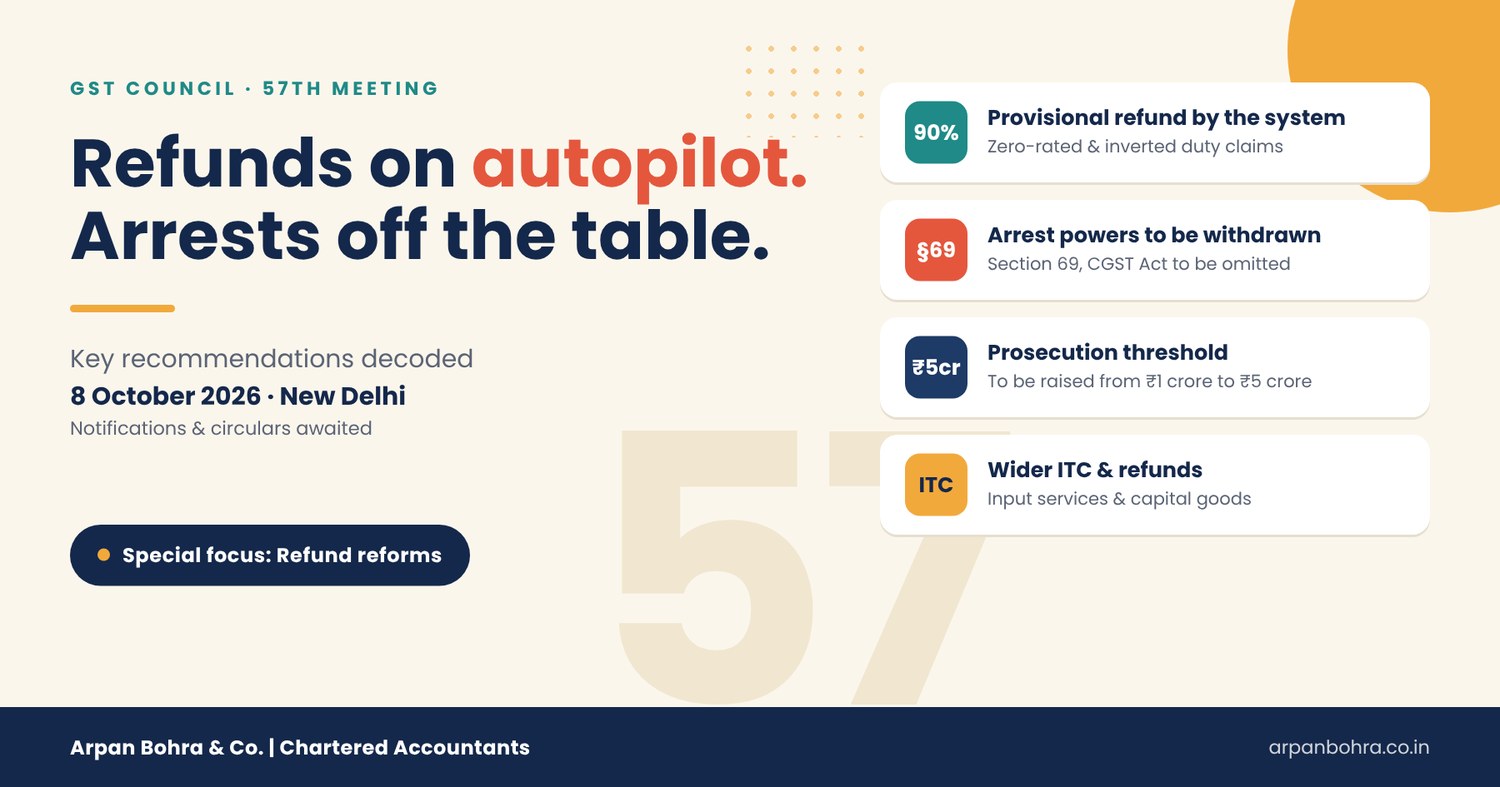
The 57th GST Council meeting in 60 seconds
- Refunds go system-based: cash ledger refunds auto-sanctioned; 90% provisional refund by the system for zero-rated and inverted duty claims.
- More ITC becomes refundable: input services (inverted duty) and capital goods (zero-rated and inverted duty, spread over 60 months).
- Exporters get relief: the 1.5x turnover cap in rule 89(4)(C) goes; services to one’s own foreign branch can qualify as export.
- Trust-based enforcement: section 69 (arrest) to be omitted; prosecution threshold ₹1 crore → ₹5 crore; general penalty ₹25,000 → ₹10,000.
- Fewer notices: no show cause notice below ₹10,000 of tax; 5% penalty in non-fraud cases on early payment.
Important: these are recommendations. They will take effect only through amendments to the CGST/IGST Acts and Rules, notifications and circulars, which are awaited.
In this article
- How will GST refunds work after the 57th GST Council meeting?
- Refund of ITC on input services and capital goods
- Four changes for exporters
- Arrest, prosecution and penalties
- E-way bill interception
- Registration and returns
- Input tax credit unblocked
- Rate clarifications – goods and services
- What should businesses do now?
- FAQs
1. How will GST refunds work after the 57th GST Council meeting?
The Council has recommended amending section 54 of the CGST Act, 2017 and the CGST Rules for system-based processing and sanction of three categories of refund: excess balance in the electronic cash ledger, zero-rated supplies, and inverted duty structure (IDS). This will be rolled out in two phases.
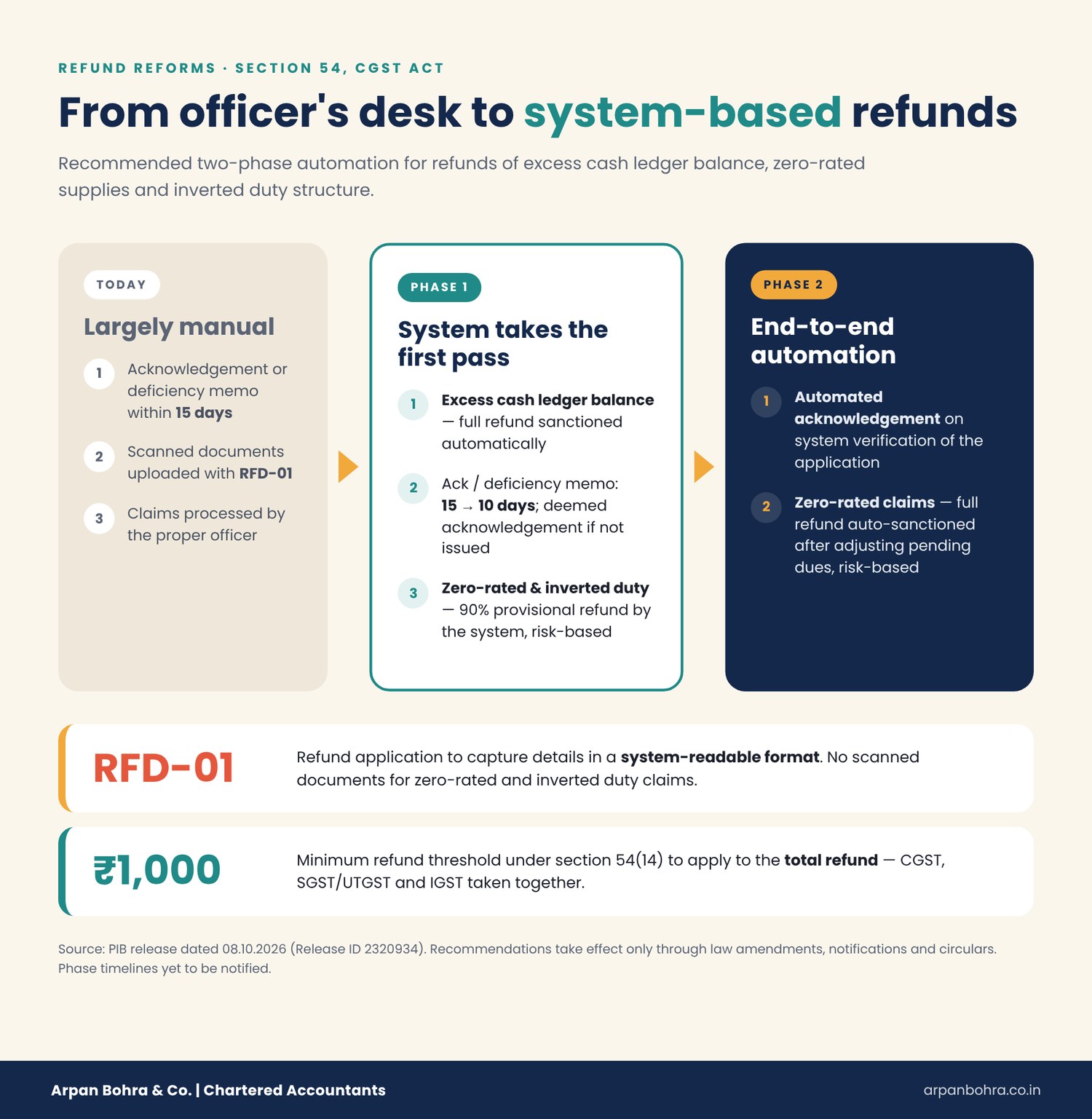
| Refund type | Phase 1 | Phase 2 |
|---|---|---|
| Excess cash ledger balance | Full refund sanctioned automatically, without officer intervention | — |
| Acknowledgement / deficiency memo | Time limit reduced from 15 to 10 days; deemed acknowledgement if not issued within 10 days | Automated acknowledgement on system verification |
| Zero-rated supplies | 90% provisional refund sanctioned by the system, based on risk evaluation | Full refund sanctioned by the system after adjusting pending dues, based on risk evaluation |
| Inverted duty structure | 90% provisional refund sanctioned by the system, based on risk evaluation | Not specified in the press release |
Other refund fixes recommended
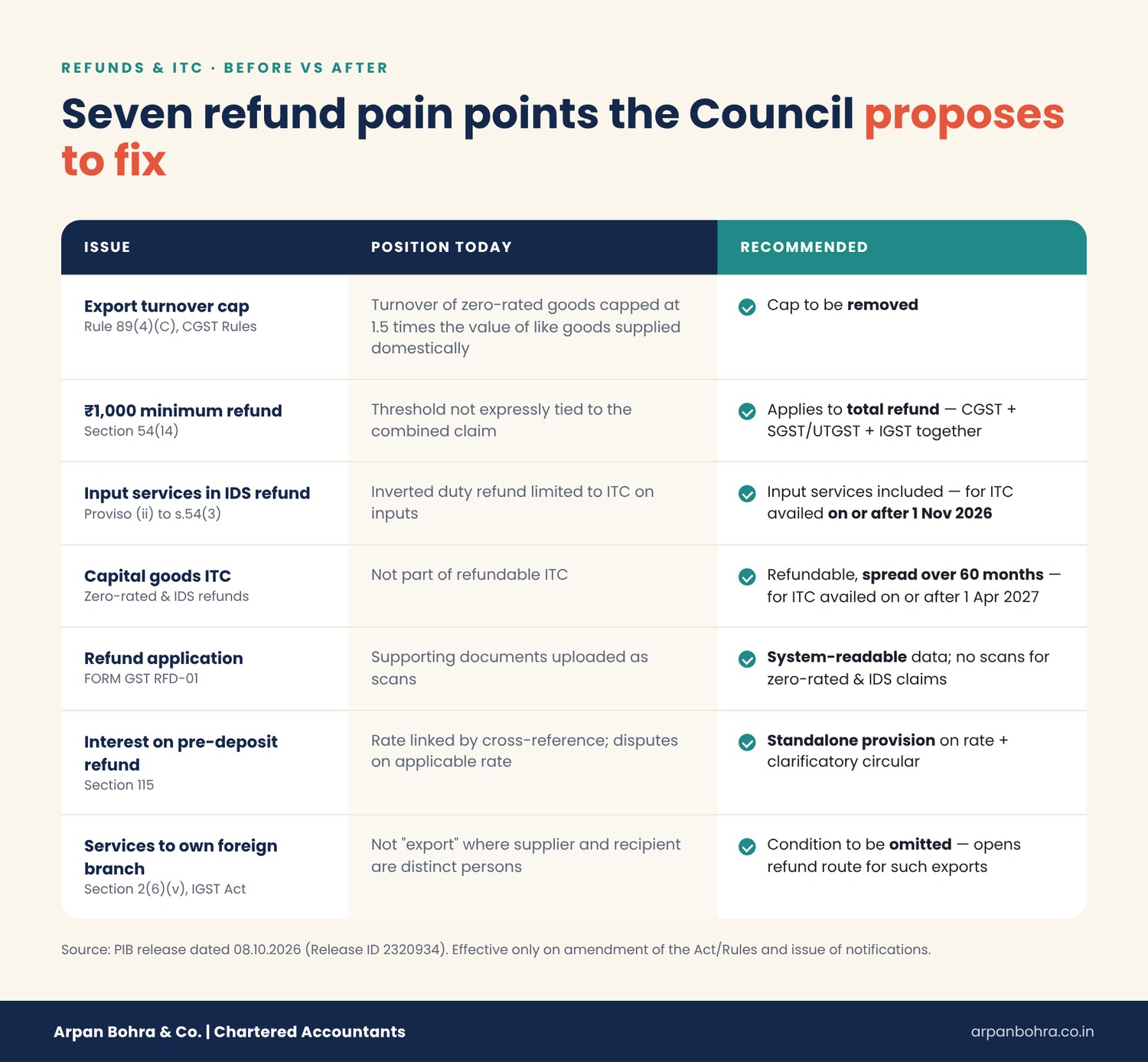
- FORM GST RFD-01 will capture details in a system-readable format. Scanned documents will not be required for zero-rated and IDS claims.
- Rule 89(4)(C): the cap limiting turnover of zero-rated goods to 1.5 times the value of like goods supplied domestically is to be removed.
- Section 54(14): an Explanation will clarify that the ₹1,000 minimum applies to the total refund – CGST, SGST/UTGST and IGST taken together.
- Section 115 (interest on refund of pre-deposit): to become a standalone provision on the rate of interest, with a circular to settle the issues on rate.
Practitioner’s view: Deemed acknowledgement is significant because the 60-day time limit for the refund order under section 54(7), and interest on delayed refunds under section 56, run from receipt of the complete application. How the deemed acknowledgement links to these timelines will depend on the final drafting – position requires verification once the amendment is notified. Note also that the automatic sanction is risk-based. Taxpayers with return mismatches may still see their claims routed to an officer.
2. Refund of ITC on input services and capital goods
This is arguably the most important refund change. Today, inverted duty refunds under clause (ii) of the proviso to section 54(3), read with rule 89(5), cover only ITC on inputs. ITC on input services and capital goods remains locked. The Supreme Court upheld this restriction in Union of India v. VKC Footsteps India Pvt. Ltd. (2021), while noting that the Council could reconsider the formula. The 57th GST Council meeting has now done so.
| ITC on | Refund type | Eligible ITC | Manner |
|---|---|---|---|
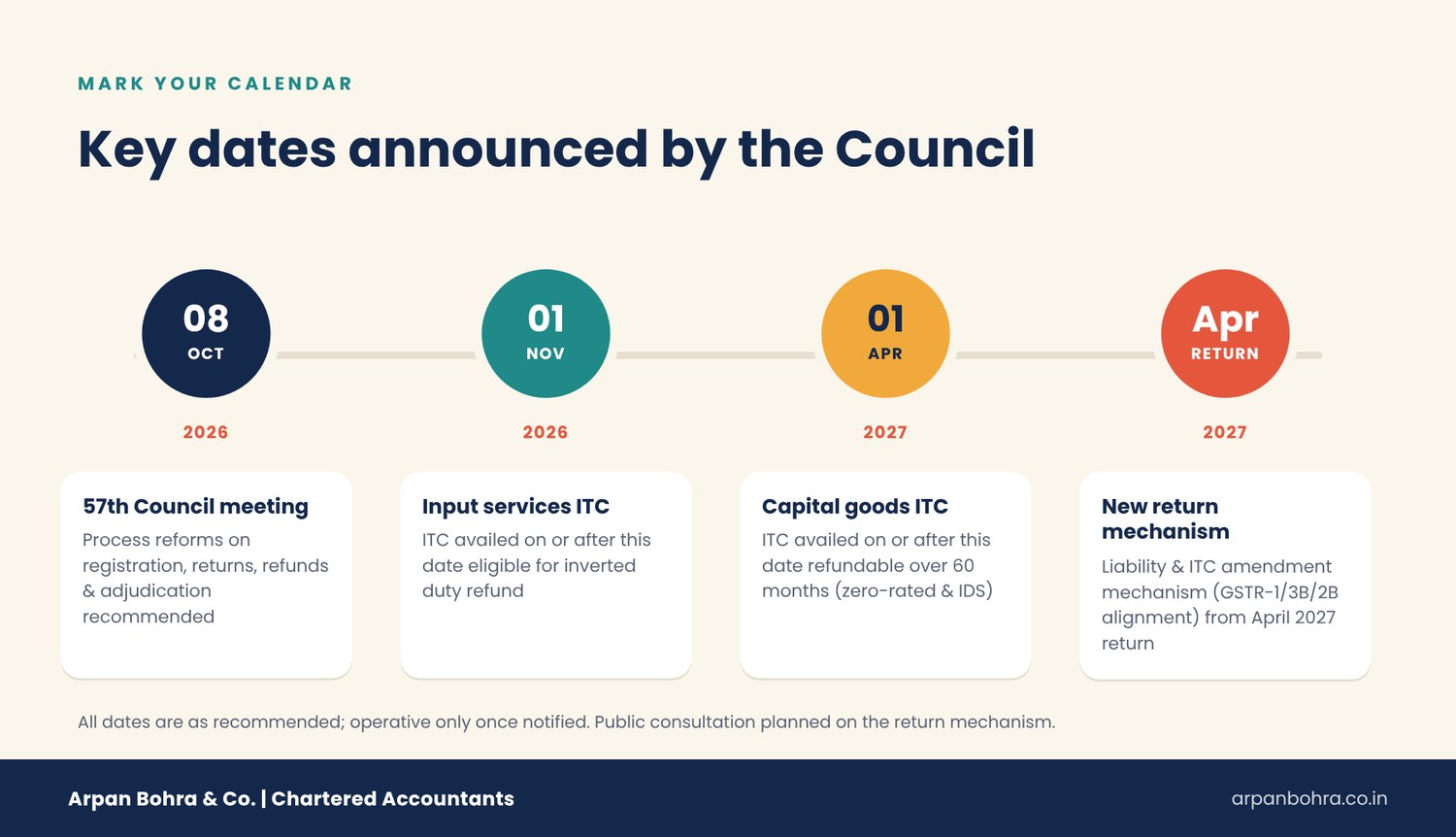
| Input services | Inverted duty structure | ITC availed on or after 1 November 2026 | Part of accumulated ITC refund |
| Capital goods | Zero-rated supplies and inverted duty structure | ITC availed on or after 1 April 2027 | Spread over 60 months |
Points to note:
- The relief is prospective. ITC on input services availed before 1 November 2026, and on capital goods availed before 1 April 2027, is not covered by the recommendation.
- Because this needs an amendment to section 54(3) of the CGST Act, the way the 1 November 2026 date will be given legal effect is still to be seen – position requires verification.
- The refund formula in rule 89(4) and 89(5) will need to be revised. The 60-month spread suggests a staggered, per-period refund of capital goods ITC. The exact method will come with the amended Rules.
3. Four changes for exporters that unlock refunds
| Provision | Recommendation | Who benefits |
|---|---|---|
| Section 2(6)(v), IGST Act | Omit the condition that supplier and recipient are not establishments of a distinct person (Explanation 1 to section 8) | Indian service providers supplying to or through their own foreign offices or branches |
| Section 13(3)(a), IGST Act | Omit clause (a); place of supply moves to the default rule in section 13(2) – the recipient’s location | Service providers working on goods made physically available by foreign recipients |
| Section 16(1), IGST Act | Explanation: supply to an overseas buyer delivered in an SEZ/FTWZ, paid in convertible foreign exchange (or INR where RBI permits), is deemed a supply to the SEZ/FTWZ | Manufacturers delivering to overseas buyers inside an SEZ/FTWZ |
| Export proceeds | Circular to clarify issues on receipt of payment in foreign exchange or INR, as permissible | Exporters of goods and services |
For Hyderabad’s services economy around HITEC City and the Financial District, the section 2(6)(v) change deserves attention. Indian subsidiaries of foreign companies were already clarified as not being establishments of a distinct person (Circular No. 161/17/2021-GST). The amendment mainly helps Indian entities that render services to their own branches or offices abroad. Until now, such supplies could not qualify as exports, so no refund was available.
4. Arrest, prosecution and penalties: a trust-based shift
| Area | Present | Recommended |
|---|---|---|
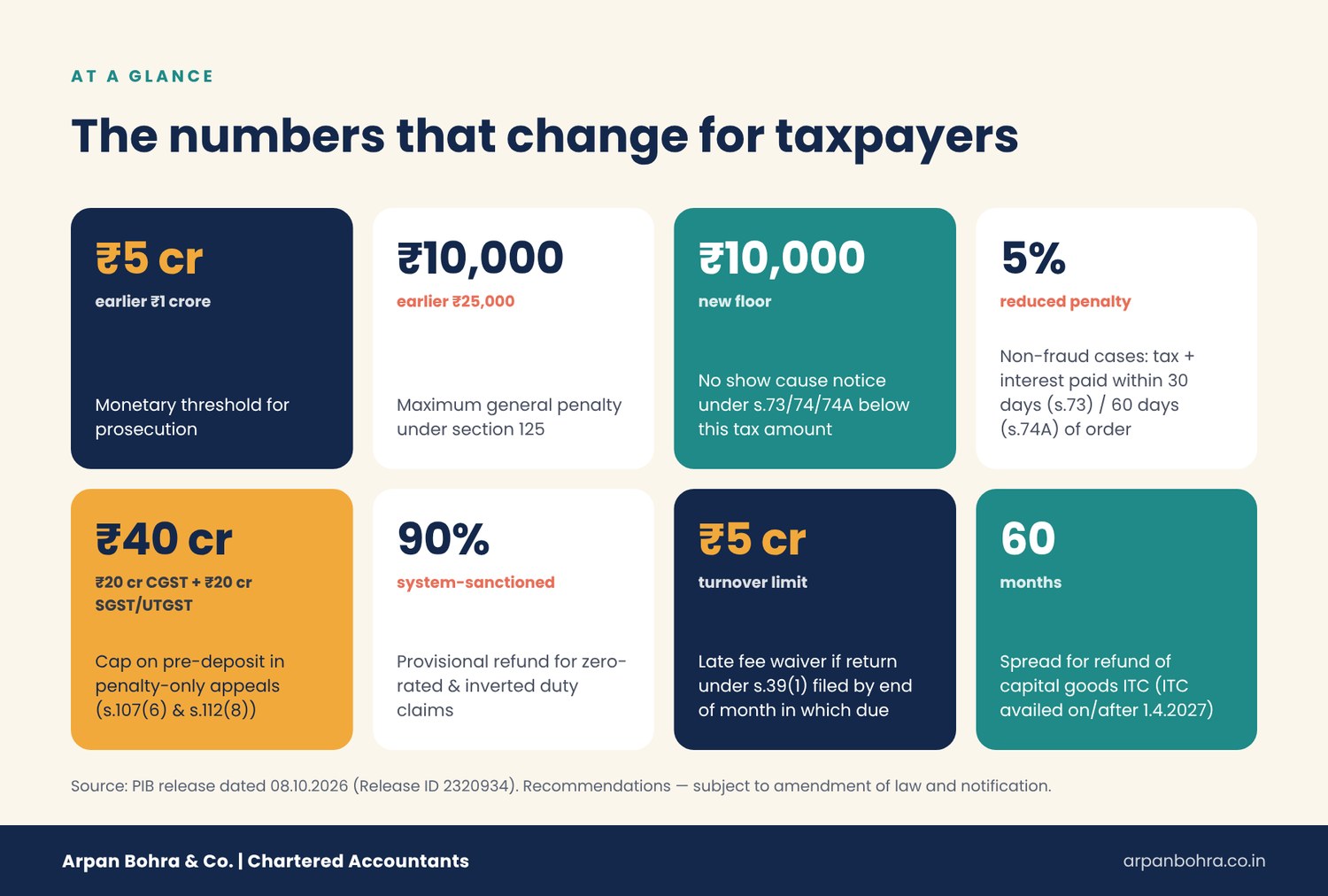
| Arrest – section 69 | Power to arrest exists | Section 69 to be omitted – complete withdrawal |
| Prosecution threshold | ₹1 crore | ₹5 crore |
| Section 132(1) | Wide list of offences | Clause (i) omitted; “evades tax” deleted from clause (e); “or in any other manner deals with” deleted from clause (h); clause (c) limited to fraudulent ITC without receipt of goods/services or without invoice; punishments rationalised |
| Show cause notice – sections 73/74/74A | No minimum amount | No notice if tax (CGST+SGST+IGST+Cess) is below ₹10,000; pending notices and appeals below ₹10,000 to be decided as if the threshold applied |
| Penalty in non-fraud cases | Minimum penalty ₹10,000 | Minimum penalty removed; 5% penalty if tax and interest are paid within 30 days (s.73) or 60 days (s.74A) of the order |
| Voluntary payment | — | Penalty deemed a “charge” where tax, interest and penalty are voluntarily paid within the specified time |
| General penalty – section 125 | Up to ₹25,000 | Up to ₹10,000 |
| Pre-deposit – penalty-only orders | No separate cap for penalty-only orders | Capped at ₹40 crore (₹20 crore CGST + ₹20 crore SGST/UTGST) for appeals before the Appellate Authority (s.107(6)) and the Tribunal (s.112(8)) |
| Blocking of credit – rule 86A | No specific objection mechanism | Taxpayer may object and get a personal hearing before the officer decides |
A circular will also lay down guidelines for officers on the quality and timeliness of notices and orders, invoking fraud or suppression only on the merits of each case, and following natural justice, including personal hearings.
Litigation watch: The Council has also recommended a validation clause for notices that courts have held invalid because they covered multiple financial years. This favours the department. Since it seeks to revive notices already set aside, its scope and any retrospective effect are likely to be litigative. Taxpayers with favourable orders on this ground should track the final wording closely. For the appellate route, see our GSTAT Guide – A to Z of Appeal before GSTAT.
5. E-way bill: interception only on intelligence
Amendments to sections 68, 129 and 130 of the CGST Act are recommended:
- A conveyance can be intercepted only on specific intelligence and with authorisation of an officer not below the rank of Joint Commissioner.
- Inspection, detention or seizure only where the supplier or recipient is located or registered in the intercepting State – no interception in transit States.
- Where no e-way bill is generated, or no document showing origin or destination is carried, action can be taken regardless of jurisdiction.
- Confiscation under section 130 will not apply to goods or conveyances in transit.
6. Registration and returns: less officer interface
| Area | Recommendation |
|---|---|
| New registration | Comprehensive circular with document list and FAQs; drop-down document selection in FORM GST REG-01; better portal guidance |
| Amendment (rule 19) | Automatic acceptance of all amendments except Principal Place of Business (PPoB); for rule 14A registrants, PPoB changes are also automatic |
| Cancellation on application (REG-16) | Phase 1: automatic once returns are filed and dues paid, if ITC passed on never exceeded ₹2.5 lakh in a month, or final return (GSTR-10) is filed in time. Phase 2: all applications automatic; GSTR-10 details within REG-16 |
| Suo motu cancellation | Certain grounds in rule 21 omitted; system-based cancellation and revocation for non-filing of returns or bank details (rules 21A, 22, new rule 23A) |
| E-commerce sellers (new rule 14B) | Small sellers supplying through e-commerce operators can register in States without physical presence by declaring the operator’s warehouse as PPoB, where ITC passed on is up to ₹2.5 lakh per month (excluding stock transfers) |
| Returns – from April 2027 return | GSTR-1/1A/IFF enhancements; rule 61(1A) and 61(1B) to align GSTR-3B with GSTR-1 and GSTR-2B; IMS rule 60(6A) (accept/reject/pending); new rule 86C (Credit Reversal and Reclaim Statement) and rule 86D (RCM statement); DRC-03 to capture invoice details. To be placed for public consultation |
| Late fee – section 39(1) | Waived for taxpayers with turnover up to ₹5 crore in the preceding FY, if the return is filed by the end of the month in which it was due |
| ARQP scheme | In-principle approval of an optional Annual Return Quarterly Payment scheme for turnover up to ₹5 crore making only B2C supplies |
| E-invoicing | Extended to RCM supplies received from unregistered persons and to import of services, for turnover of ₹5 crore and above |
Other items: sections 16, 37 and 39 to be aligned with the ITC time limit in section 16(4); clarity on e-commerce operator liability under section 9(5); and changes to align the GST Appellate Tribunal with the Tribunals Reforms Act, 2026.
7. Input tax credit unblocked
Section 17(5) is to be amended to remove blocks on ITC for, among others:
- Outdoor catering
- Health and life insurance
- Telecommunication towers
- Pipelines laid outside factory premises
- Free samples
- Goods destroyed or written off on expiry of shelf life as required by law
Separately, limited ITC in the same line of business will be allowed for restaurant/outdoor catering, hotel accommodation up to ₹7,500 per unit per day, and gym/fitness services. Circulars are also recommended on the ISD mechanism, ITC for banks and NBFCs opting for section 17(4), payment of pre-deposits, ITC on demonstration vehicles, and the omission of rule 96(10) with effect from 23.10.2017, in line with the Supreme Court’s decision.
8. Rate clarifications – goods and services
| Item | Recommendation |
|---|---|
| Sublimation paper | Classified under heading 4809; past cases regularised “as is where is” |
| Toys | Rate entries cover all toys under heading 9503 (dolls, puzzles, etc.), not only tricycles, scooters and pedal cars |
| Sea-weed extract bio-stimulants | Classified under heading 3101 as fertilisers (if registered under Schedule VI, FCO 1985); past cases regularised |
| Second-hand vehicles (margin scheme) | ITC allowed on inputs and input services other than the vehicles procured |
| Plastic, e-waste, tyre scrap, used cooking oil | RCM on supply by unregistered to registered persons; 2% TDS on B2B supplies |
| Psyllium seeds (Isabgol) | NIL rate, whether fresh, chilled, frozen or dried |
| Re-treaded tractor tyres | Aligned with the rate on new tractor tyres |
| EV passenger transport / rental with operator | Option of 5% with restricted ITC, where battery charging cost is included |
| Delivery services through e-commerce operators | 5% without ITC; GTA exemption (Entry 21A) excluded for goods ordered through an ECO |
| Exemptions | Helicopter seat-sharing from/to NE States, Sikkim and Bagdogra; warehousing of seeds for sowing; coffee curing; Seamen’s Provident Fund Organisation; toll rights under TOT model; import of services by Indian establishments of foreign shipping lines from related persons without consideration (past period regularised) |
| Clarifications | Motor vehicle leasing recoveries; R&D self-certification for Entry 44A; Fund Transfer Pricing in banks treated as “interest”; O&M valuation under TOT model |
9. What should businesses do now?
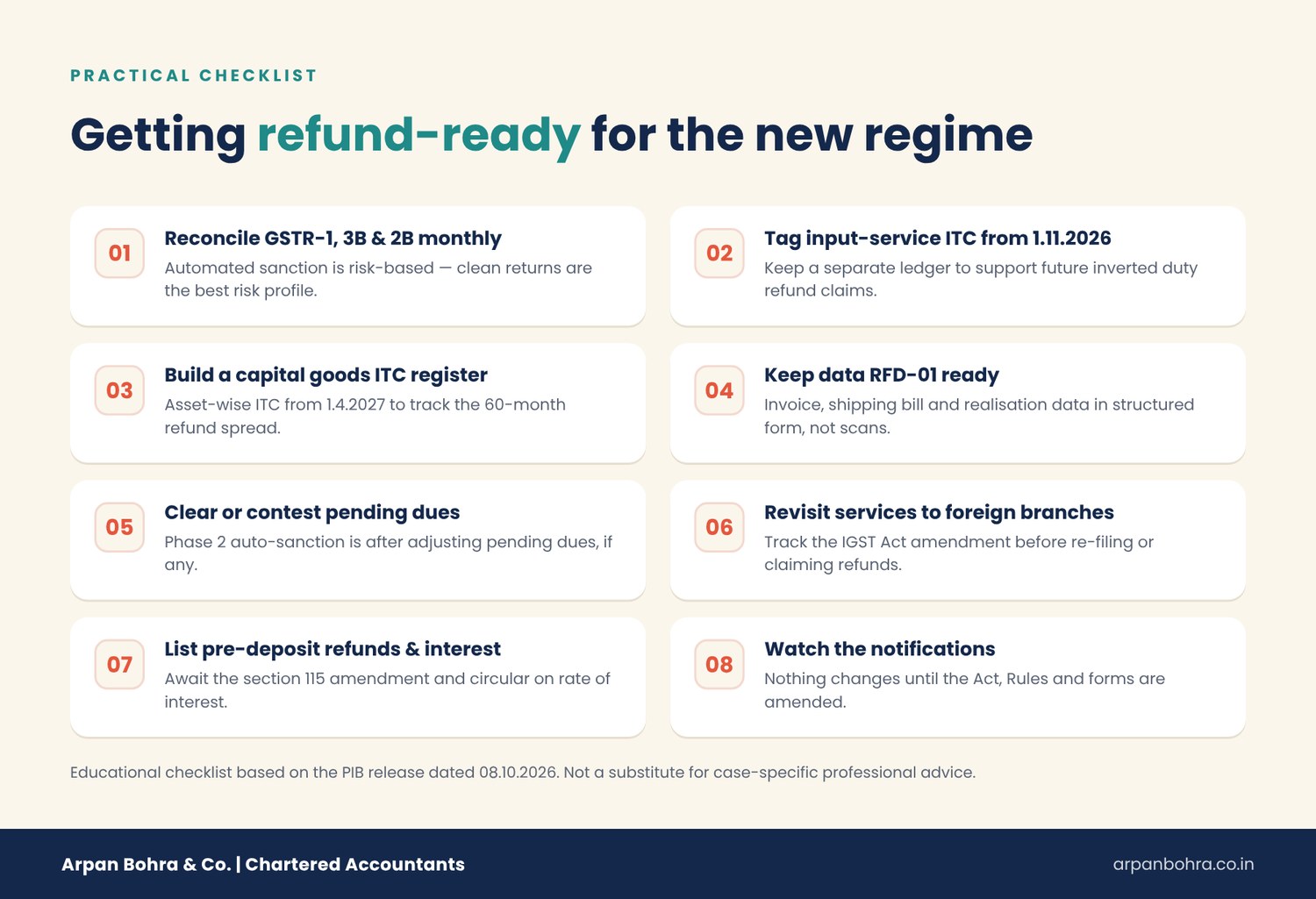
- Do not act on recommendations alone. Continue under existing law until amendments and notifications are issued.
- Exporters and IDS claimants: separate ITC on input services from 1 November 2026, and plan an asset-wise capital goods ITC register from 1 April 2027.
- Keep returns reconciled: automated refunds are risk-based, so mismatches between GSTR-1, GSTR-3B and GSTR-2B may route claims for manual scrutiny.
- Pending litigation: review notices and appeals below ₹10,000, penalty-only matters (pre-deposit cap), and pre-deposit refunds where interest is due.
- Service exporters with foreign branches: map past and current transactions affected by section 2(6)(v) of the IGST Act, and await the amendment before taking any refund position.
For upcoming due dates, see our Compliance Calendar October 2026.
Frequently asked questions
When was the 57th GST Council meeting held?
The 57th GST Council meeting was held on 8 October 2026 in New Delhi, chaired by Union Finance Minister Smt. Nirmala Sitharaman.
Will GST refunds become automatic after the 57th GST Council meeting?
Partly. Refunds of excess cash ledger balance are to be fully auto-sanctioned. For zero-rated and inverted duty claims, 90% will be sanctioned provisionally by the system on risk evaluation in Phase 1. Full auto-sanction for zero-rated claims follows in Phase 2.
Can I claim refund of ITC on input services under the inverted duty structure?
The Council has recommended it for ITC on input services availed on or after 1 November 2026. It will apply only after section 54(3) of the CGST Act and the Rules are amended.
Is refund of ITC on capital goods allowed now?
It has been recommended for zero-rated and inverted duty refunds. It applies to ITC availed on or after 1 April 2027, spread over 60 months, subject to amendment of the law.
Has the power of arrest under GST been removed?
The Council has recommended omitting section 69 of the CGST Act. Until Parliament amends the Act, the existing provision continues.
What is the new minimum amount for a GST show cause notice?
The Council has recommended a minimum of ₹10,000 of tax (CGST + SGST + IGST + Cess) under sections 73, 74 and 74A. Pending notices and appeals below this amount are to be decided as if the threshold applied.
Source
Press Information Bureau, Ministry of Finance – Recommendations of the 57th Meeting of the GST Council (Release ID 2320934, posted 08 October 2026).
Disclaimer
This article is based solely on the press release issued by the Press Information Bureau on 8 October 2026 on the recommendations of the 57th GST Council meeting. The recommendations will take effect only through amendments to the CGST Act, IGST Act and Rules, and the relevant notifications and circulars, along with the FAQs announced by the Government, all of which are awaited. The final provisions may differ from the press release.
We will publish further articles analysing the notifications, circulars and FAQs as and when they are issued.
This article is for general information and educational purposes only. It does not constitute professional advice or a solicitation. Readers should refer to the relevant law and seek professional advice on their specific facts before acting.
Arpan Bohra & Co., Chartered Accountants
Himayat Nagar, Hyderabad, Telangana
ab@arpanbohra.co.in | www.arpanbohra.co.in