

By CA Arpan Bohra (FCA, CS), Arpan Bohra & Co., Chartered Accountants, Hyderabad. Position of law as at 20 October 2026.
ESOPs make founders and employees partners, if the paperwork is right.
A start-up promises its early engineers a share of the upside. Two years on, an employee exercises vested options and receives a tax bill for a gain that exists only on paper. ESOPs are powerful retention tools, but the company law approvals and the tax timing both need planning.
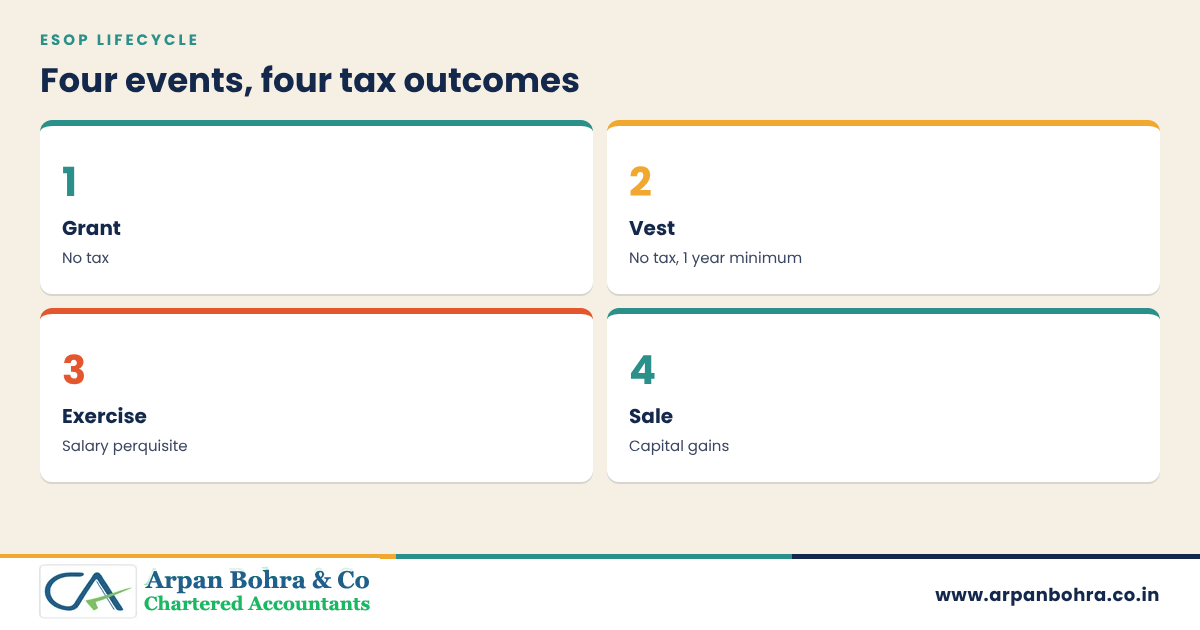
An ESOP scheme of a company must be approved by a special resolution under section 62(1)(b) of the Companies Act, 2013 and Rule 12 of the Companies (Share Capital and Debentures) Rules, 2014. Vesting must be at least one year after grant. On exercise, the difference between fair market value and exercise price is taxed as a salary perquisite; the later sale is taxed as capital gains. Employees of an eligible, DPIIT-recognised start-up may defer the tax on the perquisite for up to 48 months, or until the earlier of sale or leaving (section 192(1C), verify the current conditions).
Company law conditions
| Point | Rule |
|---|---|
| Approval | Special resolution of shareholders; separate resolution for grants to employees of subsidiaries or holding company |
| Vesting | Minimum period of one year between grant and vesting; options not transferable |
| Eligible persons | Permanent employees and directors, including a director of the subsidiary or holding company |
| Not eligible | An independent director, and a promoter or a person holding more than 10% of equity, with an exemption for DPIIT-recognised start-ups for ten years from incorporation (verify) |
| Disclosure | Explanatory statement and details in the board’s report |
| Accounting | Fair value or intrinsic value accounting as per the applicable standards |
Tax in the employee’s hands
| Event | Tax treatment |
|---|---|
| Grant and vesting | No tax |
| Exercise | Perquisite equal to fair market value on the date of exercise less the exercise price, taxed as salary, with TDS by the employer; fair market value of unlisted shares is determined by a merchant banker under the Rules |
| Start-up deferral | TDS deferred up to 48 months from the end of the assessment year of exercise, or until sale or cessation of employment, whichever is earlier, for an eligible start-up (verify) |
| Sale of shares | Capital gains on sale price less the value taken as perquisite; holding period runs from exercise; rates depend on the asset class |
| Employer | Deduction for the perquisite as salary expense (verify the current position) |
FEMA and cross-border points
- Issue of ESOPs to non-resident employees or directors of an Indian company is permitted under the NDI Rules, subject to conditions; verify the current rules.
- Non-resident employees of a foreign parent holding options in the Indian company may need reporting.
- Residents holding options in a foreign parent should check the overseas investment rules and the Schedule FA disclosure in the ITR.
Worked example
An employee is granted 10,000 options at an exercise price of ₹10 per share. After four years of vesting, fair market value is ₹110 per share and the employee exercises all options.
- Perquisite: (₹110 − ₹10) × 10,000 = ₹10,00,000 taxed as salary at slab rates (or deferred for eligible start-up employees).
- Later the shares are sold at ₹150: capital gain = (₹150 − ₹110) × 10,000 = ₹4,00,000, classified by holding period.
- If the company is a DPIIT-recognised start-up, TDS on the ₹10,00,000 perquisite can be deferred, subject to the conditions.
Figures are illustrative; rates change with the Income-tax Act, 2025.
Set-up steps
- Decide the pool size and eligibility with the board and the founders.
- Draft the ESOP scheme, grant letter, vesting schedule and leaver terms.
- Pass the special resolution and file MGT-14 with the Registrar.
- Issue grant letters and maintain the register of employee stock options (Form SH-6).
- Obtain a valuation on exercise and deduct or defer TDS as applicable.
- Reflect the pool in the shareholders’ agreement and articles.
Frequently asked questions
Is an ESOP taxable at grant?
Can a founder get ESOPs?
What is the minimum vesting period?
Who values the shares for the perquisite?
Can a start-up employee defer tax on ESOPs?
Is an ESOP the same as a sweat equity?
Arpan Bohra & Co., Chartered Accountants, Himayat Nagar, Hyderabad.
This article is shared for general professional education. Readers may write to the firm for information about its practice areas.
General educational information as at 20 October 2026. It is not legal or tax advice and does not create a professional relationship. Provisions, rates and thresholds change; verify the current law and notifications before acting. References to the 57th GST Council (8 October 2026) are to recommendations that need amendments or notifications before they have legal effect.