
For a Hyderabad exporter of software services in HITEC City, or a pharma unit selling largely overseas, a GST refund is working capital that is held up. The GST refund reforms recommended at the 57th GST Council meeting on 8 October 2026 aim to release that money faster, with less officer interface and fewer blocked credits.
The short answer
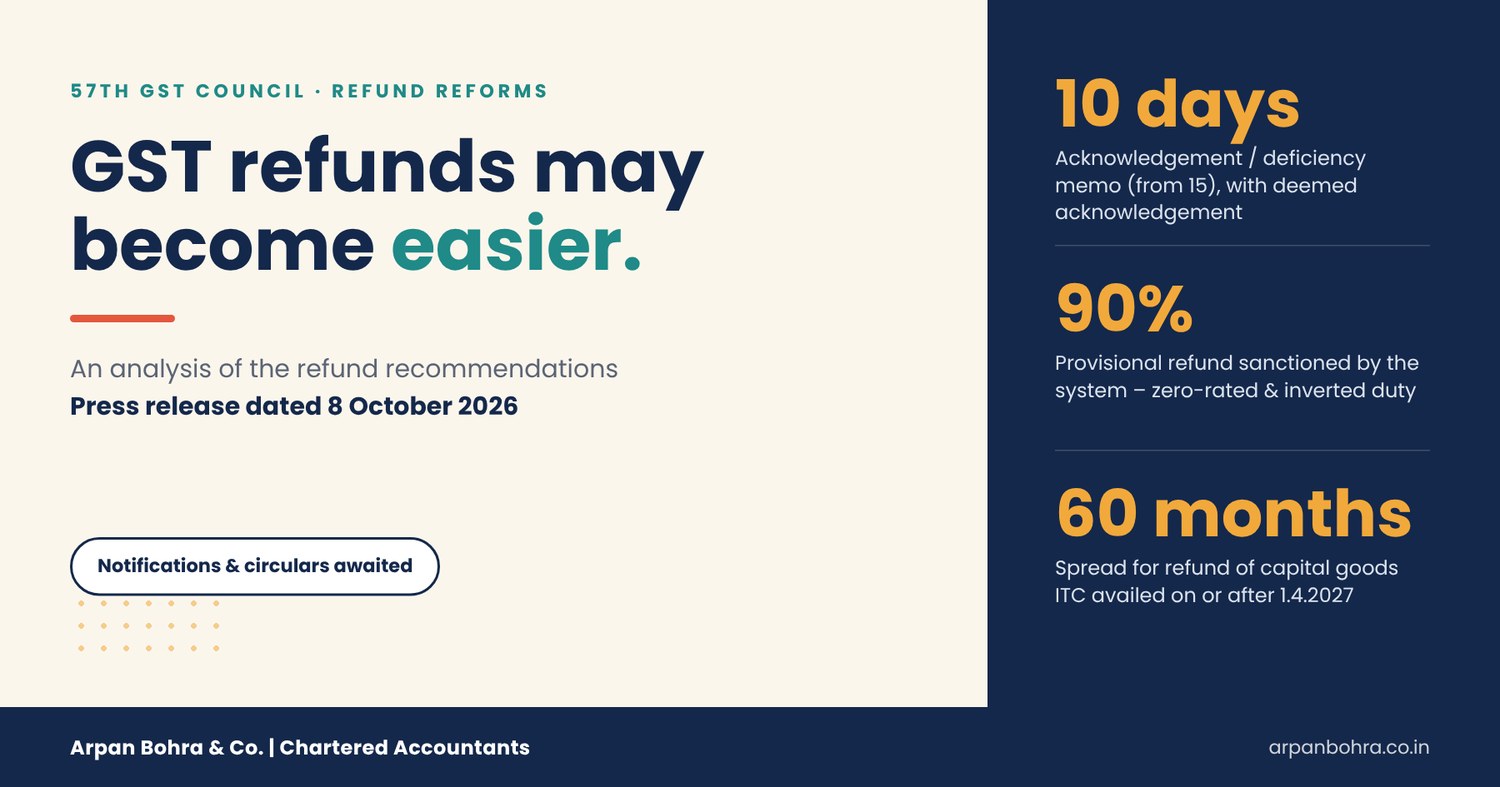
GST refunds may become easier. The Council has recommended system-based processing of refunds of excess cash ledger balance, zero-rated supplies and inverted duty claims. It has also recommended refund of ITC on input services (inverted duty) and capital goods (zero-rated and inverted duty), removal of the 1.5x export turnover cap, and clarity on the ₹1,000 threshold and on interest on pre-deposit refunds. None of this is law yet. Amendments, notifications and circulars are awaited.
In this article
1. Where do GST refunds stand today?
Refunds are governed by section 54 of the CGST Act, 2017 and rules 89 to 97A of the CGST Rules. In brief:
- The claim is filed in FORM GST RFD-01 with supporting documents.
- The proper officer issues an acknowledgement (RFD-02) or a deficiency memo (RFD-03) within 15 days (rule 90).
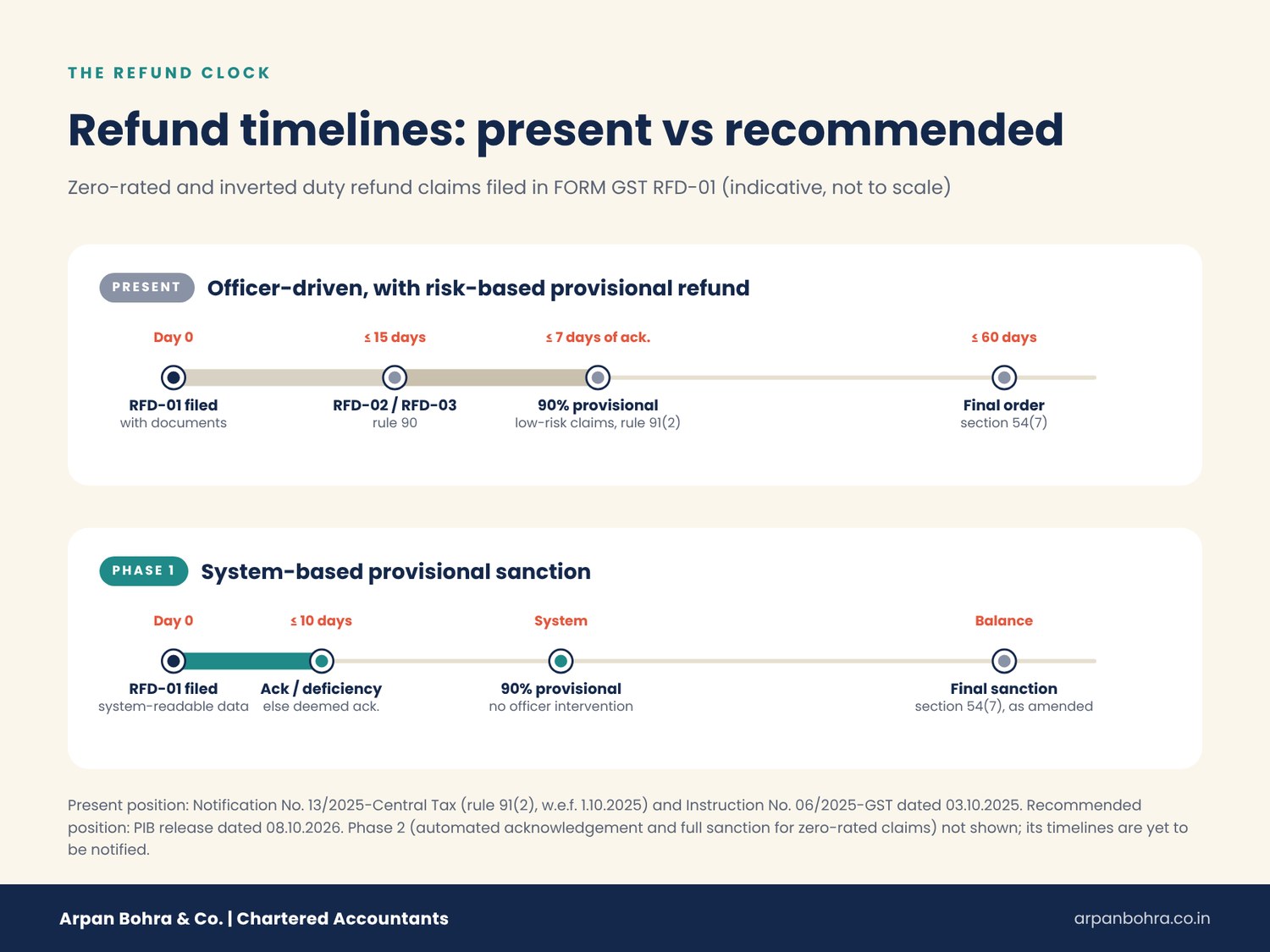
- For zero-rated supplies, 90% provisional refund is available under section 54(6) and rule 91. From 1 October 2025, rule 91(2) (Notification No. 13/2025-Central Tax) provides for provisional sanction on the basis of system risk evaluation. Instruction No. 06/2025-GST dated 03.10.2025 extended this, as an interim measure, to inverted duty claims filed on or after 1 October 2025, pending amendment of section 54(6).
- The final order is due within 60 days of receipt of the complete application (section 54(7)). Interest on delay is payable under section 56.
- For inverted duty claims, rule 89(5) counts only ITC on inputs. Input services and capital goods are excluded. The Supreme Court upheld this in Union of India v. VKC Footsteps India Pvt. Ltd. (2021).
Even under the 2025 risk-based mechanism, the proper officer issues the provisional order and may, for reasons recorded in writing, withhold it. The 57th meeting proposes to take the officer out of these routine steps.
2. What changes in Phase 1 and Phase 2 of the GST refund reforms?
| Step | Present | Phase 1 | Phase 2 |
|---|---|---|---|
| Excess cash ledger balance | Processed by the officer | Full refund sanctioned by the system, no officer intervention | — |
| Acknowledgement / deficiency memo | Within 15 days | Within 10 days; deemed acknowledgement if not issued | Automated, on system verification |
| Zero-rated supplies | 90% provisional (low-risk claims) by officer order | 90% provisional sanctioned by the system, risk-based | Full refund sanctioned by the system after adjusting pending dues, risk-based |
| Inverted duty structure | 90% provisional (interim, by Instruction) | 90% provisional sanctioned by the system, risk-based | Not specified in the release |
| RFD-01 documents | Scanned uploads | System-readable data; no scans for zero-rated and inverted duty claims | |
Our analysis of these GST refund reforms:
- Cash ledger refunds are the simplest gain. Excess deposits, typically after a wrong head of payment or an over-payment, should be refunded without officer interface.
- Deemed acknowledgement addresses claims kept pending without an RFD-02 or RFD-03. Since the 60-day period in section 54(7) and interest under section 56 run from receipt of a complete application, how the deemed acknowledgement is linked to these timelines will matter. Position requires verification once the amendment is notified.
- Risk-based means not universal. Claims flagged as risky are likely to continue through officer scrutiny. Clean, reconciled returns become a practical condition for faster refunds.
- Phase 2 adjustment of “pending dues” is new for zero-rated claims. Section 54(10) presently allows withholding or deduction of unpaid amounts that have not been stayed by an appellate forum. Taxpayers will want the system logic to follow the same safeguards.
3. Refund of ITC on input services and capital goods
The Council recommended amending clause (ii) of the proviso to section 54(3) and the Rules to allow:
| ITC on | Zero-rated supplies | Inverted duty structure | Eligible ITC |
|---|---|---|---|
| Input services | Already part of Net ITC under rule 89(4) | Newly allowed | Availed on or after 1 November 2026 |
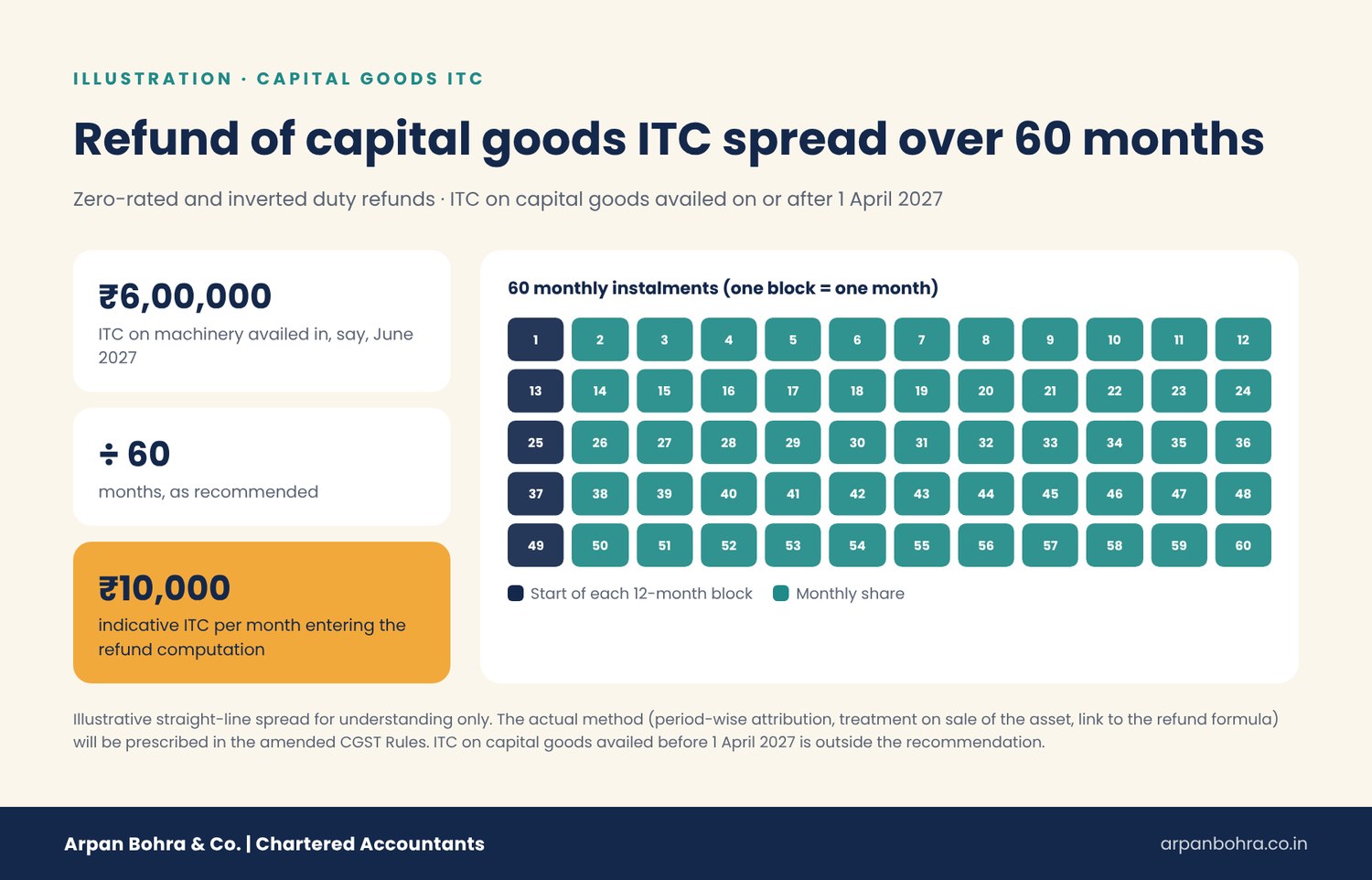
| Capital goods | Newly allowed | Newly allowed | Availed on or after 1 April 2027; spread over 60 months |
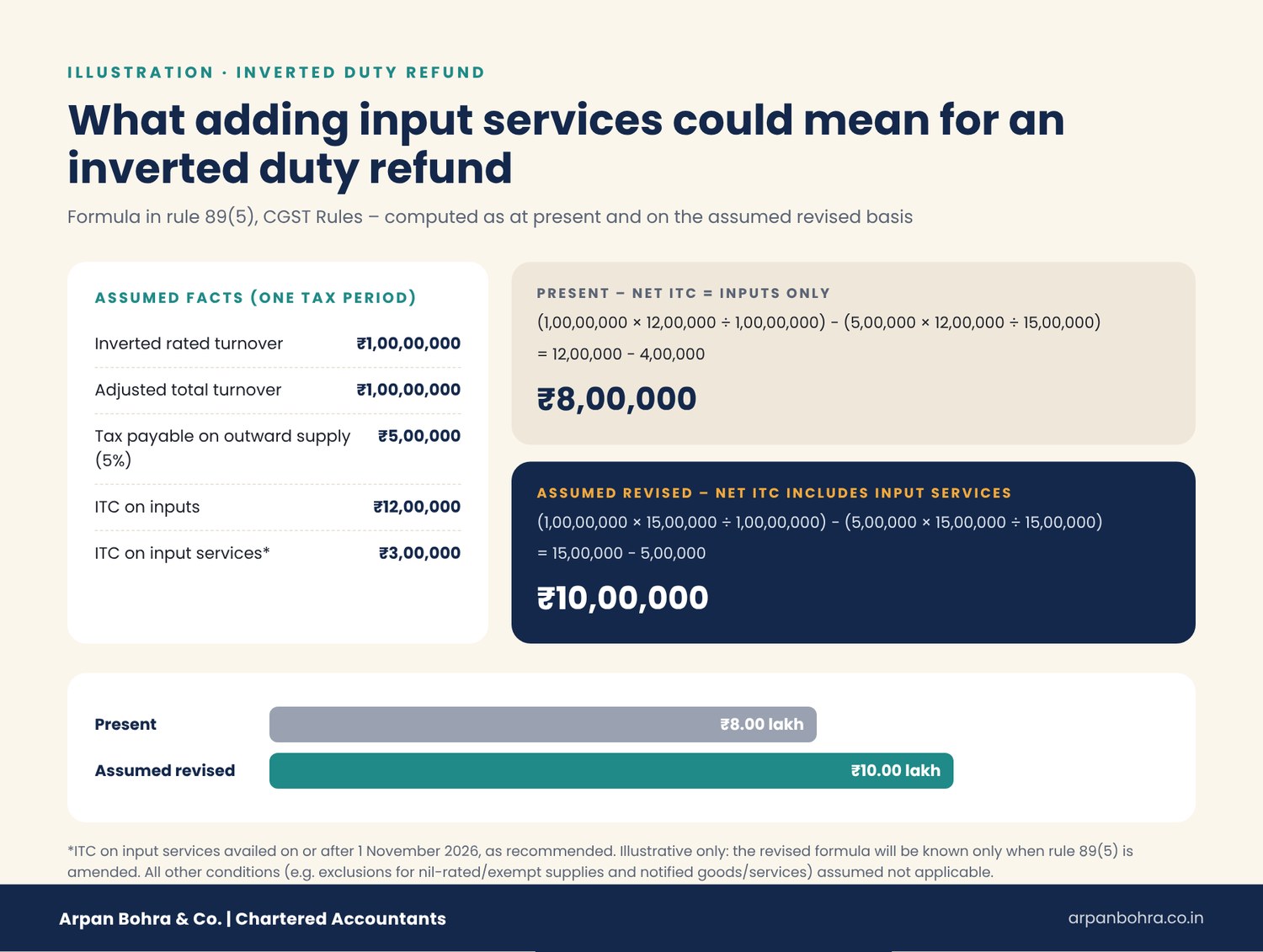
In the illustration above, a manufacturer with ₹3 lakh of input-service ITC in a period could see its refund rise from ₹8 lakh to ₹10 lakh, if the present rule 89(5) formula is retained and “Net ITC” is widened to include input services. The actual formula will be known only when the Rules are amended.
Points to note:
- Prospective only. Input-service ITC before 1 November 2026, and capital goods ITC before 1 April 2027, are outside the recommendation.
- Statutory amendment needed. Section 54(3) is in the Act, so Parliament must amend it. How the 1 November 2026 date will be given effect is yet to be seen.
- Capital goods mechanics. The 60-month spread raises questions on period-wise attribution, assets sold or put to exempt use, and the interaction with rule 43. These await the Rules.
4. Four other refund fixes
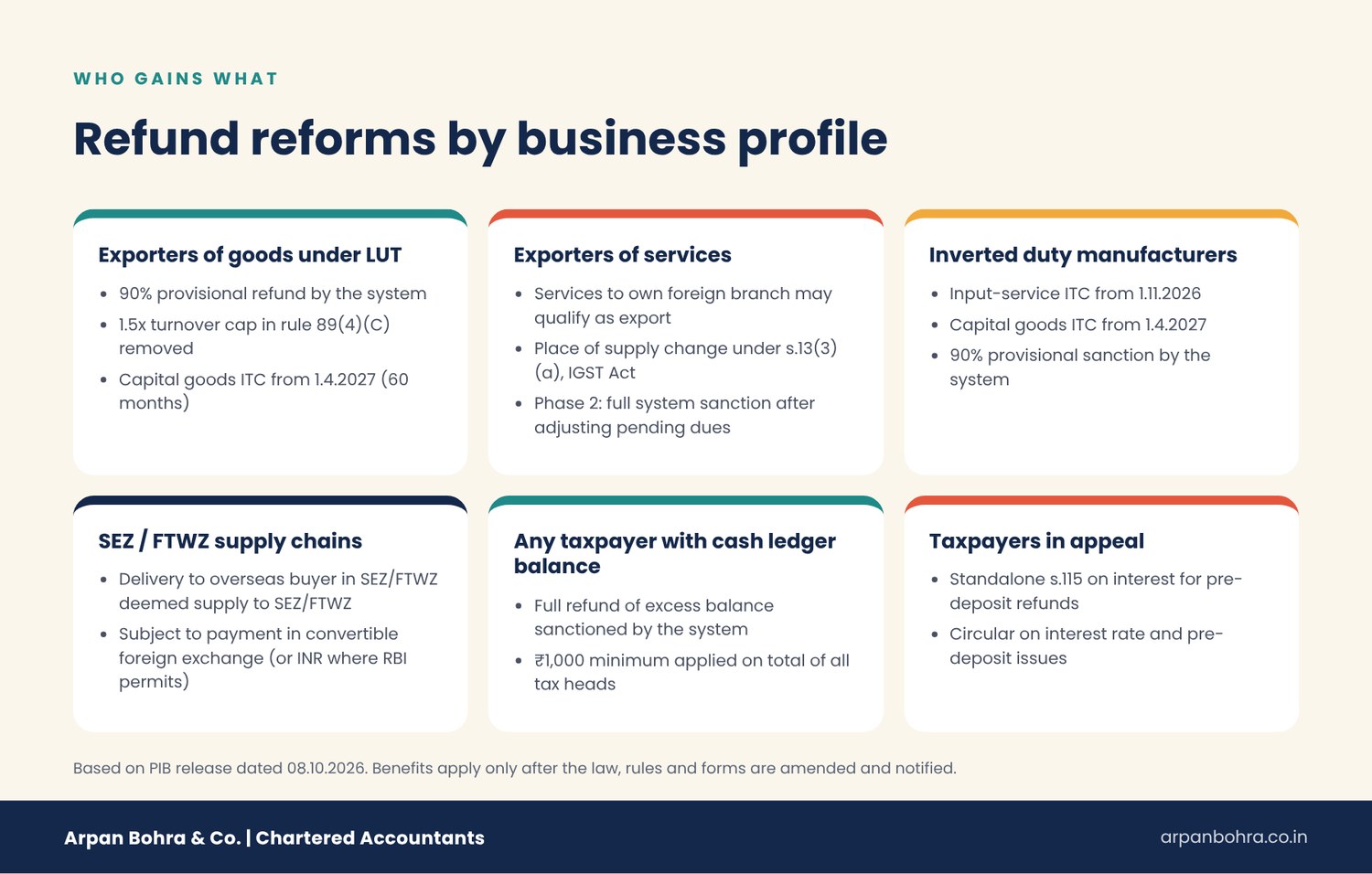
| Provision | Issue today | Recommended |
|---|---|---|
| Rule 89(4)(C) | Since 23.03.2020 (Notification No. 16/2020-CT), turnover of zero-rated goods is capped at 1.5 times the value of like goods supplied domestically. The Karnataka High Court held the rule ultra vires in 2023. | Cap to be removed |
| Section 54(14) | No refund below ₹1,000; whether per tax head or in total was unclear | Explanation: threshold applies to total of CGST, SGST/UTGST and IGST |
| Section 115 | Interest on refund of pre-deposit is linked to the rate under section 56; the applicable rate (6% or 9%) has been disputed | Standalone provision on rate of interest, plus a circular |
| FORM GST RFD-01 | Scanned statements and documents | System-readable format; no scans for zero-rated and inverted duty claims |
5. Changes for exporters that affect refunds
Four export-related recommendations widen the base of refundable claims:
- Section 2(6)(v), IGST Act to be omitted. Services by an Indian establishment to its own foreign office or branch (distinct persons under Explanation 1 to section 8) can then qualify as export, opening the refund route. Indian subsidiaries of foreign companies were already clarified as outside this restriction by Circular No. 161/17/2021-GST. This is relevant for Indian branch offices in Hyderabad’s Financial District and HITEC City that render services to their overseas head office or group branches.
- Section 13(3)(a), IGST Act to be omitted. For services on goods made physically available by the recipient, the place of supply will be the recipient’s location under section 13(2).
- Explanation to section 16(1), IGST Act. Goods delivered to an overseas buyer within an SEZ or FTWZ (Free Trade Warehousing Zone), paid for in convertible foreign exchange or in INR where permitted by RBI, will be deemed a supply to the SEZ/FTWZ. This gives certainty on zero-rating.
- Circular on export proceeds received in foreign exchange or INR, as permissible.
Separately, rule 96(10) is to be omitted with effect from 23.10.2017, in line with the Supreme Court’s decision; a circular is awaited. Note that refunds of IGST paid on export of goods under rule 96 are processed through the customs system, and the release does not otherwise discuss that route.
6. Open issues in the GST refund reforms: a litigation view
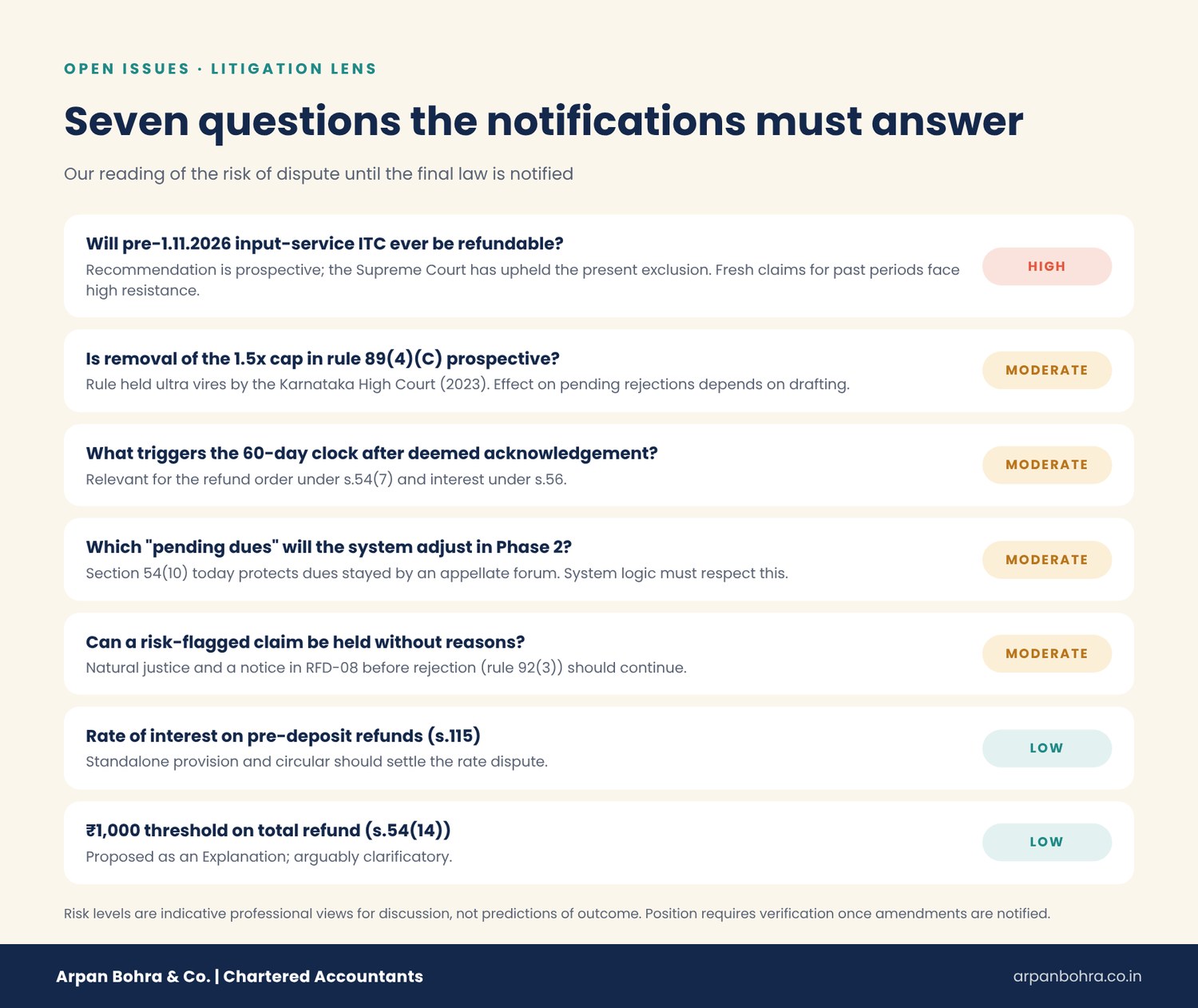
| Issue | Taxpayer’s view | Likely departmental view | Risk |
|---|---|---|---|
| Input-service ITC for periods before 1.11.2026 | Policy now accepts the anomaly | Prospective by design; VKC Footsteps upholds the exclusion | High |
| Pending rejections under rule 89(4)(C) | Rule already held ultra vires by the Karnataka High Court; removal confirms | Removal applies only from notification | Moderate |
| ₹1,000 threshold for past claims | Explanation is clarificatory, so applies to pending claims | Applies prospectively | Low |
| Withholding of risk-flagged claims | Reasons and a notice in RFD-08 (rule 92(3)) are needed before any rejection | Risk flag justifies detailed scrutiny | Moderate |
| Adjustment of pending dues (Phase 2) | Only dues not stayed, as under section 54(10) | All confirmed dues may be adjusted | Moderate |
Risk levels are indicative professional views, not predictions of outcome. Position requires verification once the amendments are notified.
7. What should refund claimants do now?
- Keep filing under the present law. Recommendations are not operative until notified. Watch the two-year limitation under section 54(1).
- Reconcile GSTR-1, GSTR-3B and GSTR-2B every month. A clean record is the best preparation for risk-based system sanction.
- Separate input-service ITC from 1 November 2026 in your books, so that future inverted duty claims can be supported.
- Set up an asset-wise capital goods ITC register from 1 April 2027 to track the 60-month spread.
- Structure your refund data (invoices, shipping bills, export realisation) for a system-readable RFD-01.
- Review pending matters: claims rejected under rule 89(4)(C) or for being below ₹1,000 in one tax head, and pre-deposit refunds where interest is due.
- Service exporters with foreign branches: map affected transactions, but take a refund position only after the IGST Act amendment.
For the complete list of 57th GST Council recommendations, see our article 57th GST Council Meeting Highlights.
Frequently asked questions
Will GST refunds be sanctioned without an officer after the 57th GST Council meeting?
For excess cash ledger balance, yes, as recommended. For zero-rated and inverted duty claims, Phase 1 provides 90% provisional sanction by the system on risk evaluation; Phase 2 provides full system sanction for zero-rated claims. All of this awaits amendment of the law.
From when can ITC on input services be included in an inverted duty refund?
The Council has recommended this for ITC on input services availed on or after 1 November 2026. It requires amendment of section 54(3) of the CGST Act and rule 89(5).
Is ITC on capital goods refundable for exporters?
It has been recommended for zero-rated and inverted duty refunds, for ITC availed on or after 1 April 2027, spread over 60 months.
Is the 1.5 times cap under rule 89(4)(C) removed?
The Council has recommended its removal. Until the rule is amended, it remains on the statute, although the Karnataka High Court held it ultra vires in 2023.
How does the ₹1,000 minimum refund rule work?
The Council has recommended an Explanation to section 54(14) that the ₹1,000 threshold applies to the total refund of CGST, SGST/UTGST and IGST taken together.
What is the time limit for acknowledging a refund claim?
At present it is 15 days under rule 90. The Council has recommended 10 days, with deemed acknowledgement if the officer does not act within that time.
Sources
Press Information Bureau – Recommendations of the 57th Meeting of the GST Council (Release ID 2320934, 08.10.2026).
CGST Act, 2017 (sections 54, 56, 115); CGST Rules, 2017 (rules 89 to 92); Notification No. 13/2025-Central Tax dated 17.09.2025; Instruction No. 06/2025-GST dated 03.10.2025; Circular No. 161/17/2021-GST.
Disclaimer
This article is based on the press release issued by the Press Information Bureau on 8 October 2026 on the recommendations of the 57th GST Council meeting, read with the existing provisions of law. The recommendations will take effect only through amendments to the CGST Act, IGST Act and Rules, and the relevant notifications and circulars, along with the FAQs announced by the Government, all of which are awaited. The final provisions may differ from the press release. The illustrations are for understanding only.
We will publish further articles as and when the notifications, circulars and FAQs are issued.
This article is for general information and educational purposes only. It does not constitute professional advice or a solicitation. Readers should refer to the relevant law and seek professional advice on their specific facts before acting.
In case of queries, kindly write to gst@arpanbohra.co.in or call 9010558981.
Arpan Bohra & Co., Chartered Accountants
Himayat Nagar, Hyderabad, Telangana
www.arpanbohra.co.in