

By CA Arpan Bohra (FCA, CS), Arpan Bohra & Co., Chartered Accountants, Hyderabad. Position of law as at 20 October 2026.
Gratuity after one year, and a bigger base: the Code changes the payroll sum.
A finance head is asked to provision gratuity after the Labour Codes took effect and finds two changes: fixed-term employees become eligible after one year, and the new wage definition pushes more pay into the base for the calculation. Both raise the liability.
Under the Code on Social Security, 2020, effective from 21 November 2025, gratuity is payable to an employee on superannuation, retirement, resignation, death or disablement after five years of continuous service, and to a fixed-term employee after one year. The standard formula is last drawn wages × 15 ÷ 26 × completed years of service. The Code’s wage definition counts allowances above 50% of total remuneration as wages, which raises the base. The statutory ceiling and the tax exemption limit should be verified; the earlier ceiling was ₹20 lakh.
What changed
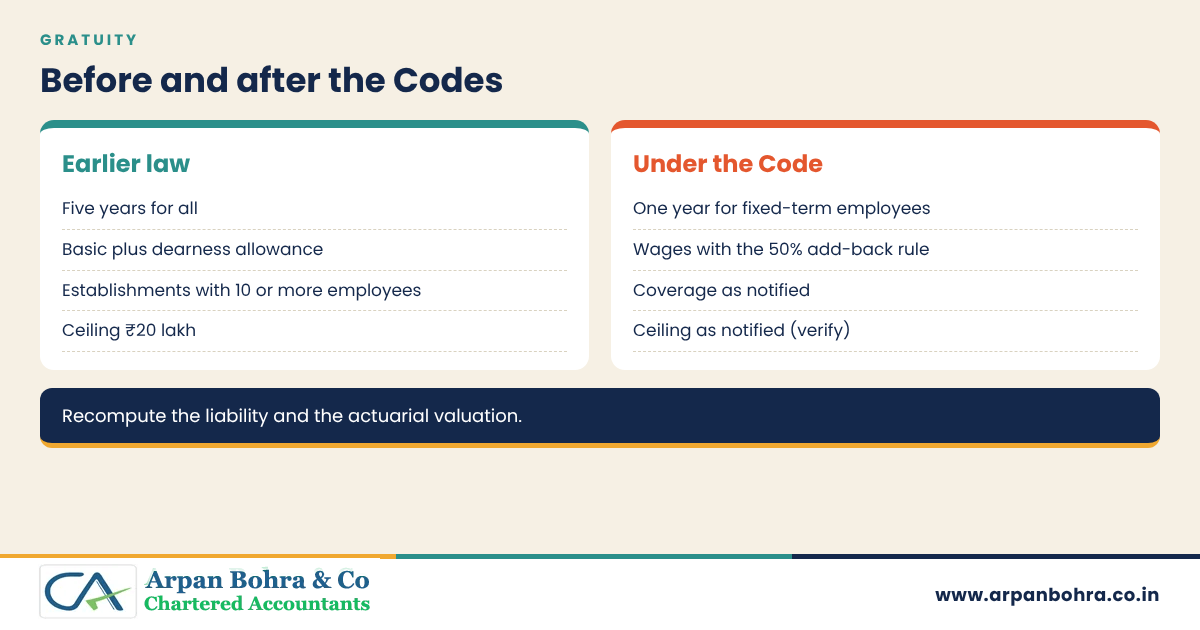
| Point | Earlier law | Under the Code |
|---|---|---|
| Fixed-term employees | Not eligible unless five years | Eligible after one year, pro rata (verify rules) |
| Wage base | Basic plus dearness allowance | Wages as defined, with the 50% add-back rule |
| Coverage | Establishments with 10 or more employees | Code on Social Security coverage; verify the headcount rule |
| Payment | Within 30 days | Within 30 days of becoming payable, with interest if delayed (verify rate) |
| Death or disablement | No minimum service | No minimum service |
Formula and the 50% rule
- Formula: last drawn wages × 15 ÷ 26 × number of completed years of service (service of more than six months in the last year is rounded up), for employees under the monthly-rated formula.
- Wage base: basic, dearness allowance and retaining allowance, plus any excess of other allowances above 50% of total remuneration, subject to the notified rules.
- Ceiling: the maximum gratuity is as notified by the Government under the Code; the earlier ceiling was ₹20 lakh. Verify the notified amount.
- Nomination: the employee must nominate persons to receive gratuity on death.
Worked example
An employee’s monthly pay: basic ₹30,000, allowances ₹40,000. Total remuneration is ₹70,000. The employee leaves after six years and eight months.
- 50% of total remuneration is ₹35,000. Basic is ₹30,000, so ₹5,000 of allowances is added back; wage for gratuity = ₹35,000.
- Completed years: six years and eight months rounds up to seven years, because the part exceeds six months.
- Gratuity = ₹35,000 × 15 ÷ 26 × 7 = ₹1,41,346 (approximately).
- For a fixed-term employee with exactly one year of service and the same wage base: ₹35,000 × 15 ÷ 26 × 1 = ₹20,192.
Illustrative only; check the notified rules for the formula and the base.
Tax treatment
| Employee | Exemption |
|---|---|
| Government employees | Fully exempt |
| Other employees covered by the gratuity law | Least of the amount received, 15 days’ salary for each completed year, and the notified limit (₹20 lakh in the 1961 Act; verify the increased limit and the position under the 2025 Act) |
| Not covered by the law | Different limits, based on half-month’s average salary |
Employer actions
- Recompute the gratuity liability on the Code wage definition and the one-year rule for fixed-term staff.
- Update the actuarial valuation under Ind AS 19 or AS 15.
- Update the offer letters for fixed-term hires to reflect the entitlement.
- Check the trust or insurance arrangement for funding.
- Set a process to pay within 30 days of becoming payable.
- Collect nominations from all employees.
Frequently asked questions
When is gratuity payable?
When does a fixed-term employee get gratuity?
What is the formula?
What is the gratuity ceiling?
Is gratuity taxable?
Does the Code apply to small establishments?
Arpan Bohra & Co., Chartered Accountants, Himayat Nagar, Hyderabad.
This article is shared for general professional education. Readers may write to the firm for information about its practice areas.
General educational information as at 20 October 2026. It is not legal or tax advice and does not create a professional relationship. Provisions, rates and thresholds change; verify the current law and notifications before acting. References to the 57th GST Council (8 October 2026) are to recommendations that need amendments or notifications before they have legal effect.