
Updated 10 October 2026
A Hyderabad software company raises its October invoices and asks: “Do we still file SOFTEX?”
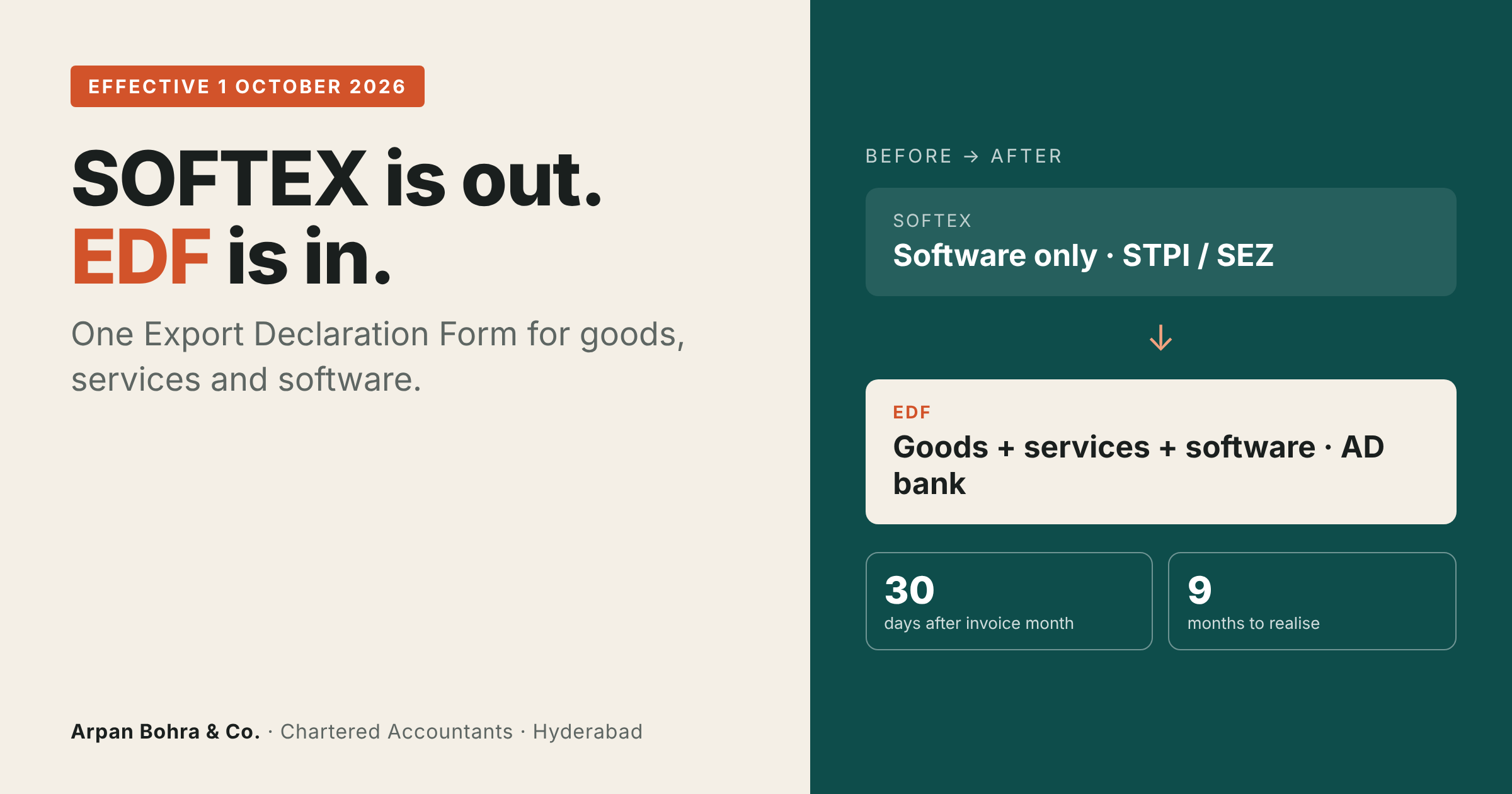
No. From 1 October 2026, one Export Declaration Form (EDF) covers goods, services and software. Services and software exporters file one EDF a month, within 30 days after the end of the month in which the invoice was raised. The authority is usually the Authorised Dealer (AD) bank.
EDF in 30 seconds
| Question | Answer |
|---|---|
| What is it? | The declaration of an export, in the form given at the Annex to the 2026 Regulations |
| Since when? | 1 October 2026 |
| Replaces? | SOFTEX (software exports) |
| Who files? | The exporter, with the “specified authority” |
| How often (services/software)? | One EDF per month, covering all invoices and buyers |
| Due date | Within 30 days after the end of the invoice month |
| Realisation window | 9 months from invoice date (12 months if invoiced or settled in INR) |
Legal basis
| Instrument | What it does |
|---|---|
| FEMA Notification No. 23(R)/2026-RB, 13 January 2026 | Foreign Exchange Management (Export and Import of Goods and Services) Regulations, 2026; commencement 1 October 2026 |
| FEMA Notification No. 23(R)(1)/2026-RB, 22 September 2026 | Amendment: realisation periods set at 9 months (12 if INR); transitional power to Authorised Dealers (Regulation 20) |
| Regulation 3 | Declaration of exports (EDF) |
| Regulation 5 | Time for realisation |
| Regulation 13 | Consequence of long-unrealised exports |
Note: several early commentaries quote 15 and 18 months. That was the position in the January 2026 text. The September 2026 amendment substituted 9 and 12 months.
SOFTEX vs EDF
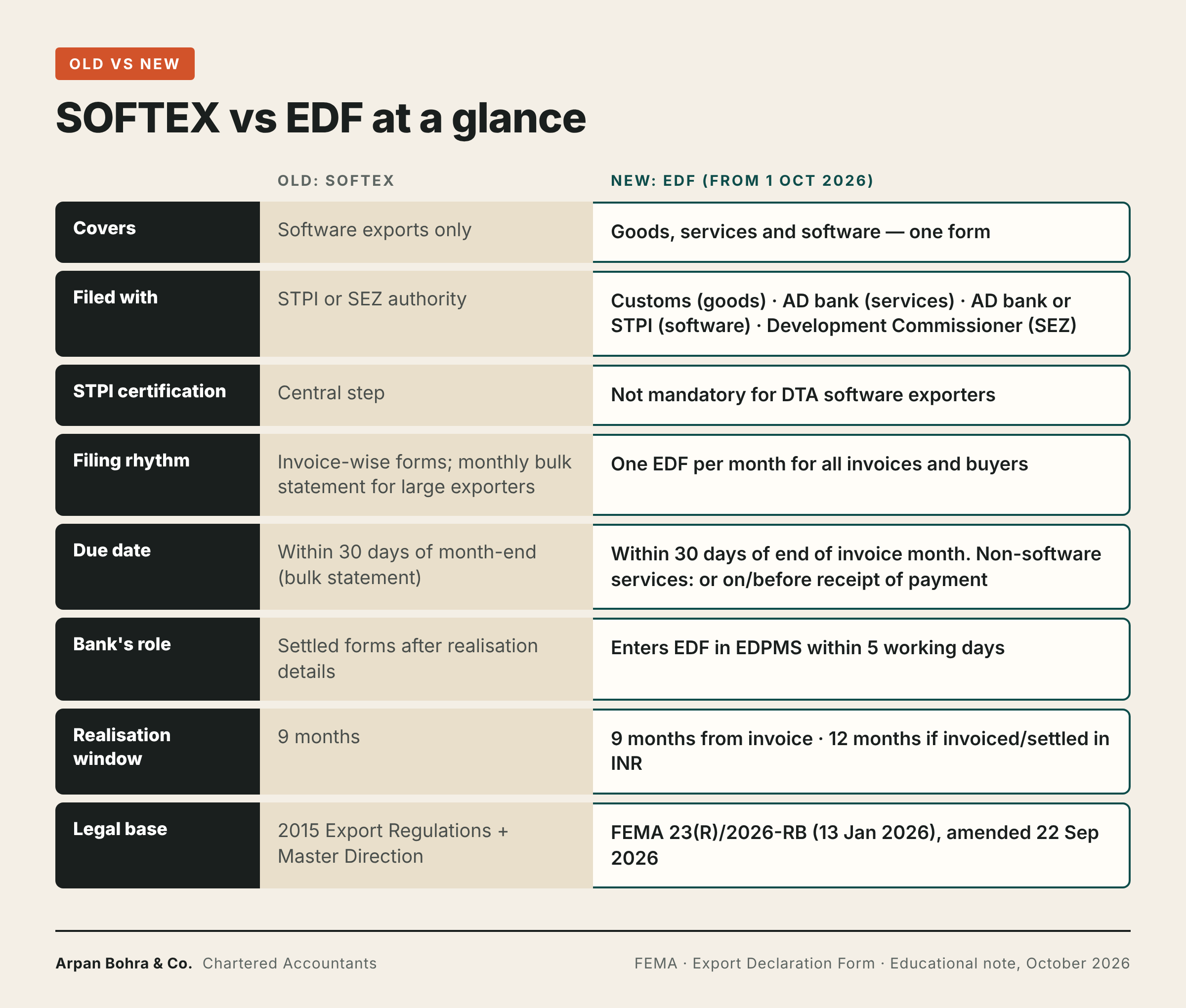
| Point | Old: SOFTEX | New: EDF (from 1 Oct 2026) |
|---|---|---|
| Covers | Software exports only | Goods, services and software, one form |
| Filed with | STPI or SEZ authority | Customs (goods); AD bank (services); AD bank or STPI (software, DTA); Development Commissioner (SEZ) |
| STPI certification | Central step | Not mandatory for DTA software exporters, as the AD bank is also a specified authority |
| Rhythm | Invoice-wise forms; bulk monthly statement for large exporters (2012 procedure) | One EDF per month for all invoices and buyers |
| Due date | Within 30 days of month-end (bulk statement) | Within 30 days after the end of the invoice month; non-software services may file on or before receipt of payment |
| Bank’s role | Settled forms after realisation details | Enters EDF in EDPMS within 5 working days (non-EDI route); closes entry on realisation |
| Realisation | 9 months | 9 months; 12 months for INR |
| Legal base | 2015 Regulations and Master Direction | 2026 Regulations |
Who files where
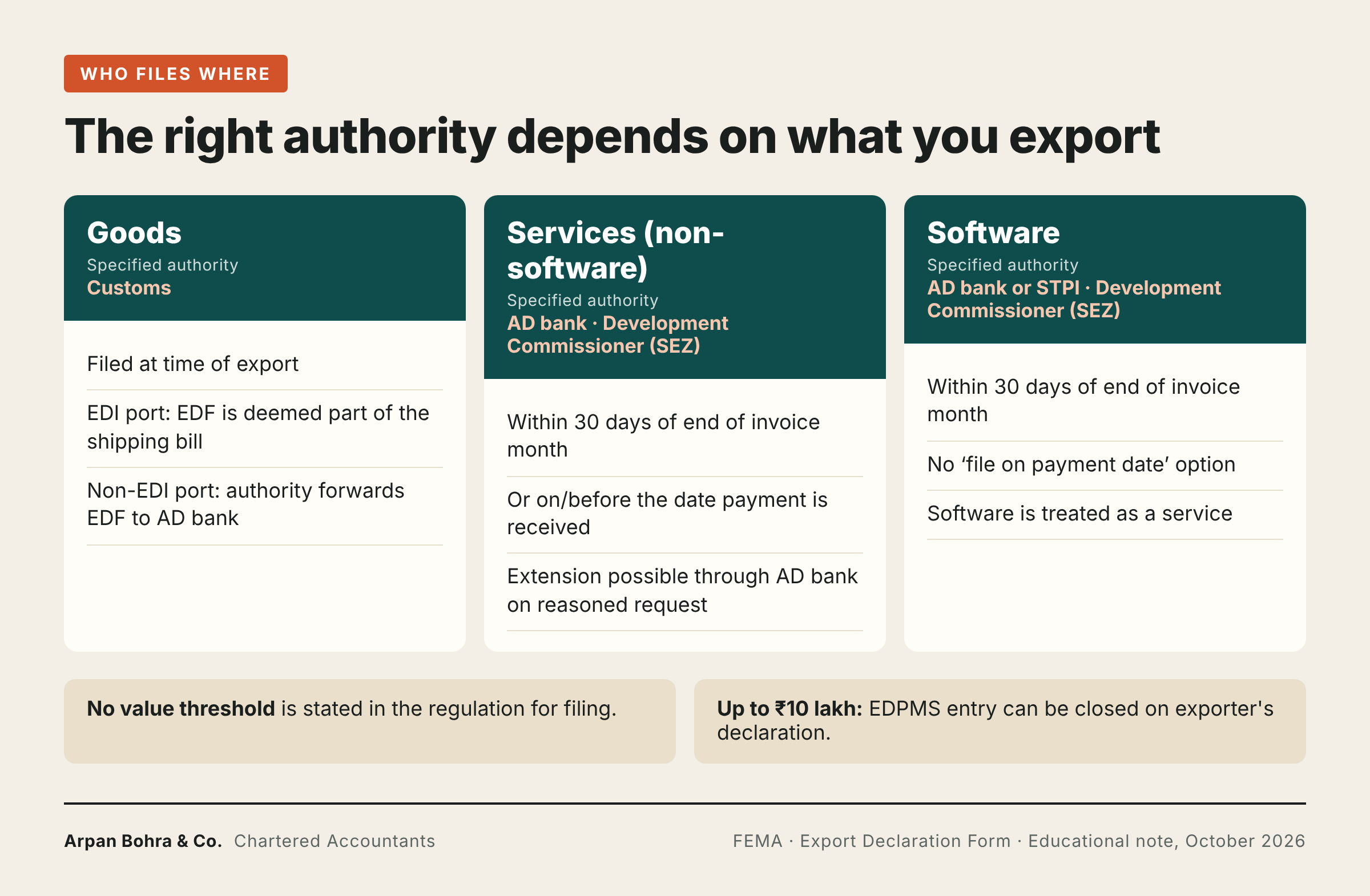
| Export | Specified authority | Timing |
|---|---|---|
| Goods | Customs (DTA); Development Commissioner (SEZ) | At time of export; deemed filed with shipping bill at an EDI port |
| Services other than software | AD bank (DTA); Development Commissioner (SEZ) | Within 30 days after end of invoice month, or on or before payment receipt |
| Software | AD bank or STPI (DTA); Development Commissioner (SEZ) | Within 30 days after end of invoice month |
Software is treated as a service for this purpose. An AD bank may extend the timeline on a reasoned request.
Five steps from invoice to closure
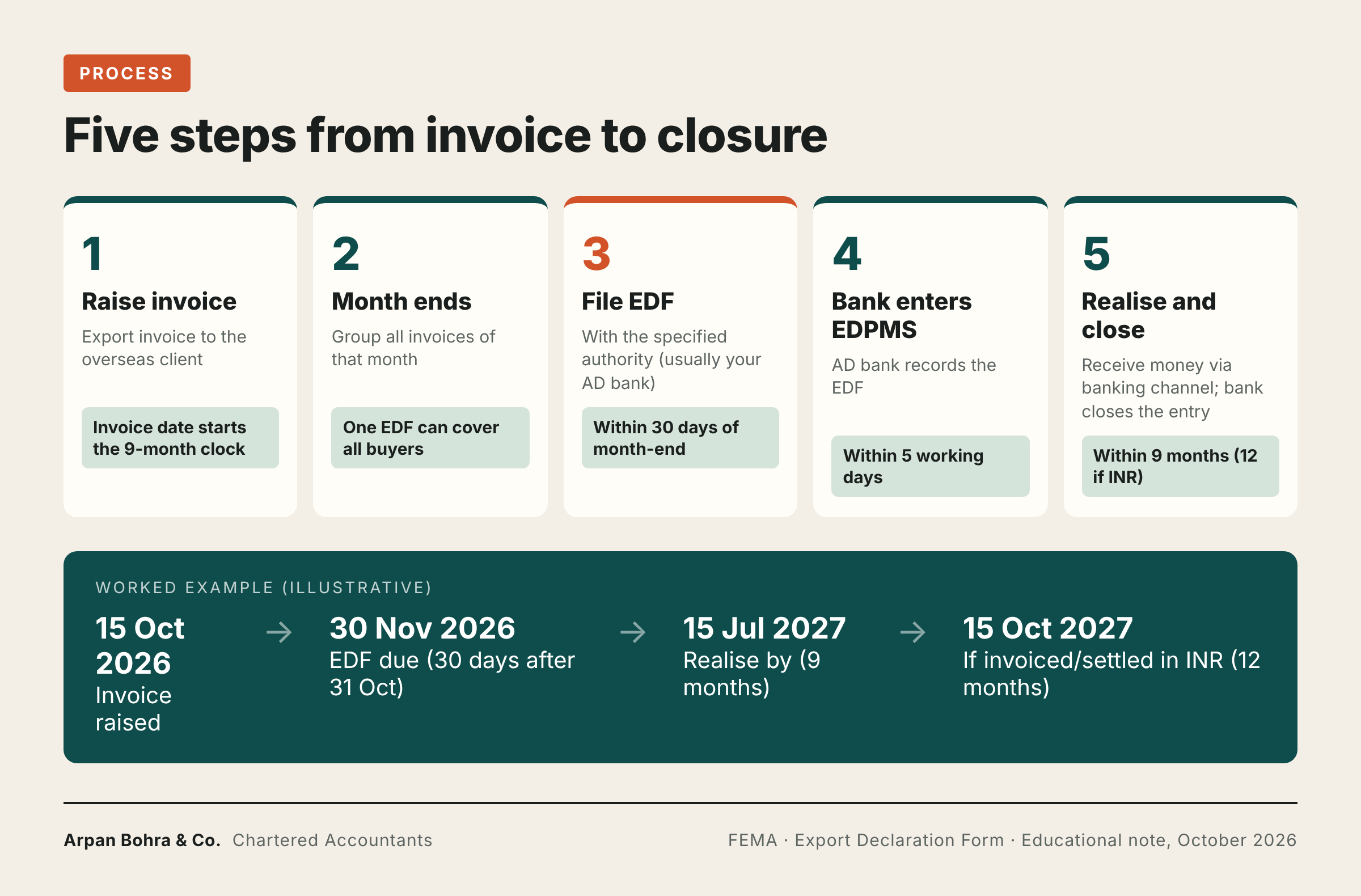
| Step | Action | Clock |
|---|---|---|
| 1 | Raise invoice | Realisation clock starts at invoice date |
| 2 | Collect all invoices of the month | One EDF can cover all buyers |
| 3 | File EDF with the AD bank (or other specified authority) | 30 days after month-end |
| 4 | Bank enters it in EDPMS | 5 working days (non-EDI route) |
| 5 | Receive payment; bank closes entry | 9 months (12 if INR) |
Illustration (assumed dates): invoice raised 15 October 2026 → EDF due 30 November 2026 → realise by 15 July 2027 (or 15 October 2027 if invoiced or settled in INR).
What the EDF asks for
| Part of the Annex | What it asks |
|---|---|
| Part 1: General information | Type of export, mode of delivery, exporter’s name and address, AD code, IEC, GSTIN, PAN, mode of realisation, consignee, country, description and total value |
| Part 2B: Export of services (per recipient) | Recipient and country, invoice number, date, currency and amount, net realisable value, contract number (if any), service description and SAC code |
| Part 4: Exporter’s declaration | Particulars are true; full export value will be delivered to the AD within the realisation period; documents on request |
| Part 5: For specified authority | Certification by Customs, SEZ, AD or STPI |
Common mistakes
| Mistake | Why it matters |
|---|---|
| Assuming small invoices are exempt | No value threshold for filing appears in Regulation 3. The ₹10 lakh relief applies to closing EDPMS entries, not to filing. |
| Missing the monthly date | The 30-day count runs from the end of the invoice month |
| Using 15 months as the realisation period | Superseded by the 22 September 2026 amendment |
| Receiving payment outside normal banking channels | The bank cannot match and close the EDPMS entry |
| Ignoring old open SOFTEX / EDPMS entries | Entries stay open until closed by the bank |
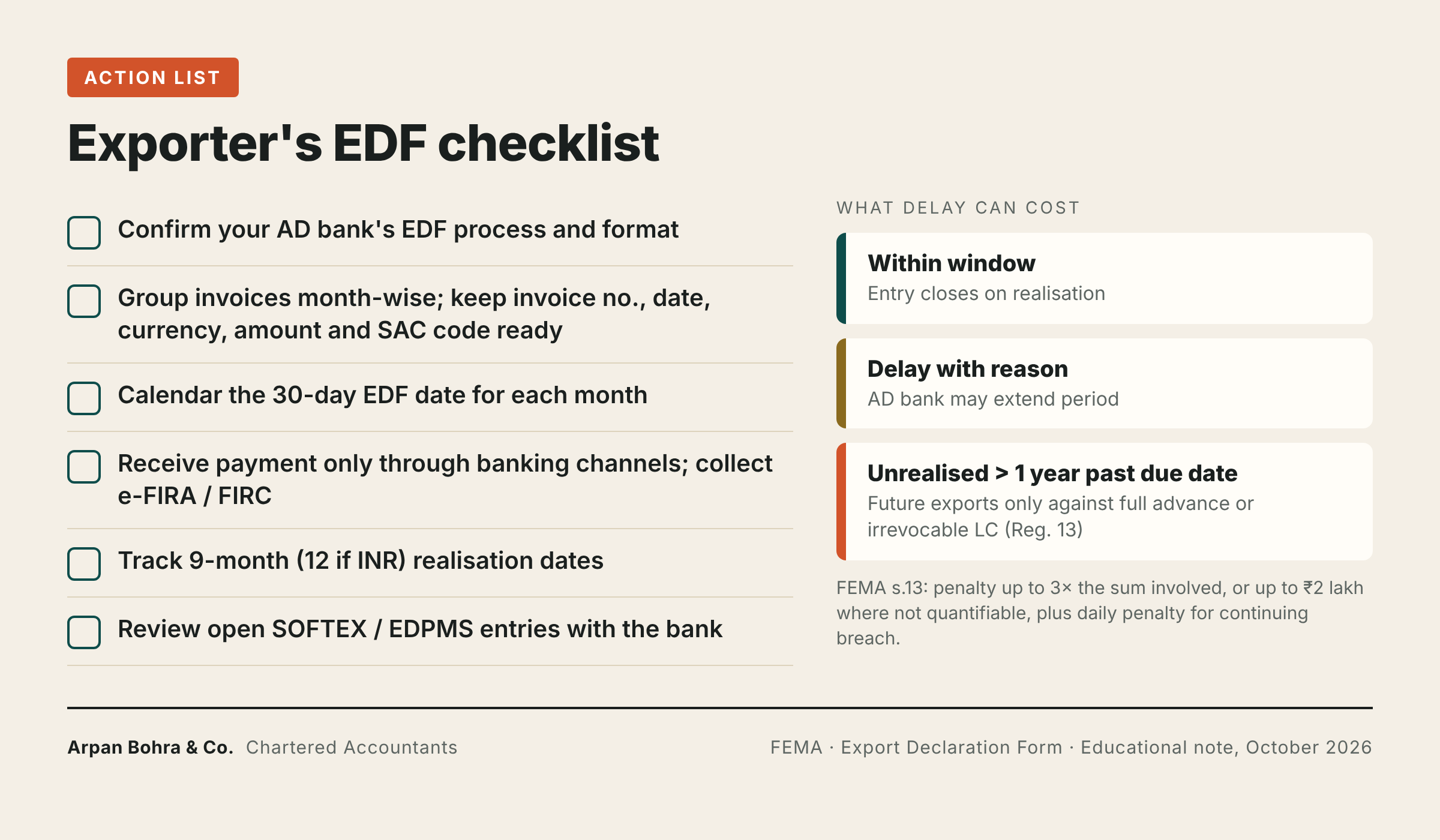
Why delay matters
| Position | Consequence |
|---|---|
| Realised within window | Entry closed by AD bank |
| Delay with genuine reason | AD bank may extend the period |
| Unrealised more than one year beyond due date (or extended date) | Regulation 13: further exports only against full advance payment or an irrevocable letter of credit |
| Contravention of FEMA | Section 13 FEMA: penalty up to three times the sum involved, or up to ₹2 lakh where the amount is not quantifiable, plus a daily penalty for continuing contravention. Compounding may be available. |
GST angle
For GST zero-rating of export of services, section 2(6) of the IGST Act, 2017 requires, among other conditions, that payment is received in convertible foreign exchange (or in Indian rupees where RBI permits). A clean EDF, e-FIRA/FIRC and EDPMS trail supports the same facts a GST officer may ask for. See also our note on GST refund reforms.
Hyderabad context
Software and IT-enabled service exporters in the HITEC City, Gachibowli and Financial District corridors, and freelancers elsewhere in Hyderabad, will deal mainly with their AD bank branch. Banks are still settling their internal procedures, so ask your bank for its EDF format, submission channel and cut-off before the first due date. Annual foreign liabilities and assets reporting is a separate compliance: FLA Return under FEMA.
Frequently asked questions
Is SOFTEX still required?
For exports on or after 1 October 2026, the EDF is the declaration. For filings relating to earlier exports, confirm treatment with your AD bank or STPI, as the Regulations do not spell out every in-flight case.
Do freelancers need to file EDF?
An exporter of services files an EDF; Regulation 3 mentions no value threshold. Whether a particular receipt is an export of service (for example, platform revenue-sharing) depends on facts and should be checked.
Can one EDF cover several clients?
Yes. For services and software, one EDF per month may cover exports to multiple recipients.
Is STPI certification still needed?
Not mandatory for DTA software exporters, because an AD bank is also a specified authority. SEZ units go through the Development Commissioner.
What is the time limit to bring the money in?
Nine months from the invoice date for services (twelve if invoiced or settled in INR), extendable by the AD bank on reasoned request.
Takeaway
EDF turns three different reporting routes into one, but the discipline is the same: file monthly, receive through banks, close within nine months. The shift of certification from STPI to AD banks makes the bank relationship part of export compliance.
This article is for general information and is not advice on any specific transaction. Please verify the current position with the official text.
Arpan Bohra & Co., Chartered Accountants
Himayat Nagar, Hyderabad
Website: www.arpanbohra.co.in
Email: office@arpanbohra.co.in | Telephone: 9010558981