
A private limited company in Hyderabad files its accounts late, skips a Board meeting, and does not update its registers. Nothing happens for a year. Then a notice arrives from the Registrar of Companies (ROC), and the penalty falls on the company and on each director personally. This article lists the non-compliances that most often lead to that notice, with the penalty for each, worked examples and a calendar to avoid them.
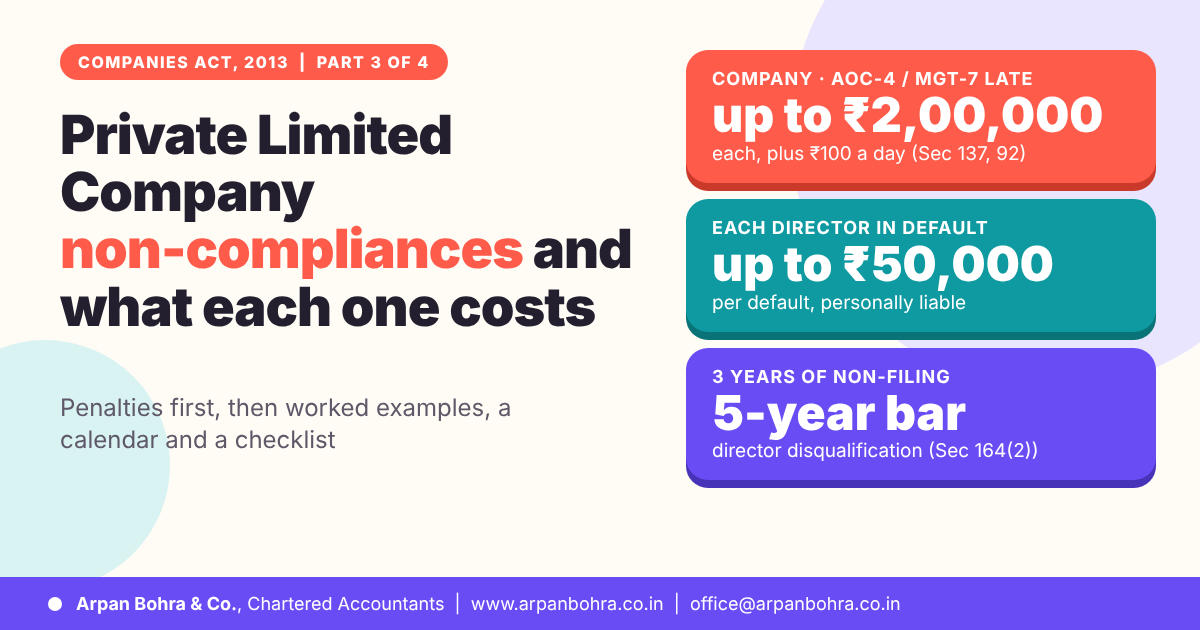
Short answer: under the Companies Act, 2013, most defaults by a private company attract a monetary penalty on the company and on every “officer in default”, which can include directors. Some also carry a five-year director disqualification (Section 164(2)). Smaller private companies get a reduced penalty under Section 446B.
What a default can cost: penalties first
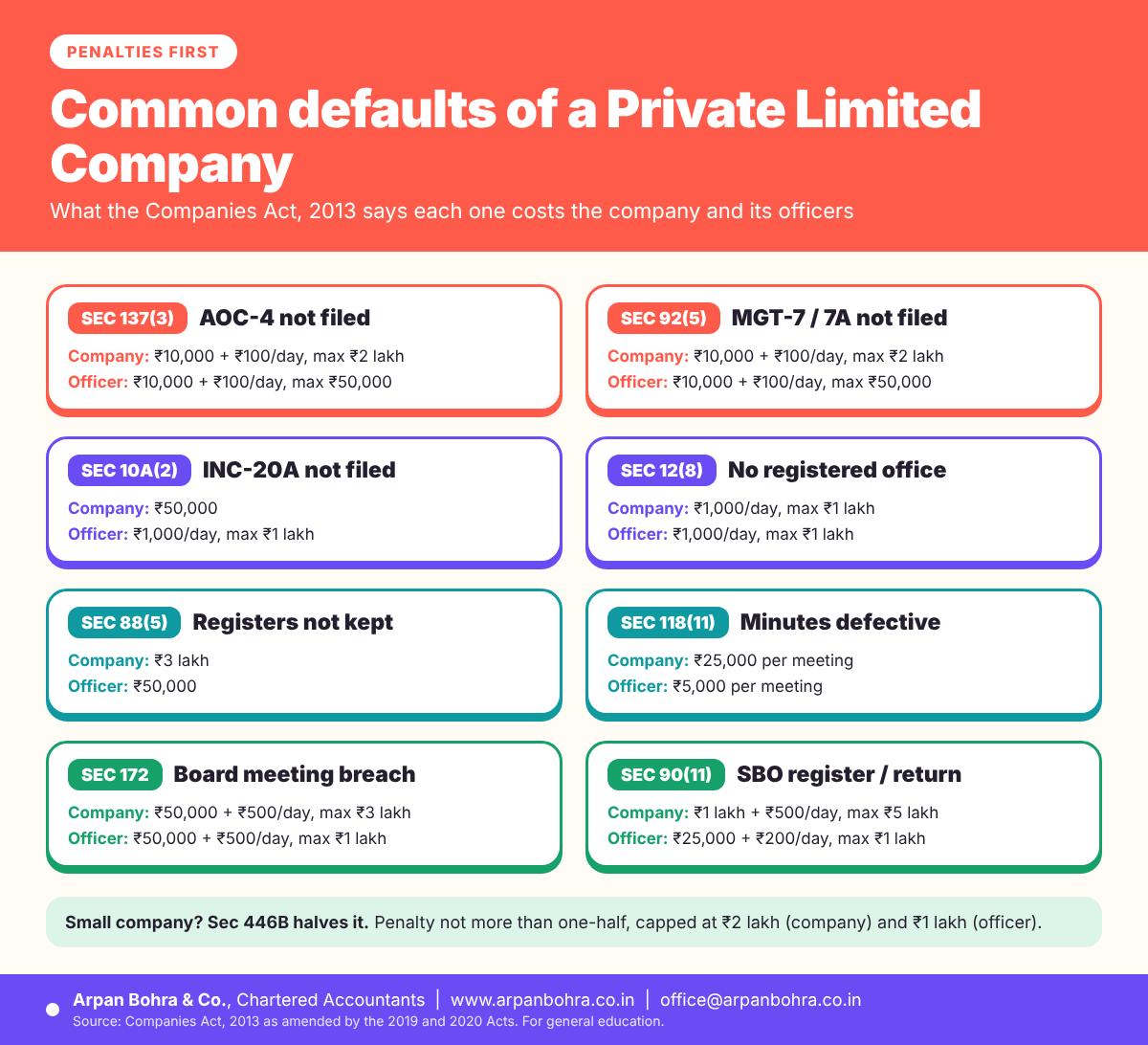
The two tables below set out the penalty for each common default. Figures are as amended by the Companies (Amendment) Act, 2019 and 2020 (effective 21 December 2020 for the 2020 changes). Amounts are in rupees. “Officer in default” is explained further below.
Table 1: Filing defaults
| Default | Section | Penalty on the company | Penalty on officers in default |
|---|---|---|---|
| Financial statements not filed with ROC (Form AOC-4) | 137(3) | ₹10,000, plus ₹100 a day while the failure continues, up to ₹2,00,000 | ₹10,000, plus ₹100 a day after the first day, up to ₹50,000 each (the Managing Director and CFO; failing them, the director the Board charged with compliance; failing that, all directors) |
| Annual return not filed (Form MGT-7 or MGT-7A) | 92(5) | ₹10,000, plus ₹100 a day after the first day, up to ₹2,00,000 | ₹10,000, plus ₹100 a day after the first day, up to ₹50,000 each |
| Resolutions and agreements not filed (Form MGT-14) | 117 | ₹10,000, plus ₹100 a day after the first day, up to ₹2,00,000 | ₹10,000, plus ₹100 a day, up to ₹50,000 each |
| Contravention of Section 134 (financial statements, Board’s report) | 134(8) | ₹3,00,000 | ₹50,000 each |
| Declaration of commencement of business not filed (Form INC-20A) | 10A(2) | ₹50,000 | ₹1,000 a day, up to ₹1,00,000 each |
| Significant beneficial owner (SBO) return, register or steps not done | 90(11) | ₹1,00,000, plus ₹500 a day after the first day, up to ₹5,00,000 | ₹25,000, plus ₹200 a day after the first day, up to ₹1,00,000 each |
| SBO fails to make the declaration | 90(10) | Not applicable (penalty is on the person) | ₹50,000, plus ₹1,000 a day after the first day, up to ₹2,00,000 |
Table 2: Governance and record-keeping defaults
| Default | Section | Penalty on the company | Penalty on officers in default |
|---|---|---|---|
| Annual General Meeting (AGM) not held as required | 99 | Fine up to ₹1,00,000, plus up to ₹5,000 a day of continuing default | Same, on every officer in default |
| Board meeting requirements breached (no specific penalty in the Chapter) | 172 | ₹50,000, plus ₹500 a day while failure continues, up to ₹3,00,000 | ₹50,000, plus ₹500 a day, up to ₹1,00,000 each |
| Notice of Board meeting not given | 173(4) | Not applicable | ₹25,000 on the officer whose duty it was |
| Minutes not prepared, signed or kept as required | 118(11) | ₹25,000 for each meeting | ₹5,000 for each meeting |
| Tampering with minutes | 118(12) | Not applicable | Imprisonment up to 2 years, and fine of ₹25,000 to ₹1,00,000 |
| No working registered office | 12(8) | ₹1,000 a day, up to ₹1,00,000 | ₹1,000 a day, up to ₹1,00,000 each |
| Statutory registers not maintained (members, etc.) | 88(5) | ₹3,00,000 | ₹50,000 each |
| Books of account not kept properly | 128(6) | Not applicable | Fine of ₹50,000 to ₹5,00,000 on the Managing Director, whole-time director in charge of finance, CFO or other person charged by the Board |
| Director KYC (Form DIR-3 KYC) missed | Rule 12A | Not applicable | DIN is marked deactivated; ₹5,000 fee to reactivate |
| Any other contravention with no specific penalty | 450 | ₹10,000, plus ₹1,000 a day after the first day, up to ₹2,00,000 | ₹10,000, plus ₹1,000 a day, up to ₹50,000 |
Who is an “officer in default”?
Under Section 2(60), this means an officer who is knowingly guilty of the default, or who knew of it through Board proceedings or received information about it and did not object. For filing defaults under Sections 137 and 92, the Act and the Rules identify specific persons. In a two-director private company, both directors are usually exposed.
Beyond the fine: consequences that cost more
- Director disqualification. A director of a company that has not filed financial statements or annual returns for any continuous period of three financial years cannot be re-appointed in that company, or appointed in another, for five years (Section 164(2)(a)). A person appointed to a company already in default has six months before the disqualification applies.
- Deactivated DIN. A director who misses DIR-3 KYC has the DIN marked “Deactivated due to non-filing of DIR-3 KYC” until KYC is filed with a ₹5,000 fee (MCA FAQ).
- Striking off. A company that has stopped carrying on business may be proposed for removal from the register under Chapter XVIII. The Registrar can also act under Section 10A(3) if the commencement declaration is not filed within 180 days of incorporation.
- Additional filing fees. Late filing of forms attracts additional fees under the Registration Offices and Fees Rules on top of the penalties above.
- Failure to pay an adjudicated penalty. If a company does not pay within 90 days of receiving the order, it faces a further fine of ₹25,000 to ₹5,00,000. A defaulting officer faces up to six months’ imprisonment, or a fine of ₹25,000 to ₹1,00,000, or both (Section 454(8)).
Worked examples
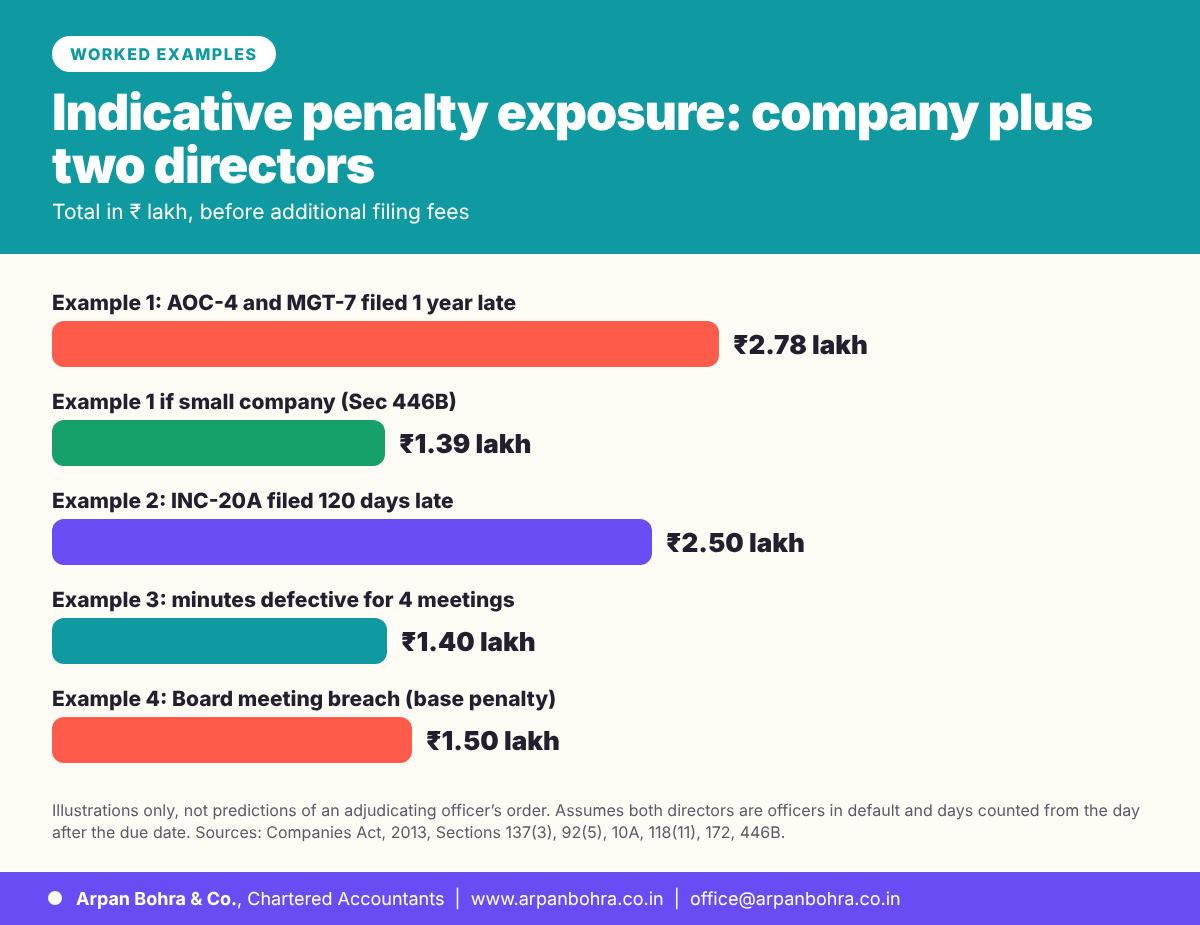
These are illustrations of how the figures operate, not predictions of what an adjudicating officer will order. They assume that every director is treated as an officer in default and that days are counted from the day after the due date.
Example 1: Accounts and annual return filed one year late
A private company with two directors files both AOC-4 and MGT-7 about 365 days late.
| Item | Company | Each director |
|---|---|---|
| Section 137(3), AOC-4 | ₹10,000 + ₹100 × 365 = ₹46,500 | ₹10,000 + ₹100 × 364 = ₹46,400 |
| Section 92(5), MGT-7 | ₹10,000 + ₹100 × 364 = ₹46,400 | ₹10,000 + ₹100 × 364 = ₹46,400 |
| Indicative total for the year | about ₹92,900 | about ₹92,800 each |
Total indicative exposure across the company and two directors: about ₹2.78 lakh, plus additional filing fees. If the company is a small company, Section 446B applies and the total would be not more than one-half of this on the usual reading (about ₹1.39 lakh). If the default runs for three continuous financial years, both directors face disqualification for five years under Section 164(2)(a).
Example 2: Commencement declaration (INC-20A) filed 120 days late
| Person | Calculation | Penalty |
|---|---|---|
| Company | Fixed | ₹50,000 |
| Each director | ₹1,000 × 120 days = ₹1,20,000, capped | ₹1,00,000 |
| Two directors | 2 × ₹1,00,000 | ₹2,00,000 |
| Total indicative | ₹2,50,000 |
The per-day cap is reached after 100 days, so delay beyond that adds nothing to the officer’s penalty but does not stop the Registrar from taking action under Section 10A(3).
Example 3: Four Board meetings with defective minutes
If minutes of four meetings in a year are not signed, numbered or kept as required by Section 118, the penalty is ₹25,000 on the company for each meeting (₹1,00,000) and ₹5,000 on each defaulting officer for each meeting (₹20,000 per officer), assuming each meeting is treated as a separate default.
Example 4: Only two Board meetings in a year
A company that is not a small company holds two Board meetings in a year, with a gap of about 190 days. This breaches Section 173(1) (at least four meetings a year, with no more than 120 days between two consecutive meetings). With no specific penalty in the Chapter, Section 172 applies: ₹50,000 on the company and ₹50,000 on each officer in default, plus ₹500 a day while the failure continues. A small company, One Person Company or dormant company has a relaxed rule under Section 173(5): at least one meeting in each half of the calendar year, with a gap of not less than 90 days.
Smaller private companies: reduced penalties under Section 446B
For a One Person Company, small company, start-up company or producer company, the penalty is not more than one-half of the penalty specified in the provision, subject to a maximum of ₹2,00,000 for the company and ₹1,00,000 for the officer in default (Section 446B, as substituted by the 2020 Act, effective 22 January 2021).
A “small company” is currently one with paid-up share capital up to ₹4 crore and turnover up to ₹40 crore, as revised by the Companies (Specification of Definitions Details) Amendment Rules, 2022 (notification G.S.R. 700(E), 15 September 2022). The definition excludes holding and subsidiary companies, Section 8 companies and companies governed by a special Act. A “start-up company” for this purpose means a private company recognised as a start-up by DPIIT.
How the ROC proceeds
The Central Government has delegated adjudication powers to Registrars of Companies (S.O. 831(E), 24 March 2015). Penalties are levied under Section 454 after notice and an opportunity to be heard. A person aggrieved by the order may appeal to the Regional Director within 60 days of receiving a copy of the order, on the prescribed form and fee (Section 454(5)). Payment is made through the MCA portal.
Practical points that help in a reply: respond to the first notice within the time given, state whether the default has been cured and when, show that officers named did not have the duty or knowledge, and ask for the reduction available under Section 446B if the company qualifies.
The most common non-compliances, explained
1. Financial statements and annual return not filed. Financial statements must be filed within 30 days of the AGM, and the annual return within 60 days of the AGM. If no AGM is held, the days run from the date the AGM should have been held (Section 92(4)).
2. AGM not held on time. The first AGM is due within nine months of the end of the first financial year. Later AGMs are due within six months of the end of each financial year, with no more than 15 months between two AGMs (Section 96).
3. Fewer Board meetings than required. Four meetings a year with no more than 120 days between two meetings is the rule (Section 173(1)), with the relaxation above for small companies, One Person Companies and dormant companies.
4. Poor minutes. Minutes must be prepared, signed and kept within 30 days of the meeting, in books with consecutively numbered pages (Section 118).
5. DIR-3 KYC missed. Directors who hold a DIN as on 31 March must file KYC on or before 30 September of the next financial year.
6. Registers not maintained. The register of members, directors and others must be kept up to date (Section 88). The SBO declaration and register are a separate requirement (Section 90).
7. Commencement declaration (INC-20A) not filed. A company with share capital must file a declaration within 180 days of incorporation that every subscriber has paid for the shares agreed to be taken (Section 10A).
8. Registered office not verified. A company must have a registered office from the 15th day of incorporation (Section 12(1)).
9. Related party, loan and investment rules ignored. These carry their own penalties. Read our guides on related party transactions and on Sections 185 and 186.
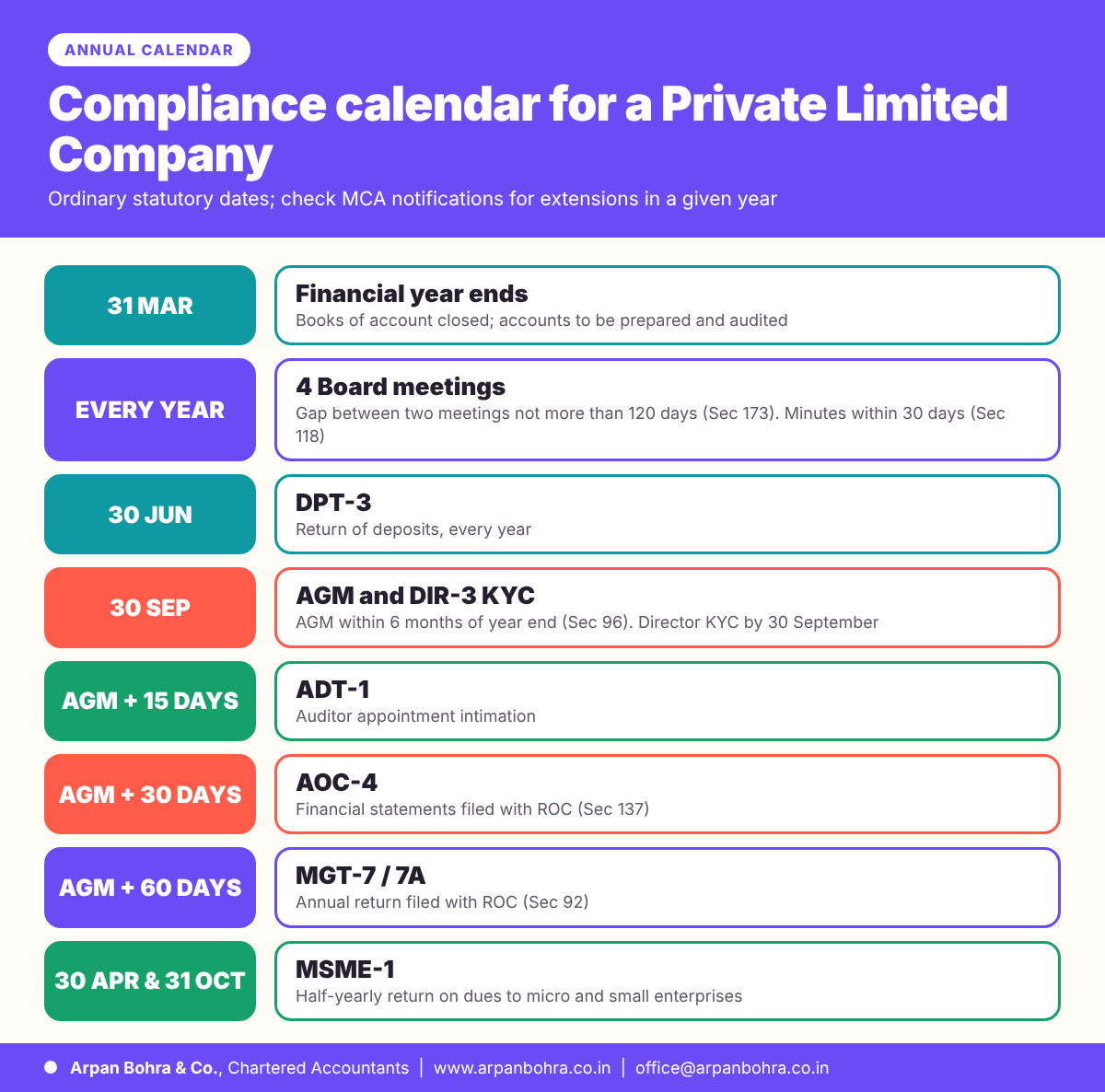
Annual compliance calendar for a private company
| Compliance | Form | Timeline | Law |
|---|---|---|---|
| Director’s disclosure of interest | MBP-1 | First Board meeting of each financial year | Section 184(1) |
| Board meetings | Minutes | At least 4 a year; gap not more than 120 days | Section 173 |
| Appointment of auditor | ADT-1 | Within 15 days of the general meeting | Section 139 |
| AGM | Notice and minutes | Within 6 months of financial year end | Section 96 |
| Financial statements | AOC-4 | Within 30 days of AGM | Section 137 |
| Annual return | MGT-7 or MGT-7A | Within 60 days of AGM | Section 92 |
| Return of deposits | DPT-3 | By 30 June every year | Deposit Rules, 2014 |
| Director KYC | DIR-3 KYC | By 30 September every year | Rule 12A |
| Dues to micro and small enterprises | MSME-1 | Half-yearly: by 31 October and by 30 April | Section 405 |
Timelines are the ordinary statutory or prescribed dates. MCA sometimes extends or relaxes dates by circular, so check the current MCA notifications before relying on a date for a particular year.
Quick self-check
- Have AOC-4 and MGT-7 been filed for every financial year since incorporation?
- Were at least four Board meetings held last year, with no gap above 120 days (or two meetings in the half-year pattern for a small company)?
- Are minutes signed, dated and in numbered books?
- Is DIR-3 KYC done for every director?
- Is INC-20A filed (if the company has share capital)?
- Are the registers of members and directors and the SBO register current?
- Is the registered office open, and is the address as per ROC records?
- Are MBP-1 disclosures on file for each director?
- Have special resolutions been filed in MGT-14 within 30 days?
For queries on this article, write to office@arpanbohra.co.in.
Status of the Corporate Laws (Amendment) Bill, 2026
The Corporate Laws (Amendment) Bill, 2026 was introduced in Parliament on 23 March 2026, and the Joint Parliamentary Committee report is dated 3 August 2026. Based on the sources checked, it has not been enacted. This article states the law as in force on the date of review. Please check the position again before relying on any proposed change.
Frequently asked questions
1. What is the penalty if a private limited company does not file its annual return?
Under Section 92(5), the company is liable to a penalty of ₹10,000 and a further ₹100 for each day after the first, up to ₹2,00,000. Each officer in default is liable to ₹10,000 and a further ₹100 a day after the first, up to ₹50,000.
2. Can a director be personally penalised for the company’s default?
Yes. The penalty provisions apply to the company and to every officer in default. Section 2(60) describes who that can be. Directors are often named in ROC notices.
3. Does a small private company pay a lower penalty?
Yes. Under Section 446B, the penalty on a small company, One Person Company, start-up company or producer company is not more than one-half of the specified penalty, subject to a maximum of ₹2,00,000 for the company and ₹1,00,000 for the officer.
4. Can a director be disqualified for not filing returns?
Yes. If the company has not filed financial statements or annual returns for any continuous period of three financial years, its directors face disqualification for five years under Section 164(2)(a).
5. What happens if a director misses DIR-3 KYC?
The DIN is deactivated until KYC is filed with the late fee of ₹5,000, as stated in the MCA FAQ.
6. Can an ROC penalty order be challenged?
Yes. An appeal lies to the Regional Director within 60 days of receiving the order under Section 454(5), on the prescribed form and fee.
Official and primary sources
- Companies Act, 2013 (text with amendment notes), LawX (Section 137)
- Companies (Amendment) Act, 2020 changes to Section 450
- Section 446B, Companies Act, 2013
- MCA FAQ on DIR-3 KYC
- Amendment to small company definition, KS&K summary
Takeaway
Most of these penalties are small on a single default and large when defaults repeat across years and across directors. The safest course is an annual calendar, a single person responsible for each filing, and regular checks of the ROC master data. This article is for general education and is not legal advice; the facts of each company and the text of the provision should be checked before acting.
Arpan Bohra & Co., Chartered Accountants
Website: https://www.arpanbohra.co.in/
Email: office@arpanbohra.co.in