

Updated 11 October 2026. The depreciation rate chart as per the Companies Act 2013 is set by Schedule II, read with section 123(2). Schedule II prescribes the useful life of each class of asset, and depreciation is charged over that life after leaving a residual value of not more than 5% of original cost. The chart below converts those useful lives into straight line method (SLM) and written down value (WDV) rates, and the calculator works out year-wise depreciation for your asset.
Depreciation rate chart as per Schedule II, Part C
Rates are computed on the assumption of a 5% residual value and single-shift working. SLM rate = 95% divided by useful life. WDV rate = 1 minus the nth root of 5%, where n is the useful life in years. Useful lives are from Part C of Schedule II. This table lists the commonly used classes; Part C also covers specialised plant (for example glass, steel, non-ferrous metals, oil and gas, power, civil construction), ships and other classes, for which the Schedule itself should be consulted.
| Nature of asset | Useful life (years) | SLM rate | WDV rate |
|---|---|---|---|
| Buildings (other than factory) – RCC frame structure | 60 | 1.58% | 4.87% |
| Buildings (other than factory) – other than RCC frame | 30 | 3.17% | 9.50% |
| Factory buildings | 30 | 3.17% | 9.50% |
| Fences, wells, tube wells | 5 | 19.00% | 45.07% |
| Temporary structures and others | 3 | 31.67% | 63.16% |
| Bridges, culverts, bunders etc. | 30 | 3.17% | 9.50% |
| Roads – RCC carpeted | 10 | 9.50% | 25.89% |
| Roads – other carpeted | 5 | 19.00% | 45.07% |
| Roads – non-carpeted | 3 | 31.67% | 63.16% |
| Plant and machinery – general (not continuous process) | 15 | 6.33% | 18.10% |
| Plant and machinery – continuous process plant | 25 | 3.80% | 11.29% |
| Telecom – towers | 18 | 5.28% | 15.33% |
| Telecom – transceivers, switching centres, network equipment | 13 | 7.31% | 20.58% |
| Power – wind energy generation | 22 | 4.32% | 12.73% |
| Medical – X-ray, CAT scan, ultrasound, ECG equipment | 13 | 7.31% | 20.58% |
| Medical – other equipment | 15 | 6.33% | 18.10% |
| Furniture and fittings – general | 10 | 9.50% | 25.89% |
| Furniture – hotels, restaurants, schools, colleges, libraries, cinemas etc. | 8 | 11.88% | 31.23% |
| Motor cycles, scooters, mopeds | 10 | 9.50% | 25.89% |
| Buses, lorries, cars – used for hire | 6 | 15.83% | 39.30% |
| Buses, lorries, cars – not used for hire | 8 | 11.88% | 31.23% |
| Tractors, harvesting combines, heavy vehicles | 8 | 11.88% | 31.23% |
| Electric vehicles | 8 | 11.88% | 31.23% |
| Office equipment | 5 | 19.00% | 45.07% |
| Computers – servers and networks | 6 | 15.83% | 39.30% |
| Computers – end-user devices (desktops, laptops etc.) | 3 | 31.67% | 63.16% |
| Laboratory equipment – general | 10 | 9.50% | 25.89% |
| Laboratory equipment – educational institutions | 5 | 19.00% | 45.07% |
| Electrical installations and equipment | 10 | 9.50% | 25.89% |
| Aircraft or helicopters | 20 | 4.75% | 13.91% |
| Railway sidings, locomotives, rolling stock, tramways | 15 | 6.33% | 18.10% |
Depreciation calculator
Select the asset class, enter the cost and the month count for the first year. The calculator applies the Schedule II useful life and a residual value of up to 5%.
Depreciation calculator (Schedule II, Companies Act 2013)
Rules to remember while using the chart
- Residual value and useful life. The residual value should not exceed 5% of original cost, and the useful life should not ordinarily differ from Part C. A company that adopts a different residual value or useful life must disclose the difference and justify it with technical advice.
- Pro rata for additions and disposals. Depreciation on an asset added during the year is calculated from the date of addition. For an asset sold, discarded, demolished or destroyed, it runs up to the date of disposal.
- Shift working. The useful lives assume single-shift working. For double-shift use, depreciation for that period increases by 50%, and for triple-shift use it is calculated at 100% (that is, double the single-shift charge). Assets marked NESD (no extra shift depreciation) in Schedule II are excluded from this adjustment.
- Component accounting. Where a significant part of an asset has a different useful life, the useful life of that part is determined separately. This became mandatory for financial years starting on or after 1 April 2015.
- Regulator-notified assets. Where a useful life or residual value is notified by a regulator under an Act of Parliament, or by the Central Government, that notification applies regardless of Schedule II (Part B).
- Intangible assets. Amortised under the applicable accounting standards (Ind AS or the Companies (Accounting Standards) Rules, as applicable), not under the tangible asset chart above.
Worked example: motor car not used for hire
Illustrative figures. Original cost Rs 10,00,000, useful life 8 years, residual value 5% (Rs 50,000), full-year use.
- SLM: (10,00,000 − 50,000) ÷ 8 = Rs 1,18,750 every year (rate 11.88%).
- WDV: rate 31.23%. Year 1 depreciation Rs 3,12,344 (closing Rs 6,87,656); year 2 Rs 2,14,785 (closing Rs 4,72,871); year 3 Rs 1,47,698 (closing Rs 3,25,172), and so on until the residual value is reached.
Companies Act depreciation and Income Tax depreciation are different
The chart above is for books of account under the Companies Act, 2013. Depreciation for income tax purposes is computed separately under the income tax law, on blocks of assets at the prescribed rates. The two will usually differ, and the difference is dealt with through deferred tax in the financial statements. See our note on the rate of depreciation under the Income Tax Act, 1961 (this older note should be read together with the current income tax law applicable to the relevant year).
Frequently asked questions
Which section of the Companies Act, 2013 requires depreciation to follow Schedule II?
Section 123(2) provides that depreciation is to be provided in accordance with Schedule II.
What is the maximum residual value under Schedule II?
Not more than 5% of the original cost of the asset. A different residual value must be disclosed and justified with technical advice.
What is the useful life of a computer under the Companies Act?
Three years for end-user devices such as desktops and laptops, and six years for servers and networks.
What is the useful life of an electric vehicle?
Eight years under Part C of Schedule II. Motor cycles, scooters and mopeds are 10 years; buses, lorries and cars used for hire are 6 years and those not used for hire are 8 years.
Is depreciation on assets bought during the year charged for the full year?
No. It is calculated pro rata from the date of addition, and for disposals up to the date of disposal.
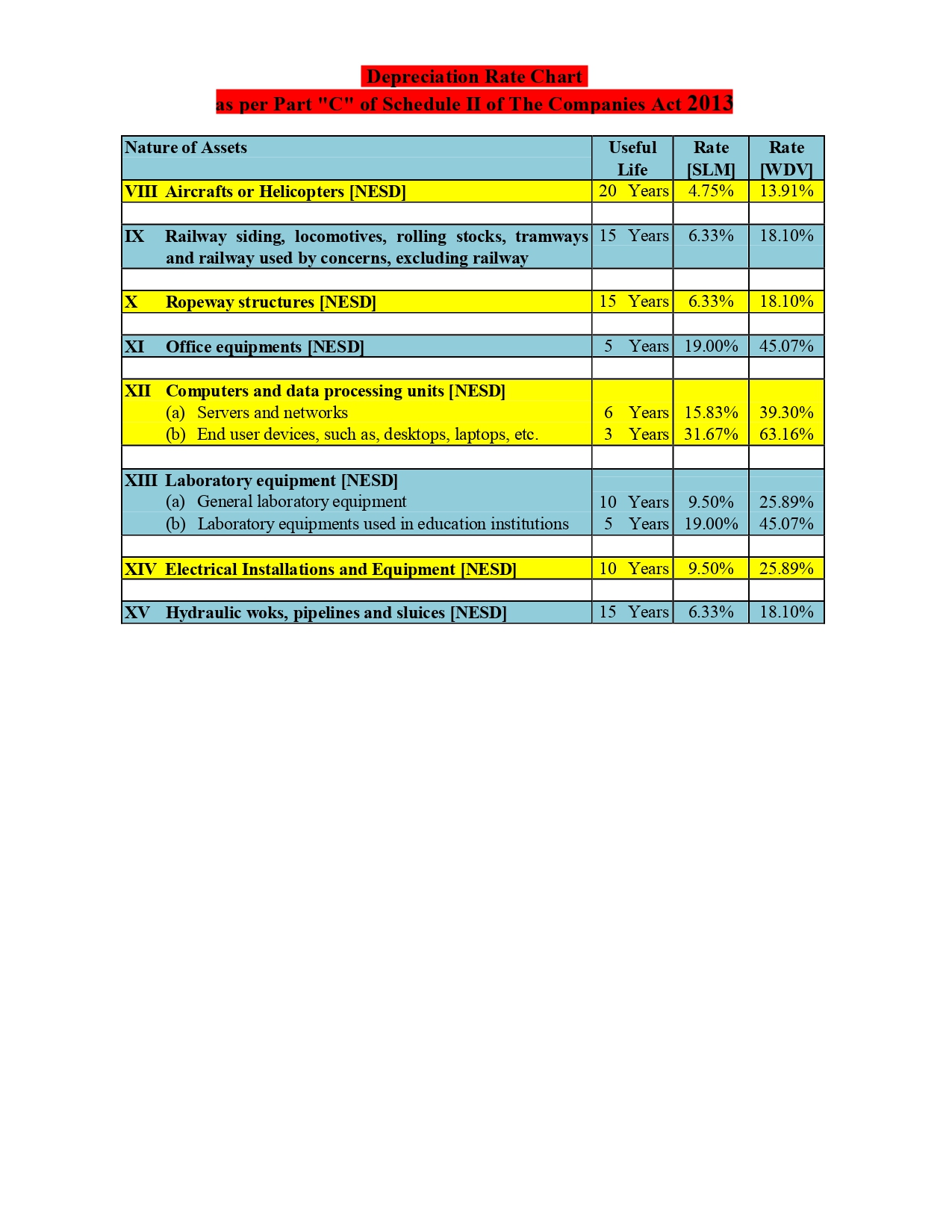
Original chart (page images)
The scanned chart that this page originally carried is retained below for reference.


Source
- Schedule II, Companies Act, 2013 – useful lives to compute depreciation: Schedule II (Income Tax Department reference copy).
This note is for general information and educational purposes only and does not constitute professional advice. Rates are computed using the formulae stated above and should be verified against Schedule II and the accounting framework applicable to your company before use.
Arpan Bohra & Co., Chartered Accountants
Himayat Nagar, Hyderabad, Telangana
9010558981 | office@arpanbohra.co.in | www.arpanbohra.co.in