
A law is only as strong as the people who enforce it. RERA works because it creates referees: a regulator, a compensation judge and an appeals tribunal. Break the rules, and each one has real powers.
The answer in 30 seconds: The State Authority regulates and decides most complaints, the Adjudicating Officer decides compensation, and the Appellate Tribunal hears appeals. Builders, agents and buyers can all be penalised, with the heaviest penalties reserved for promoters.
Part 4 of 5. Part 3 showed you how to complain. This part shows who hears it and what happens to law-breakers.
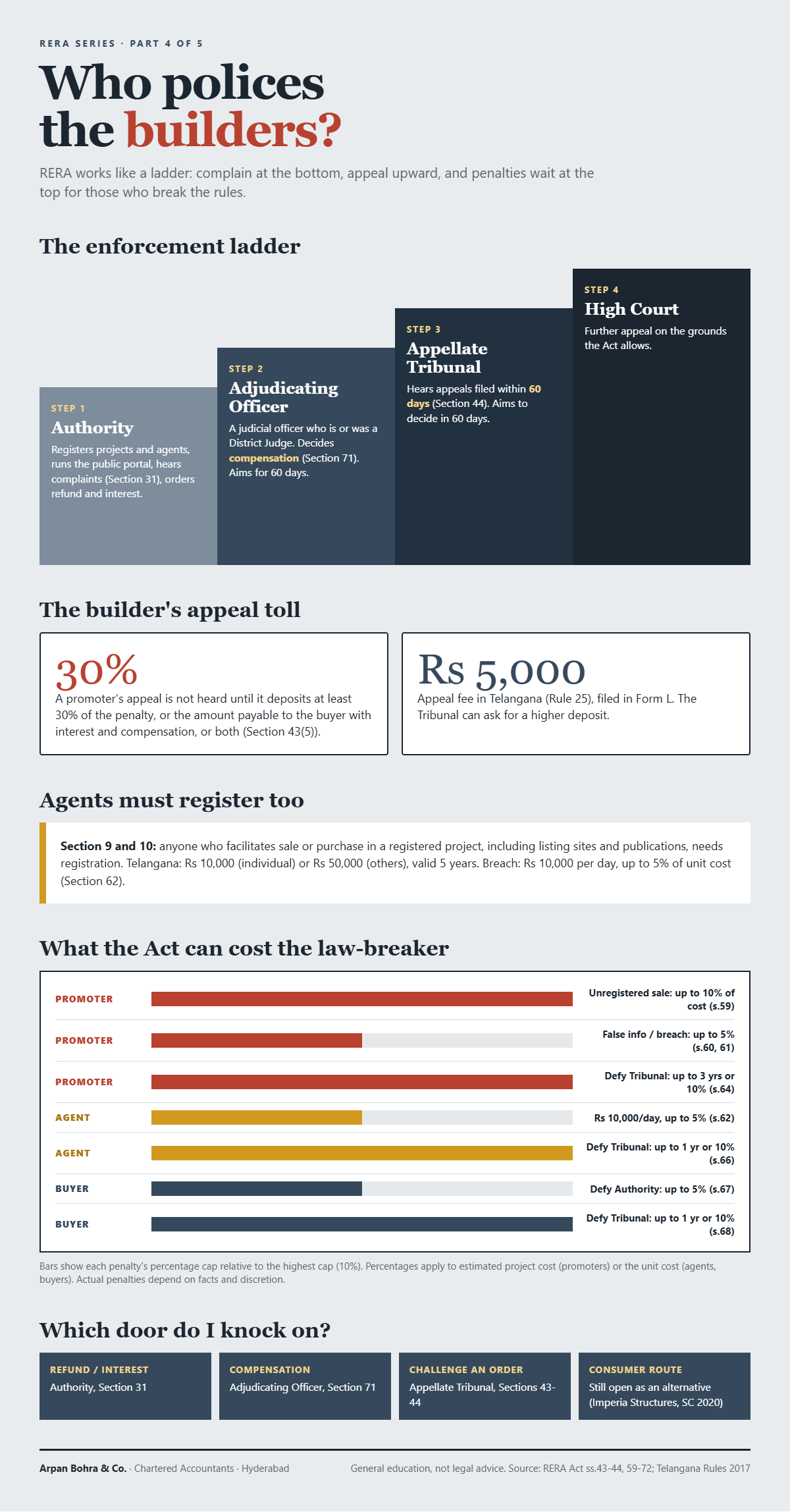
The RERA enforcement ladder
| Level | Who | What they do | Key section |
|---|---|---|---|
| 1 | Real Estate Regulatory Authority (Telangana: TG-RERA) | Registers projects and agents, maintains the public portal, hears complaints, orders refunds and interest, imposes penalties | 20 onwards, 31 |
| 2 | Adjudicating Officer | A judicial officer who is or was a District Judge; decides compensation claims under Sections 12, 14, 18 and 19; aims to decide within 60 days | 71, 72 |
| 3 | Real Estate Appellate Tribunal (REAT) | Hears appeals from the Authority and the Adjudicating Officer; appeals within 60 days; aims to decide within 60 days | 43, 44 |
| 4 | High Court | Further appeal against Tribunal orders on the grounds the Act allows | See the Act’s appeal provision |
What the RERA Authority actually does
- Registers real estate projects and real estate agents.
- Publishes registered projects, promoters and agents on its website.
- Hears complaints under Section 31 from any aggrieved person, including allottees, promoters and agents.
- Issues directions and imposes penalties.
- Can revoke a project’s registration in specified cases, after which the Act allows the Authority to arrange completion, including through the association of allottees.
The appeal toll: why builders cannot stall
An appeal must be filed within sixty days of receiving the order, though the Tribunal can accept a late appeal for sufficient cause. For a promoter there is a catch (Section 43(5)): the appeal is not heard until it deposits at least 30% of the penalty, or the full amount payable to the allottee with interest and compensation, or both. The Tribunal may demand more. In Telangana the appeal fee is Rs 5,000 (Rule 25).
Real estate agents under RERA (Sections 9 and 10)
An agent who facilitates sale or purchase in a registered project must register. That includes listing websites, publications and exhibitions. Telangana’s Rules provide a fee of Rs 10,000 for an individual and Rs 50,000 for other applicants, validity of five years, and renewal fees of Rs 5,000 or Rs 25,000.
Agents must not facilitate sales in unregistered projects, must keep proper records and must avoid unfair practices. A breach of Sections 9 or 10 costs Rs 10,000 per day of default, up to 5% of the cost of the units involved (Section 62).
RERA penalties at a glance
| Who | Breach | Penalty | Section |
|---|---|---|---|
| Promoter | Selling or advertising without registration | Up to 10% of estimated project cost | 59(1) |
| Promoter | Continuing the violation or ignoring orders | Up to 3 years’ imprisonment, a further fine up to 10%, or both | 59(2) |
| Promoter | False information or breach of Section 4 | Up to 5% of estimated cost | 60 |
| Promoter | Other contraventions | Up to 5% of estimated cost | 61 |
| Promoter | Ignoring the Authority’s order | Daily penalty, up to 5% of estimated cost in total | 63 |
| Promoter | Ignoring the Tribunal’s order | Up to 3 years, or daily fine up to 10%, or both | 64 |
| Agent | Breach of Sections 9 or 10 | Rs 10,000 a day, up to 5% of unit cost | 62 |
| Agent | Ignoring the Authority’s order | Daily penalty, up to 5% of unit cost | 65 |
| Agent | Ignoring the Tribunal’s order | Up to 1 year, or daily fine up to 10%, or both | 66 |
| Buyer | Ignoring the Authority’s order | Penalty up to 5% of unit cost | 67 |
| Buyer | Ignoring the Tribunal’s order | Up to 1 year, or daily fine up to 10%, or both | 68 |
When a company commits an offence, those in charge of its business can be personally liable unless they prove they lacked knowledge or exercised due diligence (Section 69). Certain offences can be compounded (Section 70), and courts take cognizance only on a written complaint from the Authority or an authorised officer (Section 80).
RERA, civil courts and consumer forums
Section 79 bars civil courts from hearing matters the RERA bodies can decide, and Section 88 says the Act adds to other laws. In Imperia Structures Ltd. v. Anil Patni (2020), the Supreme Court held that a consumer forum is not a civil court, so a buyer can still approach it. A buyer already before a consumer forum may withdraw and move to RERA under the proviso to Section 71(1).
Which door should you knock on?
| Need | Forum to consider |
|---|---|
| Refund with interest, or interest for delay | Authority (Section 31) |
| Compensation for loss | Adjudicating Officer (Section 71) |
| Challenge an order | Appellate Tribunal (Sections 43 and 44) |
| Prefer a consumer route | Consumer Commission (alternative remedy) |
For Hyderabad projects, all of this runs through TG-RERA and the Telangana Rules, 2017.
Next: Part 5 is the Telangana playbook for checking a Hyderabad project line by line.
RERA Authority and Tribunal: FAQs
Who decides compensation? The Adjudicating Officer, a judicial officer who is or was a District Judge (Section 71).
How long do I have to appeal? Sixty days from receiving the order, extendable by the Tribunal for sufficient cause (Section 44).
Must a builder deposit money to appeal? Yes: at least 30% of the penalty, or the amount payable to the allottee, or both (Section 43(5)).
Does an agent need to register? Yes, to facilitate sale or purchase in a registered project (Section 9). Telangana prescribes five-year validity.
Can I still go to a consumer forum? Imperia Structures (2020) says RERA does not bar consumer complaints.
Can directors be personally liable? Section 69 can make persons in charge of a company liable, unless they prove lack of knowledge or due diligence.
Sources
- RE(R&D) Act, 2016 text (TG-RERA)
- Telangana RE(R&D) Rules, 2017
- TG-RERA FAQ
- Imperia Structures v. Anil Patni, LiveLaw report
General education, not legal advice.
Arpan Bohra & Co., Chartered Accountants · Website: arpanbohra.co.in · Email: ab@arpanbohra.co.in