
By CA Arpan Bohra (FCA, CS), Arpan Bohra & Co., Chartered Accountants, Hyderabad. Position of law as at 20 October 2026.
Three founders in Hyderabad incorporate a technology company with equal shares and a handshake. Two years later an investor offers to buy out one founder, another founder wants to leave, and nobody can say who has the right to buy the exiting shares, at what price, or whether the third founder can be forced to sell along with the rest. A shareholders’ agreement (SHA) answers these questions in advance. It is the document that governs the relationship between owners, the way the articles govern the company.
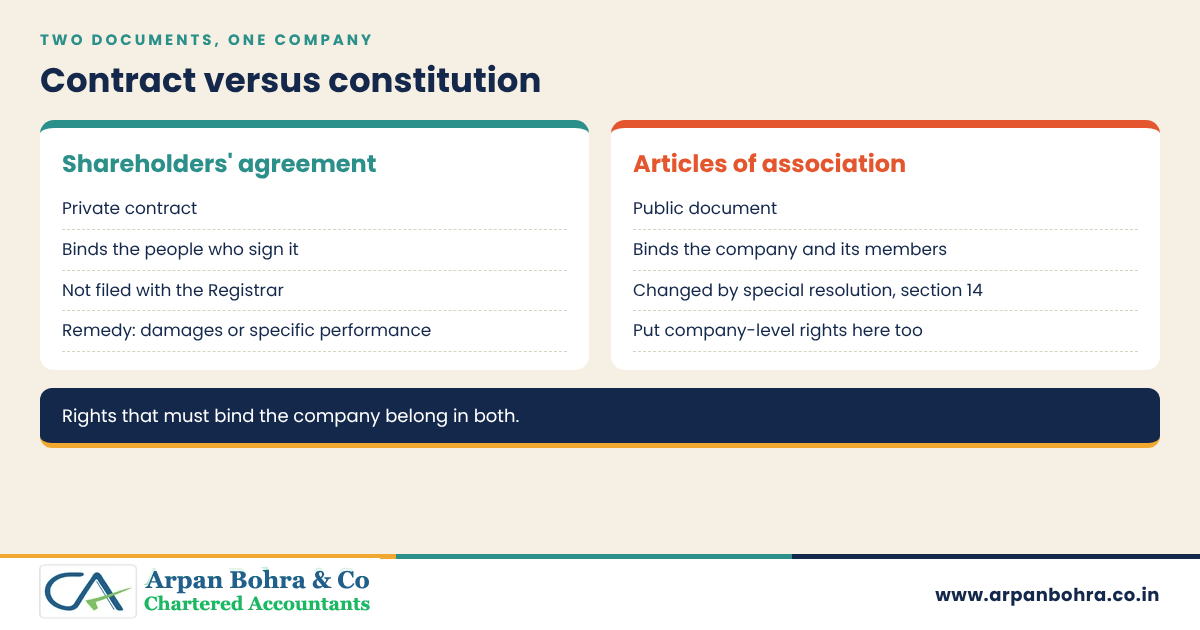
A shareholders’ agreement is a private contract among shareholders (and usually the company) that sets governance rights, transfer rules, exit mechanics and protections that the Companies Act, 2013 does not fix for you. It binds only its signatories under the Indian Contract Act, 1872. Rights meant to bind the company itself, such as transfer restrictions and board nomination, should also be written into the articles of association by special resolution under section 14, because courts have declined to enforce SHA-only restrictions against the company (V.B. Rangaraj v. V.B. Gopalakrishnan, 1992). Section 58(2) of the Companies Act provides that a contract or arrangement between two or more persons about the transfer of securities is enforceable as a contract (verify the current text).
Why a shareholders’ agreement
- Predictable exits. Who can sell, to whom, at what price and on what notice.
- Protected minorities. Veto rights over matters that change the investment, and information rights.
- Managed control. Board seats, quorum and reserved matters, so that day-to-day management is not stalled by every decision.
- Deadlock plans. A route to break a 50:50 stalemate without a winding-up petition.
- Founder retention. Vesting, leaver terms and non-solicitation that survive a falling-out.
SHA versus articles of association
| Point | Shareholders’ agreement | Articles of association |
|---|---|---|
| Nature | Private contract (Indian Contract Act, 1872) | Constitutional document; binds the company and its members under section 36 |
| Parties bound | Signatories only | Company and all members |
| Public record | No | Yes, filed with the Registrar |
| How to change | By agreement of the parties | Special resolution under section 14, with filing |
| Remedy | Damages or specific performance against parties | Enforcement against the company and members, subject to the Act |
| Weak spot | Cannot compel the company to act against its articles | Inflexible and visible to the public |
The clauses that matter
| Clause | What it does | Drafting point |
|---|---|---|
| Board and reserved matters | Allocates board seats and lists decisions needing investor or supermajority consent | Define the list tightly; an over-long list freezes management |
| Right of first refusal (ROFR) and tag-along | Existing holders can buy first; minority can sell on the same terms | Fix notice, price-matching and time periods |
| Drag-along | Majority can compel others to join a sale | State the threshold and the minimum price protection |
| Lock-in and transfer restrictions | Prevents exit or transfers for a period | Mirror in the articles for a private company |
| Pre-emption and anti-dilution | Protects percentage and price on new issues | Check the pricing rules under the Companies Act and FEMA for non-resident holders |
| Put and call options | Exit rights at pre-agreed terms | Foreign investment options are regulated; confirm the current FEMA position and that no assured return is promised |
| Deadlock | Escalation, mediation, shotgun or buy-sell mechanism | Avoid clauses that leave no exit |
| Non-compete and non-solicit | Protects the business | Post-term non-competes face section 27 of the Contract Act; limit the scope |
| Dispute resolution | Arbitration seat, language and rules | State the seat and the arbitrator appointment mechanism |
| Stamp duty and execution | Formalities | Stamp as per State law; see our note on deeds as legal insurance |
The start-up system: founders, ESOPs and investors
| Stage | Document | What it fixes |
|---|---|---|
| Incorporation | Founders’ agreement and articles | Roles, equity split, IP assignment to the company |
| Early hires | ESOP scheme (section 62(1)(b) and the Companies (Share Capital and Debentures) Rules, 2014) | Pool size, vesting, exercise and leaver treatment |
| Seed or angel round | SHA with term sheet terms | Board seat, information rights, anti-dilution |
| Later rounds | Amended and restated SHA with new articles | Liquidation preference, protective provisions, exit timelines |
| Exit or IPO | Termination or conversion of rights | Listed companies must align special rights with the SEBI framework (verify) |
- Founder vesting. A typical structure vests shares over several years with a cliff, so a departing founder keeps only what has vested. The terms are commercial, not statutory.
- Good leaver and bad leaver. Define each by facts, such as resignation, termination for cause or misconduct, and set the price to match.
- IP and confidentiality. Make founders assign IP to the company so that it is not held personally.
Enforceability and litigation view
| Question | Position | Risk |
|---|---|---|
| SHA terms not in the articles, enforced against the company | Courts have declined to bind the company to restrictions absent from the articles (V.B. Rangaraj); the Delhi High Court in World Phone India v. WPI Group treated a board nomination right as binding between the parties but not on the company unless in the articles. Treat as the prudent view | Moderate to high if not aligned |
| SHA terms enforced between signatories | Generally enforceable as a contract; the Bombay High Court has upheld put options between parties in IL&FS Investment Managers v. Enentus Pte Ltd. (verify the year and citation) | Low to moderate |
| Transfer of shares under section 58(2) | A contract on the transfer of securities is enforceable as a contract between the parties; it does not by itself bind the company | Moderate |
| Specific performance | Available under section 10 of the Specific Relief Act, 1963 as amended in 2018, subject to its conditions | Moderate |
| Foreign investors and options | Subject to FEMA conditions on pricing and exit | Litigative; verify current rules |
Worked example
A company has Founder A at 50%, Founder B at 30% and an investor at 20%. The SHA contains a ROFR, a tag-along and a drag-along at 75%.
- ROFR. A proposes to sell 10% to an outsider. A must first offer it to B and the investor on the same terms. If neither accepts within the notice period, A may sell to the outsider at no lower price within the stated window.
- Tag-along. If A sells a controlling stake, B and the investor can require the buyer to purchase their shares on the same terms.
- Drag-along. A (50%) and the investor (20%) together hold 70%, below the 75% threshold, so they cannot force B to sell. Had the threshold been 70%, they could. The number in the clause decides who controls an exit.
- Articles. If the ROFR is also in the articles, an attempted sale in breach can be refused registration by the board; if it is only in the SHA, the remedy is against A as a contracting party.
The percentages are illustrative only.
Checklist
- Agree the commercial terms in a term sheet: equity, board, reserved matters and exit.
- List every right that must bind the company and add it to the articles by special resolution, with filings.
- Check the compliance of each clause with the Companies Act, FEMA and, for listed companies, SEBI rules.
- Fix timelines, price formulas and notice mechanics so that clauses can operate without further negotiation.
- Choose the arbitration seat and the governing law.
- Stamp and execute properly, keep original signed copies and update the registers.
- Review the SHA at every funding round and on the entry of a new shareholder.
Frequently asked questions
Is a shareholders’ agreement mandatory?
Is a shareholders’ agreement enforceable in India?
Should the SHA terms be in the articles of association?
What is a drag-along right?
What is the difference between tag-along and ROFR?
Do start-ups need a founders’ agreement as well?
Arpan Bohra & Co., Chartered Accountants, Himayat Nagar, Hyderabad.
This article is shared for general professional education. Readers may write to the firm for information about its practice areas.
General educational information as at 20 October 2026. It is not legal or tax advice and does not create a professional relationship. Provisions, rates and thresholds change; verify the current law and notifications before acting. References to the 57th GST Council (8 October 2026) are to recommendations that need amendments or notifications before they have legal effect.