
By CA Arpan Bohra (FCA, CS), Arpan Bohra & Co., Chartered Accountants, Hyderabad. Position of law as at 20 October 2026.
A Hyderabad start-up has grown from 12 to 22 employees. The payroll manager asks three questions in one week: does PF now apply, how much does the new wage ceiling add to the monthly outgo, and does the company need a grievance committee? Since 21 November 2025 these answers sit in four Labour Codes, not in the older Acts, and several limits have moved in 2026. This guide collects the wage ceilings and headcount thresholds employers most often need, with the status of each figure marked where it depends on rules still being finalised.
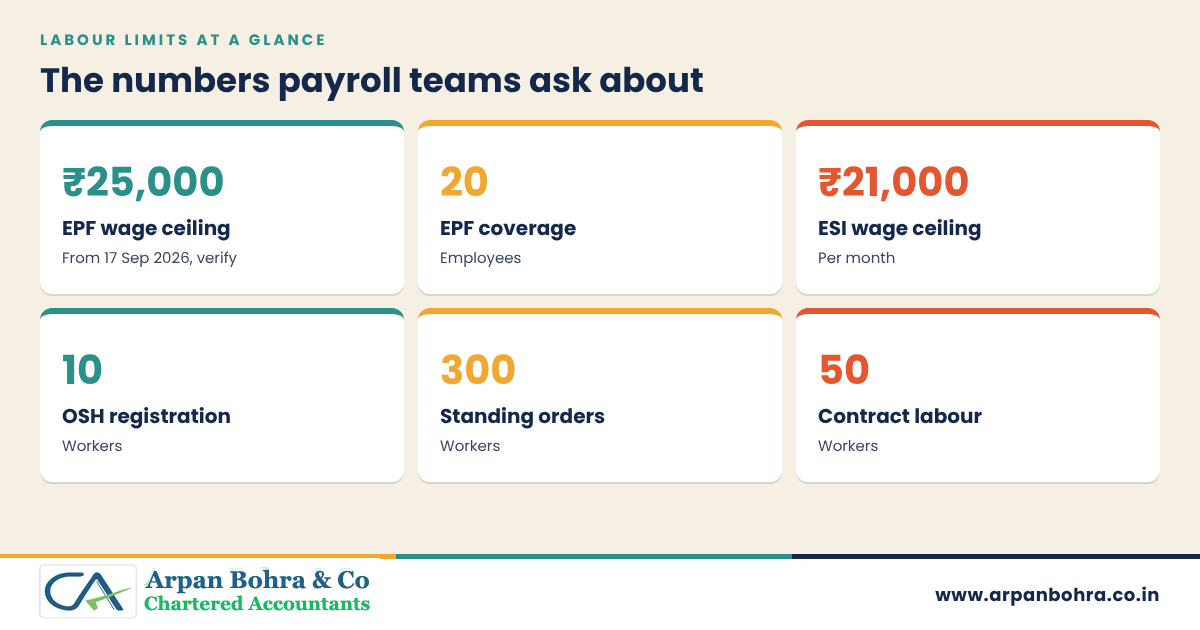
The four Labour Codes, namely the Code on Wages, 2019, the Industrial Relations Code, 2020, the Code on Social Security, 2020 and the Occupational Safety, Health and Working Conditions Code, 2020, were made effective from 21 November 2025 and subsume 29 central laws. The EPF wage ceiling has been reported as raised to ₹25,000 a month from 17 September 2026 (S.O. 5109(E)); the ESI ceiling of ₹21,000 is reported as unchanged, but the ESI chapter of the Code is not yet fully operational and the old ESI Act’s framework is preserved until 20 November 2026. Headcount triggers include 20 employees for EPF, 10 for establishment registration under the OSH Code, 300 for standing orders, and 50 for contract labour. Verify each figure against the notification before applying it.
The four Codes at a glance
| Code | Replaces (examples) | Employer touchpoints |
|---|---|---|
| Code on Wages, 2019 | Payment of Wages Act, Minimum Wages Act, Payment of Bonus Act, Equal Remuneration Act | Minimum wages, wage definition, bonus, overtime, deductions |
| Industrial Relations Code, 2020 | Industrial Disputes Act, Trade Unions Act, Industrial Employment (Standing Orders) Act | Standing orders, retrenchment and closure, grievance committee, strikes |
| Code on Social Security, 2020 | EPF Act, ESI Act, Payment of Gratuity Act, Maternity Benefit Act | PF, ESI, gratuity, maternity benefit, gig and platform workers |
| OSH Code, 2020 | Factories Act, Contract Labour Act, Shops and Establishments-type central laws | Registration, licences, safety, working hours, contract labour |
Provident fund
| Item | Position | Status |
|---|---|---|
| Coverage | Establishments with 20 or more employees; voluntary coverage for smaller establishments | Verify against the Code and the notified rules |
| Wage ceiling | ₹25,000 a month from 17 September 2026 (reported S.O. 5109(E)); ₹15,000 from 29 May 2026 (S.O. 2702(E)) before that | Reported from secondary sources; confirm in the Gazette |
| Contribution rate | 12% employee and 12% employer on PF wages | Statutory rate; the employer split between PF and pension continues as per the scheme (verify) |
| Wage definition | Allowances beyond 50% of total remuneration are added back to wages under section 2(88) | Applies from 21 November 2025; restructuring salary to reduce PF wages is limited |
| Mid-month change | A ceiling change effective 17 September falls in the middle of a wage month | Unsettled; await an EPFO circular on September 2026 contributions |
ESI
- The ESI Act, 1948 stands repealed by the Code on Social Security with effect from 21 November 2025, but its rules, regulations and schemes are preserved for one year, until 20 November 2026, under section 164(2)(b) (as reported; verify the notifications).
- The wage ceiling for coverage is ₹21,000 a month (₹25,000 for persons with disabilities), reported as continuing under Ministry FAQs dated 16 March 2026, which are not binding.
- Chapter IV of the Code, which will govern ESI contributions and benefits, is not yet fully operational, so the date from which contributions under the new chapter apply is awaited.
- The employer contribution rate cited under the central rules is 3.25% of wages (verify) and the employee rate is notified separately.
- The classic coverage trigger of 10 or more employees continues for the existing framework; confirm for your State and sector.
Gratuity, bonus and wages
| Item | Position (verify before applying) |
|---|---|
| Gratuity, regular employees | Five years of continuous service; 15 days’ wages for each completed year; ceiling notified by the Government (earlier ₹20 lakh) |
| Gratuity, fixed-term employees | Eligible after one year of service, pro rata |
| Bonus | Minimum 8.33% of wages under the Code on Wages. The eligibility ceiling is reported as ₹21,000 a month but sources differ; check the notified figure |
| Overtime | At least twice the normal rate of wages |
| Deductions | Capped at 50% of wages |
| Appointment letters | Mandatory for all employees |
| Women in night shifts | Permitted with consent and safety measures |
| Maternity benefit | 26 weeks of paid leave under the Code; crèche mandatory for establishments with 50 or more employees |
Headcount thresholds
| Trigger | Threshold | Source and note |
|---|---|---|
| EPF coverage | 20 employees | Code on Social Security |
| ESI coverage | 10 employees under the existing ESI framework | Preserved until 20 November 2026; verify |
| Establishment registration | 10 or more workers | OSH Code |
| Factory | 20 workers with power; 40 workers without power | OSH Code |
| Contract labour provisions | 50 contract workers | OSH Code |
| Safety committee | 500 workers | OSH Code (verify) |
| Grievance redressal committee | 20 or more workers | Industrial Relations Code |
| Works committee | 100 or more workers | Industrial Relations Code |
| Standing orders | 300 or more workers | Industrial Relations Code (verify State rules) |
| Layoff, retrenchment and closure permission | 300 or more workers for the permission chapter | Industrial Relations Code (verify State variations) |
| Trade union registration | 7 members | Industrial Relations Code |
Worked example
A Hyderabad company has 22 employees. One employee earns PF wages of ₹40,000 a month.
- Coverage: 22 employees, above the 20-employee trigger, so EPF applies (verify).
- Contribution on the ₹25,000 ceiling: 12% × ₹25,000 = ₹3,000 for the employee and ₹3,000 for the employer, compared with ₹1,800 each at a ₹15,000 ceiling. Contribution on the higher actual wage of ₹40,000 is a voluntary arrangement under the earlier framework; confirm the current position.
- ESI: the employee earns above ₹21,000, so is not covered for ESI. A colleague at ₹18,000 gross would be covered if the establishment is covered.
- Gratuity: a fixed-term employee with one year of service and a last drawn wage of ₹30,000 would be entitled to 15 ÷ 26 × ₹30,000 × 1 = ₹17,308 (rounded), where the wage definition applies as notified.
These figures are illustrations to show the arithmetic. Actual liabilities depend on the notified wage definition and the rules in force.
Compliance risk and practical position
| Issue | Primary position | Risk |
|---|---|---|
| PF at the revised ceiling for September 2026 | Apply from the notified date or the most cautious reading until EPFO clarifies; document the basis | Moderate |
| Salary restructuring to lower PF wages | The 50% add-back rule limits it | High if aggressive |
| ESI under the Code versus the old Act | Continue the existing framework until the notified date for Chapter IV; watch 20 November 2026 | Moderate, evolving |
| Standing orders and grievance committee | Adopt at the threshold, and keep records of headcount over the preceding 12 months | Low to moderate |
| Contract labour and principal employer liability | Collect statutory compliance proofs from contractors | Moderate |
Frequently asked questions
Which Labour Codes are in force?
What is the EPF wage ceiling now?
At how many employees does PF become applicable?
What is the ESI wage limit?
When is gratuity payable to fixed-term employees?
Do I need standing orders if I have fewer than 300 workers?
Arpan Bohra & Co., Chartered Accountants, Himayat Nagar, Hyderabad.
This article is shared for general professional education. Readers may write to the firm for information about its practice areas.
General educational information as at 20 October 2026. It is not legal or tax advice and does not create a professional relationship. Provisions, rates and thresholds change; verify the current law and notifications before acting. References to the 57th GST Council (8 October 2026) are to recommendations that need amendments or notifications before they have legal effect.