
By CA Arpan Bohra (FCA, CS), Arpan Bohra & Co., Chartered Accountants, Hyderabad. Position of law as at 20 October 2026.
Missing a ROC date costs ₹100 a day, with no cap.
A private company has had no business for two years and its owners assume that no filings are required. Three years later the directors discover that their DINs are deactivated and that they are disqualified from being directors of any company. Annual filings with the Registrar of Companies (ROC) continue whether or not the company trades.
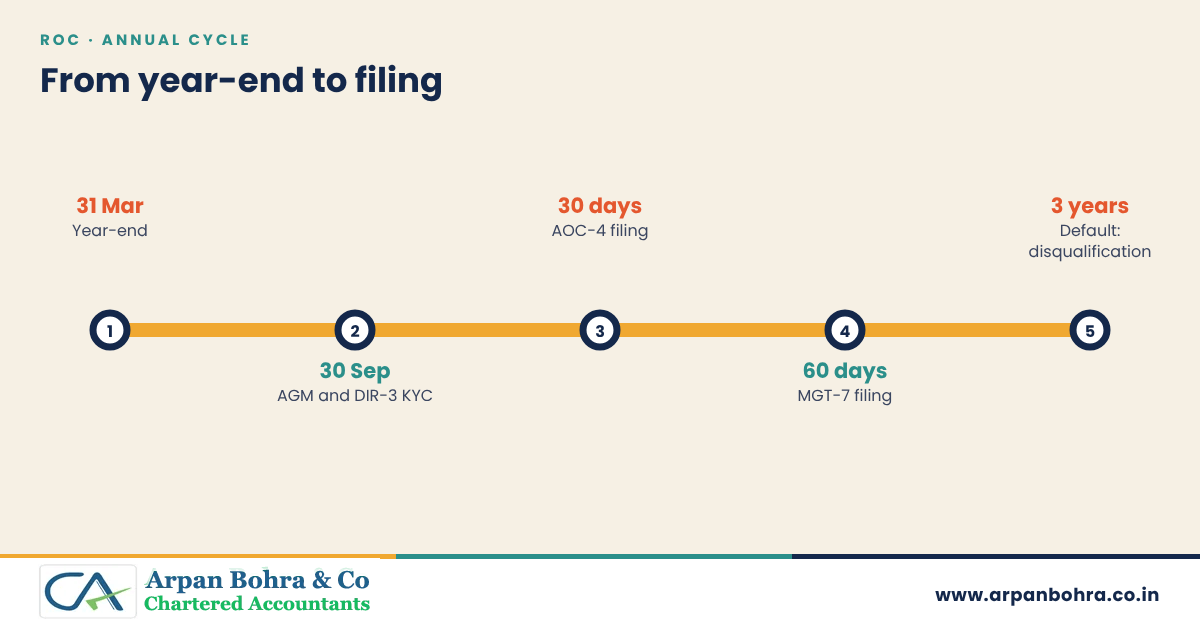
A company must hold its AGM within six months of the financial year-end (30 September for FY 2025-26), file financial statements in Form AOC-4 within 30 days of the AGM and the annual return in Form MGT-7 (MGT-7A for small companies and OPCs) within 60 days of the AGM. Late filing attracts an additional fee of ₹100 per day with no upper limit, and continued default for three years can lead to disqualification of directors under section 164(2) for five years. LLPs file Form 11 by 30 May and Form 8 by 30 October, with a fee of ₹100 per day. Verify the current dates and any extension for the year.
Annual calendar for a private company
| Form | What | Due date |
|---|---|---|
| AGM | Annual general meeting (section 96) | Within six months of the financial year-end, that is 30 September |
| AOC-4 | Financial statements | 30 days from the AGM |
| MGT-7 / MGT-7A | Annual return | 60 days from the AGM |
| ADT-1 | Appointment of auditor | 15 days from the AGM |
| DPT-3 | Return of deposits and outstanding loans | 30 June |
| MSME-1 | Half-yearly return of outstanding MSME dues | 31 October (April to September) and 30 April (October to March) |
| DIR-3 KYC | Director KYC | 30 September |
| Board meetings | At least four a year, not more than 120 days apart (section 173) | Throughout the year |
Verify the current dates and any change in the form numbers.
Penalties
| Default | Provision | Consequence |
|---|---|---|
| Late AOC-4 and MGT-7 | Additional fees and sections 137(3) and 92(5) | ₹100 a day additional fee; penalty on company and officers in default under the sections (verify the amounts) |
| Late DIR-3 KYC | Rule 12A of the Companies (Appointment and Qualification of Directors) Rules | ₹5,000 late fee and DIN deactivation |
| No financial statements or annual returns for three consecutive years | Section 164(2) | Directors disqualified for five years, and DIN deactivated |
| Not holding an AGM | Section 99 | Fine on the company and officers |
| LLP: Form 11 and Form 8 late | LLP Act, 2008 and rules | ₹100 a day with no cap |
If you are already in default
- File all pending returns with the additional fee; the fee is not capped for companies and LLPs unless a scheme is announced.
- Check the status of DINs and director disqualification on the MCA portal.
- If the company is dormant and has no assets, consider an application for dormant status or striking off under section 248 (verify the conditions).
- If directors are disqualified under section 164(2), the remedy is limited; courts have granted relief in some cases, but the litigation is long. Prevention is cheaper.
Worked example
A company holds its AGM on 30 September 2026 for FY 2025-26.
- AOC-4 is due 30 October 2026. MGT-7 is due 29 November 2026.
- If AOC-4 is filed on 30 January 2027, the delay is 92 days. The additional fee is ₹100 × 92 = ₹9,200 (at ₹100 a day).
- Penalty proceedings under sections 137 and 92 may follow separately and can be far larger than the additional fee.
Compliance steps
- Prepare the balance sheet and sign the directors’ report by the board meeting.
- Appoint or reappoint the auditor and file ADT-1.
- Hold the AGM by 30 September, or obtain an extension if the law allows.
- File AOC-4 and MGT-7 within the due dates.
- Complete DIR-3 KYC for all directors by 30 September.
- File MSME-1 and DPT-3 and keep statutory registers.
Frequently asked questions
When must a private company hold its AGM?
What is the late fee for AOC-4?
Do dormant companies have to file returns?
What happens if I do not file for three years?
Is DIR-3 KYC required every year?
Does an OPC need an AGM?
Arpan Bohra & Co., Chartered Accountants, Himayat Nagar, Hyderabad.
This article is shared for general professional education. Readers may write to the firm for information about its practice areas.
General educational information as at 20 October 2026. It is not legal or tax advice and does not create a professional relationship. Provisions, rates and thresholds change; verify the current law and notifications before acting. References to the 57th GST Council (8 October 2026) are to recommendations that need amendments or notifications before they have legal effect.