

By CA Arpan Bohra (FCA, CS), Arpan Bohra & Co., Chartered Accountants, Hyderabad. Position of law as at 20 October 2026.
The structure you choose on day one decides your tax, your funding and your exit.
Two founders in Hyderabad have a software idea and a first customer. One wants a limited liability partnership because compliance looks lighter; the other wants a private limited company because investors will ask for it. Both are right about something. The choice depends on funding plans, tax and the number of founders.
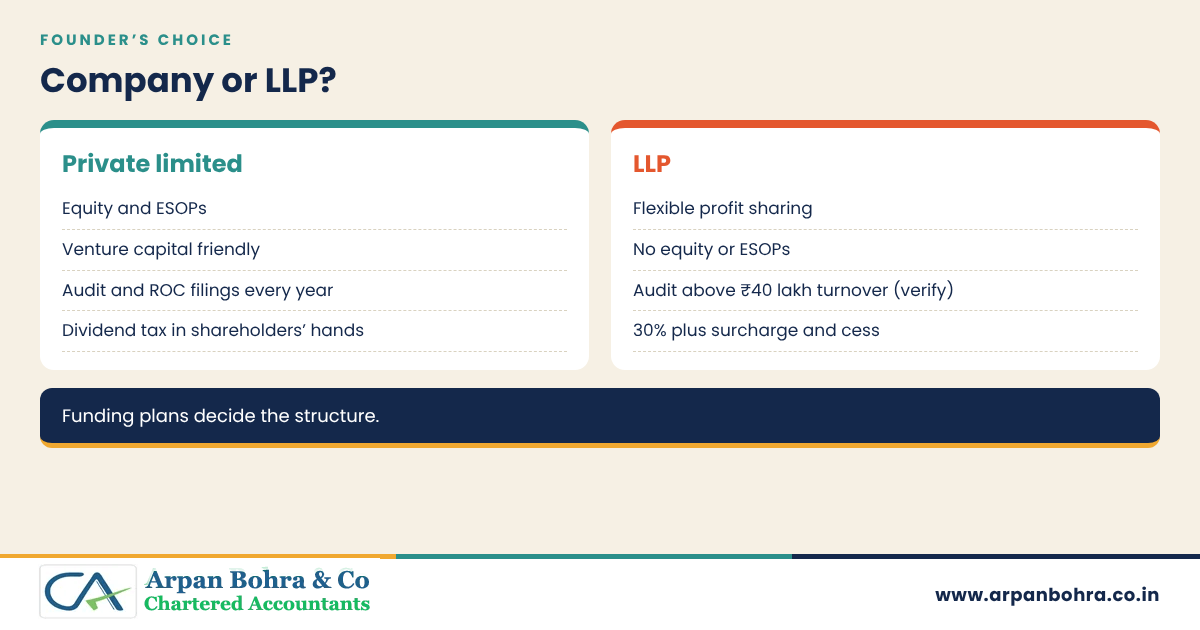
A private limited company suits ventures that will take outside equity, issue ESOPs or scale; it needs at least two directors and two members, annual audit and ROC filings. An LLP suits professional and closely held businesses that want flexible profit sharing and lower compliance; it cannot issue equity or ESOPs. A One Person Company (OPC) suits a single founder, who can later convert to a private company. A partnership and a proprietorship are simple but have unlimited liability. Thresholds and tax rates below should be verified for the current year.
Comparison
| Point | Private limited | LLP | OPC | Partnership |
|---|---|---|---|---|
| Members | Minimum 2, maximum 200 | Minimum 2 partners | One member plus a nominee | Minimum 2 |
| Liability | Limited to shares | Limited to contribution | Limited to shares | Unlimited |
| Funding | Equity, ESOP, venture capital | Contribution only, no equity | Limited | Capital of partners |
| Audit | Mandatory | Only if turnover exceeds ₹40 lakh or contribution exceeds ₹25 lakh (verify) | Mandatory | Only as per tax law |
| Income tax | Domestic company rate, concessional regime available (verify) | 30% plus surcharge and cess | As for companies | 30% plus surcharge |
| Compliance | AOC-4, MGT-7, board meetings, ADT-1, DIR-3 KYC | Form 8 and Form 11, ITR | AOC-4, MGT-7A | ITR and books |
| Exit and transfer | Share transfer | Transfer of partnership interest by agreement | Nominee succession | Dissolution or admission by deed |
Rules that matter
- A private company needs at least one director who has stayed in India for 182 days or more in the previous year (section 149(3), Companies Act, 2013).
- A small company, for relaxed compliance, has paid-up capital up to ₹10 crore and turnover up to ₹100 crore (verify the current limits).
- A start-up recognised by the DPIIT can access certain benefits, but recognition needs an eligible structure (company, LLP or partnership), and the definition and period have been revised (verify).
- LLPs cannot raise equity from investors, and conversion from LLP to company is possible but triggers tax and legal steps.
- OPCs have rules for nominee and conversion; verify the current conversion rules.
Worked example
A founder expects ₹30 lakh of profit in the first year.
- Private limited (concessional regime): tax at the domestic company rate on ₹30 lakh, plus surcharge and cess; further tax arises when profits are distributed as dividend in the shareholders’ hands.
- LLP: tax at 30% plus surcharge and cess on ₹30 lakh, with no further tax when profit is shared among partners.
- The cost difference needs to be computed with remuneration to partners and directors; the funding plan often decides.
The numbers are illustrative; compute with the current rates before deciding.
How to decide
- List funding plans: bootstrap, angel or venture capital.
- Count founders and decide on ESOPs.
- Estimate turnover and the audit and ROC cost.
- Compare effective tax rates including dividend or distribution tax.
- Check licensing requirements and customer expectations.
- Document the founders’ agreement and, once investors arrive, the shareholders’ agreement. See our guide to the shareholders’ agreement.
Frequently asked questions
Which structure is best for investors?
Is an LLP cheaper to run?
Can an OPC take investors?
Can I convert an LLP into a private limited company?
Does a private limited company need an audit if turnover is small?
Are the thresholds up to date?
Arpan Bohra & Co., Chartered Accountants, Himayat Nagar, Hyderabad.
This article is shared for general professional education. Readers may write to the firm for information about its practice areas.
General educational information as at 20 October 2026. It is not legal or tax advice and does not create a professional relationship. Provisions, rates and thresholds change; verify the current law and notifications before acting. References to the 57th GST Council (8 October 2026) are to recommendations that need amendments or notifications before they have legal effect.