

By CA Arpan Bohra (FCA, CS), Arpan Bohra & Co., Chartered Accountants, Hyderabad. Position of law as at 20 October 2026.
Your partnership deed is the only law your firm has.
Two friends start a trading firm on a verbal understanding. Three years later they disagree on profit sharing, one wants to leave and the bank asks for the partnership deed. A written deed decides these questions in advance, and for tax, it decides what the firm can claim.
A partnership is governed by the Indian Partnership Act, 1932 and the terms of its deed; an LLP is governed by the LLP Act, 2008 and its LLP agreement. Registration of a partnership firm is optional, but under section 69 an unregistered firm cannot sue a third party or a partner to enforce a contractual right, with limited exceptions. For tax, interest on capital (up to 12% a year simple) and remuneration to working partners are deductible under section 40(b) only if the deed authorises them and within the prescribed limits. Verify the limits for the relevant year and the corresponding provision of the Income-tax Act, 2025.
Clauses that matter
| Clause | Why it matters |
|---|---|
| Name, business and place | Fixes the scope of authority and the objects |
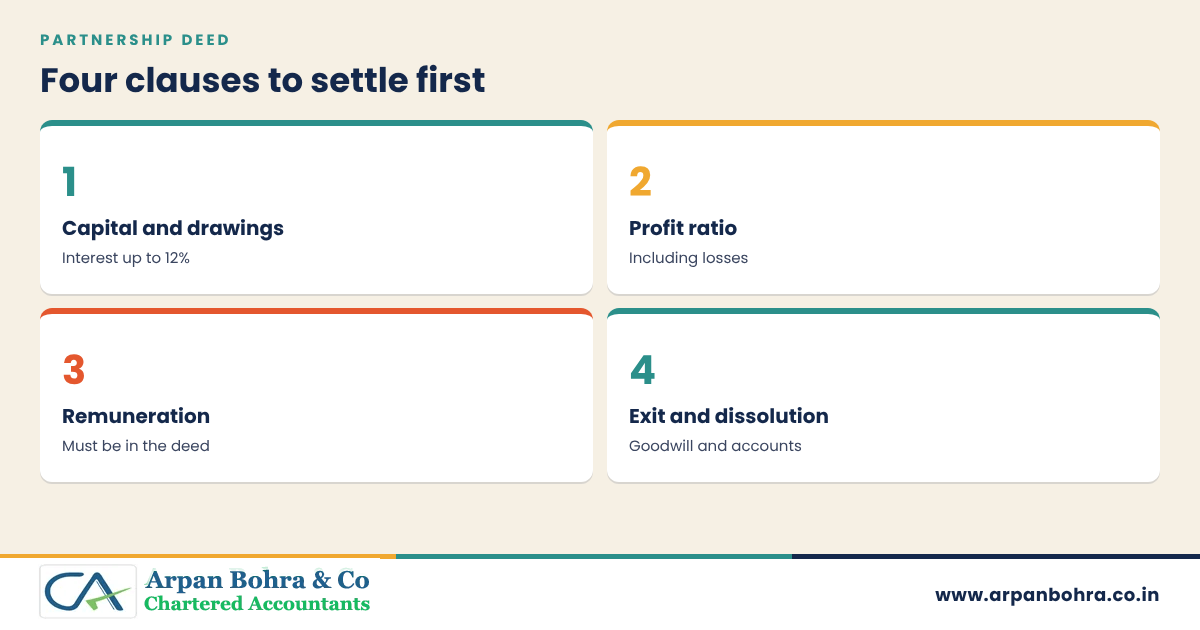
| Capital and drawings | Contribution, interest and withdrawal rules |
| Profit and loss sharing | Ratio, including the treatment of losses |
| Remuneration and interest | Must be in the deed and, for tax, specified for the year and the amount or the method |
| Authority and bank operations | Who can sign and bind the firm |
| Admission, retirement and death | Valuation of goodwill, payout, continuation of the firm |
| Dissolution and accounts | Procedure, settlement and arbitration |
| Non-compete and confidentiality | Restraint during the partnership; post-exit restraints face section 27 of the Contract Act |
Income tax: section 40(b) limits
| Item | Position (verify for the year) |
|---|---|
| Interest on capital | Allowed to the extent it is authorised by the deed and does not exceed 12% a year simple |
| Remuneration to working partners | Allowed within the limit based on book profit: ₹1,50,000 or 90% of book profit on the first ₹3,00,000 (whichever is more), and 60% of the balance, subject to the deed and to the partner being a working partner |
| Prospective effect | The remuneration clause should apply from the date of the deed; retrospective authorisation is not allowed |
| Tax rate | 30% plus surcharge and cess for a firm (verify); share of profit is exempt in the partner’s hands |
Worked example
A firm has book profit of ₹10,00,000 before partner remuneration. The deed authorises remuneration to two working partners.
- On the first ₹3,00,000: higher of ₹1,50,000 or 90% of ₹3,00,000 (₹2,70,000), so ₹2,70,000.
- On the balance ₹7,00,000: 60% = ₹4,20,000.
- Maximum allowable remuneration = ₹6,90,000, if the deed provides for it and the partners work in the firm.
Illustrative; check the current limits and the book profit definition.
LLP agreement points
- The agreement governs the mutual rights of partners; if none, the default rules in the First Schedule of the LLP Act apply.
- File Form 3 within 30 days of incorporation and again within 30 days of any change in the agreement.
- Designated partners (at least two, one resident in India) bear the compliance duties.
- The agreement should deal with contribution, profit share, exit, deadlock and dispute resolution, similar to a partnership deed.
Checklist
- Draft the deed with the business, capital, ratio, remuneration and authority clauses.
- Pay stamp duty at the State rate on the deed.
- Register the firm with the Registrar of Firms where it makes commercial sense, and apply for PAN and GST registration.
- Review remuneration clauses each year for tax compliance.
- Update the deed on admission, retirement or change of terms and file the changes (Form 3 for LLPs).
Frequently asked questions
Is registration of a partnership firm mandatory?
Can the deed be oral?
What is the interest limit under section 40(b)?
Can remuneration be paid to a sleeping partner?
Is stamp duty payable on a partnership deed?
Does the Income-tax Act, 2025 change this?
Arpan Bohra & Co., Chartered Accountants, Himayat Nagar, Hyderabad.
This article is shared for general professional education. Readers may write to the firm for information about its practice areas.
General educational information as at 20 October 2026. It is not legal or tax advice and does not create a professional relationship. Provisions, rates and thresholds change; verify the current law and notifications before acting. References to the 57th GST Council (8 October 2026) are to recommendations that need amendments or notifications before they have legal effect.