
By CA Arpan Bohra (FCA, CS), Arpan Bohra & Co., Chartered Accountants, Hyderabad. Position of law as at 20 October 2026.
A supplier’s cheque for ₹8 lakh comes back with “funds insufficient”. A tenant in Himayat Nagar stops paying rent and will not vacate. A start-up receives a notice from an unpaid vendor threatening court action. In each case the first formal step is a legal notice, and in each case the timing, wording and mode of service decide whether the later case is strong or weak. This guide explains when a notice is legally required, when it is merely sensible, how to draft one and how to reply to one.
A legal notice is a formal written communication that records a claim, gives the other side a defined chance to comply and creates documentary evidence. It is mandatory only where a statute says so: for example, section 138 of the Negotiable Instruments Act, 1881 (dishonoured cheques), section 80 of the Code of Civil Procedure, 1908 (suits against the Government), and section 106 of the Transfer of Property Act, 1882 (terminating certain tenancies). In most other civil disputes it is optional but advisable. A notice does not stop limitation running. A notice is normally drafted and signed by an advocate; this article is general education, not legal advice.
When a notice is mandatory and when it is optional
| Situation | Provision | Notice position |
|---|---|---|
| Dishonoured cheque | Section 138, Negotiable Instruments Act, 1881 | Mandatory. Demand notice within 30 days of receiving information of dishonour; drawer has 15 days from receipt to pay. |
| Suit against the Government or a public officer for an official act | Section 80, Code of Civil Procedure, 1908 | Mandatory two months’ prior notice. Section 80(2) allows a suit for urgent or immediate relief with the leave of the court. |
| Termination of a lease or tenancy | Section 106, Transfer of Property Act, 1882 | Notice to quit required: generally 15 days for a month-to-month tenancy and six months for a year-to-year tenancy, unless the contract or a State rent-control law provides otherwise (verify the State law). |
| Commercial dispute not seeking urgent interim relief | Section 12A, Commercial Courts Act, 2015 | Not a legal notice, but pre-institution mediation is mandatory before the suit. A notice is still the usual first step. |
| Unpaid operational debt of ₹1 crore or more (threshold; verify the current amount) | Section 8, Insolvency and Bankruptcy Code, 2016 | Demand notice to the corporate debtor, which has 10 days to reply or repay. Covered separately in our IBC guide. |
| Ordinary money recovery, breach of contract, defamation, property disputes | General law | Not mandatory. Advisable to fix the date of demand, support interest claims and show that the claimant acted reasonably. |
Cheque bounce: the section 138 clock
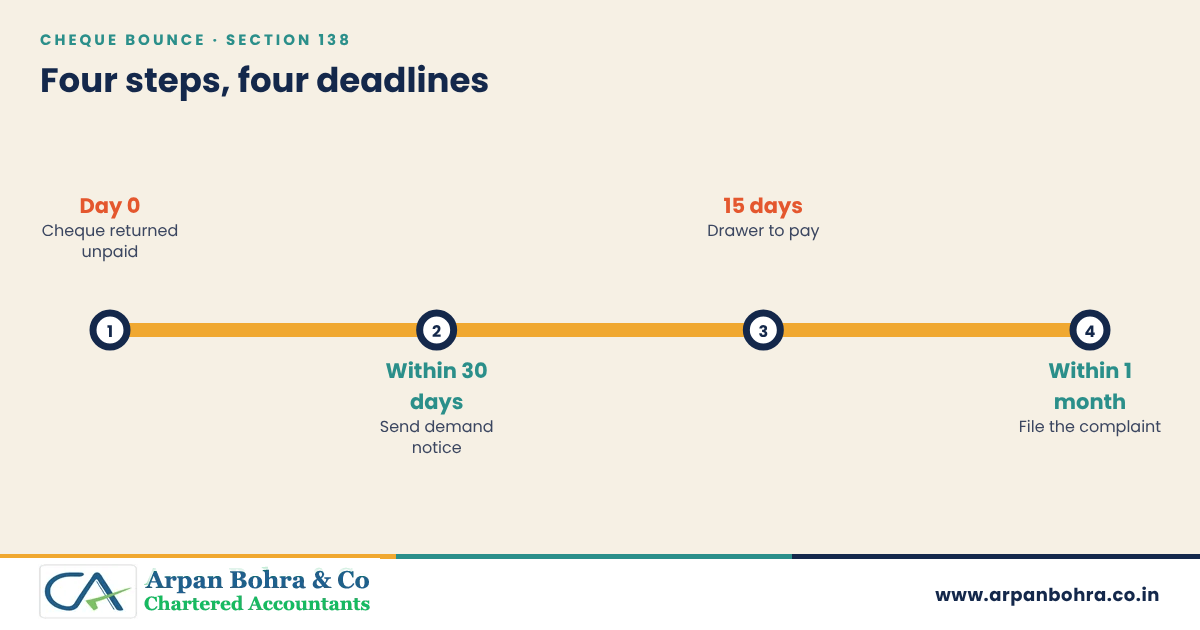
Section 138 operates on strict, sequential timelines, and a default at any step can defeat the complaint. The steps are: the cheque must be presented within its validity (three months from its date, or within its validity period if shorter); the payee must send a written demand within 30 days of receiving information from the bank about the dishonour; the drawer then has 15 days from receipt of the notice to pay; and if the drawer does not pay, the complaint must be filed within one month of the date the cause of action arises under section 142(1)(b). The Delhi High Court in Rama Oberoi v. State (CRL.M.C. 6228/2025, reported September 2025) rejected the argument that the 15 and 30 days form a single “45-day” period, so a complaint filed before the 15 days expire would be premature.
The Supreme Court in C.C. Alavi Haji v. Palapetty Muhammed (2007) held that where a notice is sent by registered post to the correct address, a presumption of service arises, and a drawer cannot defeat the complaint by refusing to collect it. The drawer may rebut the presumption. Interim compensation of up to 20% of the cheque amount may be ordered under section 143A, and an appellant against conviction must ordinarily deposit at least 20% of the fine or compensation under section 148 (verify the current text of both provisions before relying on them).
How to draft a notice
- Parties. Full legal names, addresses and capacity (proprietor, company, partner). A wrong or incomplete address is the commonest cause of a service dispute.
- Facts in sequence. Date of contract, delivery or payment, invoices, cheque details, dishonour memo, previous reminders. Stay with documented facts.
- Cause of action and legal basis. Name the breach and the provision relied on, such as section 138 of the NI Act, in a single clear paragraph.
- Specific demand. The exact amount, the interest claimed with its basis (contract or section 34 CPC and the Interest Act), and a fixed period to comply. Where a statute sets the period, use that period.
- Consequences. State the action you will take on default, such as a complaint or a suit, without threats of anything unlawful.
- Reservation of rights. Reserve the right to claim costs and other remedies, and enclose or list the supporting documents.
- Signature. Signed by the advocate or by the party; keep a clean copy, the postal receipts and the tracking record.
How to serve it
- Registered post with acknowledgement due or speed post to the address in the contract, invoices and statutory records. Keep the receipt and the tracking printout.
- Email to the address used in the transaction as an additional mode, with the notice attached as a signed PDF. Do not rely on email alone where a statute prescribes a mode of service.
- Courier or hand delivery with a signed receipt where a trace is useful.
- Send to every known address of the other side, including the registered office of a company.
How to reply to a notice
- Read the deadline first. Section 138 gives 15 days from receipt. Other notices usually state a period, commonly 7 to 30 days. Reply within it.
- Do not ignore it. Silence can be read against you on the question of whether a demand was disputed.
- Reply point by point. Admit what is correct and deny what is not. Do not make an admission of liability or an acknowledgement of debt unless you intend to, because it can restart limitation.
- Raise preliminary objections. Wrong party, time-barred claim, defective notice, no cause of action, arbitration or jurisdiction clauses, and non-compliance with section 12A where applicable.
- Reserve rights and counter-claims. State any set-off or counter-claim and the documents that support it.
- Preserve evidence. Keep the envelope, tracking record and a dated copy of the reply.
Worked example
A cheque dated 10 January 2026 is presented on 20 February 2026 and returned on 22 February 2026. The payee receives the bank’s return memo on 24 February 2026.
- Presentation within three months of the cheque date: satisfied.
- Last day to send the demand notice: 30 days from 24 February 2026, that is 26 March 2026. The payee sends it on 1 March 2026 and it is served on 3 March 2026.
- Drawer’s payment period: 15 days from receipt, ending 18 March 2026.
- If unpaid, the cause of action arises after that period and the complaint must be filed within one month. Counting from 18 March 2026, the safest last date is 17 April 2026.
The dates are illustrative. Compute each period from the actual trigger date and file well before the last day.
Common mistakes
- Sending the notice after the 30-day window, which can be fatal to a section 138 case.
- Demanding a different amount from the cheque amount in a section 138 notice.
- Using a wrong or outdated address and having no proof of dispatch.
- Treating the notice as a limitation extension.
- Making admissions in the reply that later support the claim.
- Filing a commercial suit without checking section 12A.
Frequently asked questions
Is a legal notice compulsory before filing a case?
Can a Chartered Accountant send a legal notice?
What is the time limit to send a cheque bounce notice?
How long does the other side have to reply to a legal notice?
Does a legal notice stop the limitation period?
Is an email a valid mode of serving a legal notice?
Arpan Bohra & Co., Chartered Accountants, Himayat Nagar, Hyderabad.
This article is shared for general professional education. Readers may write to the firm for information about its practice areas.
General educational information as at 20 October 2026. It is not legal or tax advice and does not create a professional relationship. Provisions, rates and thresholds change; verify the current law and notifications before acting. References to the 57th GST Council (8 October 2026) are to recommendations that need amendments or notifications before they have legal effect.