
Illustrative scenario: A trader in Hyderabad joins a chit of Rs. 1,00,000 with 20 members and a monthly instalment of Rs. 5,000. At the year end his accountant asks three questions. Where do I record the “dividend” credited by the foreman? How do I treat the “commission” deducted when he wins the auction? And what do I show for the money still lying with the foreman?
Direct answer: In the subscriber’s books, the instalments paid are carried in a chit fund account, which is an asset while the subscriber has not received the prize and turns into a liability for future instalments after the prize. The dividend, being the subscriber’s share of the discount, is credited to the profit and loss account. The foreman’s commission, and the discount given up on winning, are costs of the chit. This article summarises the legal vocabulary, then shows each entry with a worked example. We did not find a specific Accounting Standard or ICAI guidance dealing with subscriber-side chit accounting, so the entries below reflect accepted practice and should be applied consistently under your accounting policy.
Legal vocabulary: the Chit Funds Act, 1982 in plain words
| Term and provision | In simple words |
|---|---|
| Chit amount, Section 2(d): the sum-total of subscriptions payable by all subscribers for an instalment | Rs. 5,000 x 20 members = Rs. 1,00,000 |
| Discount, Section 2(g): the amount a prized subscriber gives up under the agreement, set aside for running costs, distribution, or both | The amount the winner foregoes, for example Rs. 20,000 |
| Dividend, Section 2(h): a subscriber’s share in the discount available for rateable distribution | Your share of the discount pool |
| Prized subscriber, Section 2(n): one who has received or is entitled to receive the prize amount | The member who has won the auction or draw |
| Foreman, Section 2(j): the person responsible for conducting the chit | The chit company or organiser |
| Commission, Section 21(1)(b): commission, remuneration or expenses fixed in the agreement, not exceeding five per cent of the chit amount | At most Rs. 5,000 on a Rs. 1,00,000 chit |
| Dividend distribution, Section 22(6): in accordance with the agreement, in cash, grain or as an adjustment against the next instalment | It may be paid to you or simply reduce what you pay next month |
| Duty to account, Section 25(1): the foreman is liable to account to subscribers for the amounts due to them | You are entitled to a statement of your account |
Section 6(3) of the Act caps the discount at thirty per cent of the chit amount in the text consulted; the Act’s footnote refers to an amendment raising this to forty per cent, so check whether it has been notified before relying on either figure. State rules and the State’s Registrar of Chits also apply to each chit.
The worked example
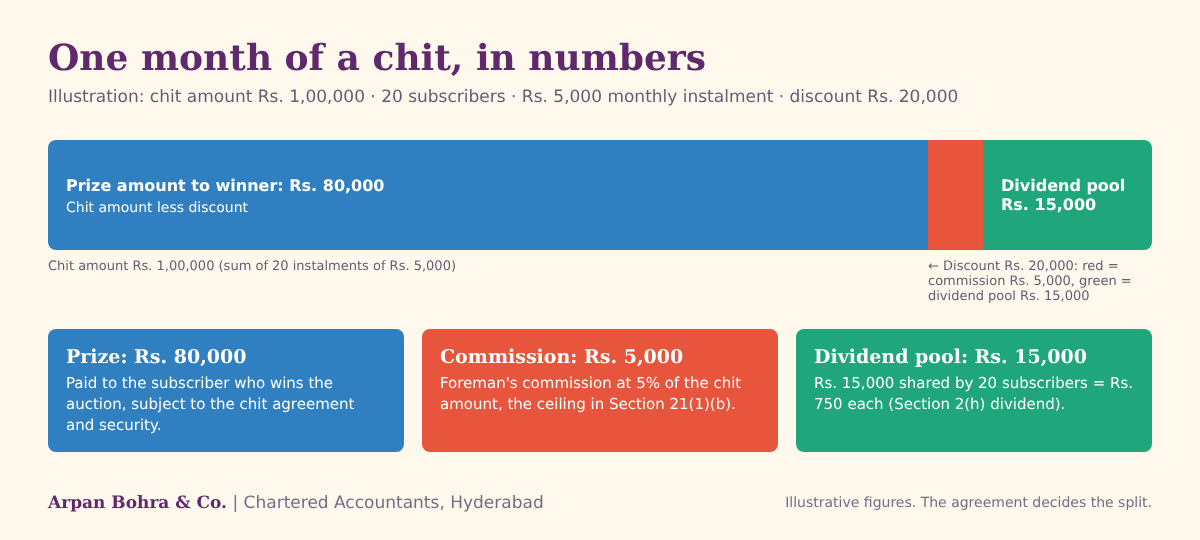
Assumptions: chit amount Rs. 1,00,000; 20 subscribers; instalment Rs. 5,000; discount of Rs. 20,000 in the auction. Of the discount, Rs. 5,000 is the foreman’s commission (5% of the chit amount) and Rs. 15,000 is distributed as dividend, which is Rs. 750 for each of the 20 subscribers. The winner receives Rs. 1,00,000 less Rs. 20,000, which is Rs. 80,000. The actual split depends on the chit agreement.
Entry 1: when you receive the dividend
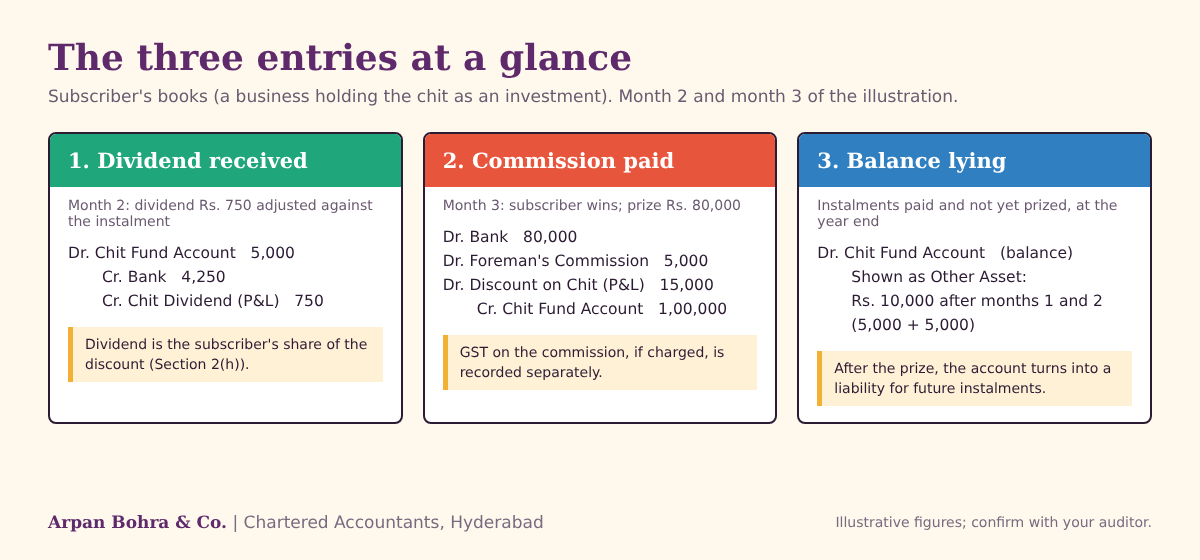
In month 2 the dividend of Rs. 750 is adjusted against the Rs. 5,000 instalment, so the subscriber pays Rs. 4,250.
| Account | Dr. (Rs.) | Cr. (Rs.) |
|---|---|---|
| Chit Fund Account | 5,000 | |
| To Bank | 4,250 | |
| To Chit Dividend (profit and loss account) | 750 |
The gross instalment is carried to the chit fund account, so that the account reflects what the subscriber has contributed, and the dividend is recognised as income. If the dividend is paid in cash instead, debit Bank and credit Chit Dividend. Two legal pointers help. First, because the Act defines dividend as a share of the discount, it is not interest on a loan. In ITO v. Margasoochi Chits Pvt. Ltd. (ITAT Bangalore, decided 16 January 2009, ITA No. 995/Bang./2008), the Tribunal held that dividends paid by a foreman are not interest for the purposes of Section 194A of the 1961 Act, because a chit involves neither borrowed money nor a debt. That is a Tribunal decision under the old Act, so it is persuasive and should be checked against the current provisions. Second, secondary sources differ on the head under which a subscriber’s dividend is taxed, so the treatment should be settled with your tax adviser for your own facts.
Entry 2: when you pay the commission
In month 3 the subscriber wins with a discount of Rs. 20,000. The foreman deducts Rs. 5,000 as commission, Rs. 15,000 is the remaining discount, and the subscriber receives Rs. 80,000. The month 3 instalment is first recorded in the same way as Entry 1 (Dr. Chit Fund Account Rs. 5,000; Cr. Bank Rs. 4,250; Cr. Chit Dividend Rs. 750).
| Account | Dr. (Rs.) | Cr. (Rs.) |
|---|---|---|
| Bank | 80,000 | |
| Foreman’s Commission (expense) | 5,000 | |
| Discount on Chit (profit and loss account) | 15,000 | |
| To Chit Fund Account | 1,00,000 |
The credit of Rs. 1,00,000 represents the chit amount that the subscriber has now drawn in advance. Practitioners discuss different presentations of the discount, such as writing it off at once or spreading it over the remaining instalments. Choose one policy and apply it to every chit.
GST on the commission
- Services provided by a foreman of a chit fund in relation to a chit are classified under heading 9971, Sl. No. 15 of Notification No. 11/2017-Central Tax (Rate), as recorded in the Appellate Authority for Advance Ruling order of 21 September 2020 in the Ushabala Chits matter. The taxable service is the foreman’s commission, not the chit amount.
- The rate in that order was 12%. Commentary reports an increase to 18% following the 47th GST Council meeting, but we have not verified a notification, so please confirm the current rate before booking GST.
- If the foreman charges GST on the commission and you are a registered business subscriber, record the GST separately. Whether input tax credit is available depends on the conditions of Sections 16 and 17 of the CGST Act.
- Interest and penalty collected by a foreman on delayed instalments were held to be outside GST by the Kerala High Court (Kerala State Financial Enterprises Ltd. v. Union of India, W.P.(C) No. 24620 of 2022, 4 September 2024) and the Andhra Pradesh High Court (M/s Usha Bala Chits Private Limited v. Commissioner of State Tax, W.P. No. 14745 of 2021, 10 December 2025). The 2020 AAAR order had taken the opposite view. These High Court decisions are persuasive outside their own States.
Entry 3: the balance lying with the foreman
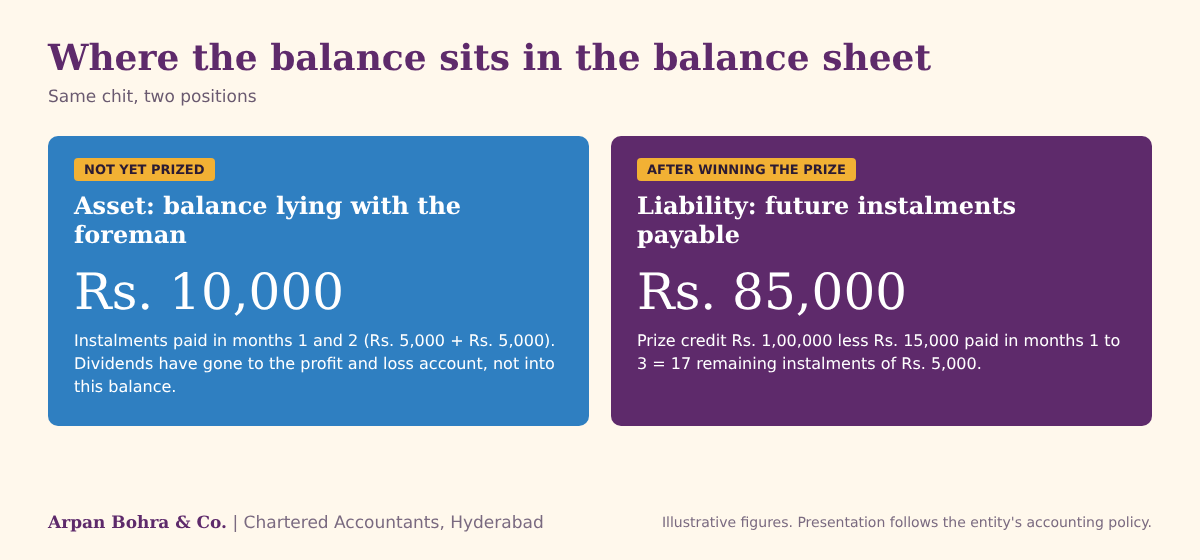
- Before you win: the instalments paid and not yet prized are shown as a chit fund balance with the foreman, as an other asset. After months 1 and 2 in the example it is Rs. 10,000 (Rs. 5,000 + Rs. 5,000). The dividend credits have gone to profit and loss, so they are not part of this balance.
- After you win: the chit fund account shows a credit balance. After the prize in month 3, the account stands at Rs. 1,00,000 credit less Rs. 15,000 of instalments, which is Rs. 85,000 payable over the 17 remaining instalments of Rs. 5,000. Show it as a liability.
- Dividend credited but not yet adjusted: show the amount as a receivable until it is paid or adjusted against the next instalment.
- Reconcile at the year end: obtain the foreman’s statement of account, to which you are entitled under Section 25(1), and agree it to your chit fund account. Differences usually arise from timing of the auction, dividend adjustments and unpaid commission.
GST and income-tax implications at a glance
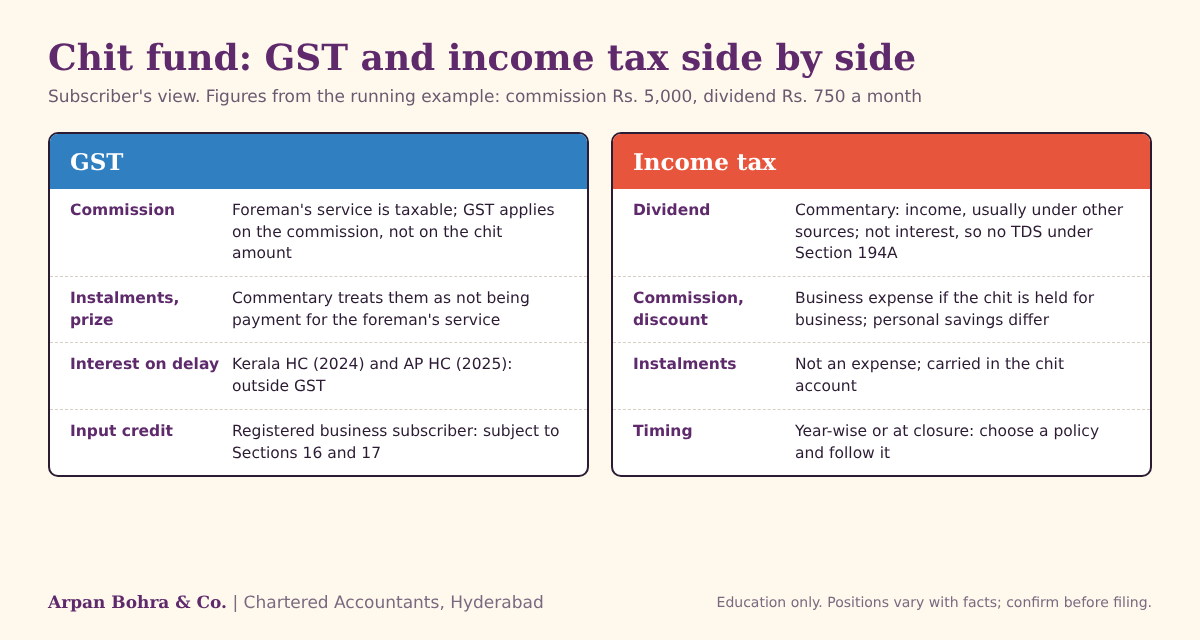
GST implications
| Item | GST position | Basis |
|---|---|---|
| Foreman’s commission (Rs. 5,000 in the example) | Taxable supply of service by the foreman; the commission is the value on which GST is calculated | Heading 9971, Sl. No. 15 of Notification No. 11/2017-Central Tax (Rate), as noted in the AAAR order of 21 September 2020 |
| Rate of GST on the commission | 12% in the 2020 AAAR order; commentary reports 18% after the 47th GST Council meeting | Confirm the current rate from the rate notification before booking GST |
| Instalments and prize money | Commentary treats them as not being consideration for the foreman’s service. The 2020 AAAR order did not separately decide on prize money | Commentary; open to challenge on facts |
| Interest and penalty on delayed instalments | Held outside GST by the Kerala High Court (4 September 2024) and the Andhra Pradesh High Court (10 December 2025). The 2020 AAAR order held otherwise | High Court decisions are persuasive outside their own States |
| Input tax credit for a registered business subscriber | Depends on the use of the service in the course of business and the conditions of Sections 16 and 17 of the CGST Act | Check the invoice, GSTIN and return filing by the foreman |
In the books, an invoice charging GST on the commission is recorded as: Dr. Foreman’s Commission Rs. 5,000, Dr. Input GST (if eligible) at the applicable rate, and the total is deducted from the prize or paid separately, as the chit agreement provides. If credit is not available, the GST is a cost and is added to the commission expense.
Income-tax implications
| Item | Income-tax position | Basis and caution |
|---|---|---|
| Instalments paid | Not a revenue expense; they are carried in the chit fund account as shown above | Accounting treatment; the cost to the subscriber is the discount and commission |
| Dividend received (Rs. 750 a month in the example) | Practitioner commentary treats it as taxable, commonly under income from other sources, or as business income where the chit is part of the business. It is not interest on a loan | Commentary is not uniform and cites few authorities; examine the facts and apply a consistent policy |
| TDS on dividend paid by the foreman | Not interest for Section 194A of the 1961 Act: ITO v. Margasoochi Chits Pvt. Ltd. (ITAT Bangalore, 16 January 2009); Hyderabad Bench in ACIT v. Margadarshi Chit Fund (P) Ltd., ITA No. 1119/Hyd/2012 (order pronounced 7 December 2012), relying on CIT v. Bilahari Investments, 288 ITR 39 (Madras) | Decisions under the 1961 Act; confirm the corresponding provision of the Income-tax Act, 2025 |
| Discount and commission on winning | Treated as a business expense where the chit is held for business purposes; where it is a personal saving, practitioners generally take the view that the loss is not allowed as a deduction | Commentary; the use of the chit determines the answer |
| Timing of recognition | Either year by year as dividends and costs arise, or on the closure of the chit by comparing total paid with total received | Choose one method and follow it consistently |
The Income-tax Act, 2025 applies from 1 April 2026. We did not find any provision of that Act dealing with chit funds specifically, so the analysis above rests on general principles and on decisions given under the 1961 Act. Readers should verify the section numbers before citing them in a return.
Common mistakes
- Expensing every instalment instead of carrying it in a chit fund account.
- Booking the dividend as a reduction of Bank only, which leaves the chit account understated.
- Ignoring the future instalments after winning, which understates liabilities.
- Recording commission and discount as one figure, so that GST on the commission is missed.
- Not reconciling with the foreman’s statement before the accounts are finalised.
Local note for Hyderabad and Telangana
Chit funds in Hyderabad and the rest of Telangana are conducted under the central Chit Funds Act, 1982 and the rules and registration requirements framed by the State. The decisions cited above from the Kerala and Andhra Pradesh High Courts do not bind Telangana authorities, but they show how the interest and commission questions are being argued.
Frequently asked questions
1. What is chit fund dividend?
Section 2(h) of the Chit Funds Act, 1982 defines dividend as the share of a subscriber in the amount of discount available for rateable distribution.
2. What is the maximum commission a foreman can take?
Section 21(1)(b) permits commission, remuneration or expenses, as fixed in the chit agreement, not exceeding five per cent of the chit amount.
3. Is a chit instalment an expense?
Generally no. Until the subscriber is prized, the instalments are carried as a chit fund balance. The cost to the subscriber lies in the discount and commission, as shown above.
4. Where is the balance with the foreman shown?
As an other asset until the subscriber receives the prize, and as a liability for future instalments after the prize, subject to the entity’s accounting policy.
5. Is GST payable on the whole chit amount?
No. Commentary and the AAAR order treat the foreman’s commission as the taxable service. Interest on delayed instalments has been held outside GST by two High Courts. Confirm the rate and the current position before filing returns.
Sources
- Chit Funds Act, 1982: text on Indian Kanoon; Act on thc.nic.in.
- AAAR (Andhra Pradesh) order dated 21 September 2020 on chit foreman services: GST Council website.
- High Court decisions on interest on delayed instalments: TaxGuru.
- ITO v. Margasoochi Chits Pvt. Ltd.: BCAJ.
- Accounting practice discussions: CAclubindia expert answer; CAclubindia forum.
- GST rate commentary: ClearTax.
Conclusion
Three questions, three entries: the dividend is income, the commission and discount are costs, and the balance with the foreman is an asset until the prize and a liability after it. The numbers in this article are illustrative; the chit agreement decides the actual split, and consistency of policy and reconciliation with the foreman’s statement matter most.
This article is for general information and education. It is not professional advice, and the position in a particular case depends on the chit agreement, the accounting framework applicable to the entity and the tax facts. Laws and rates may change after the date of publication (13 October 2026).
Arpan Bohra & Co., Chartered Accountants
Website: https://www.arpanbohra.co.in/