
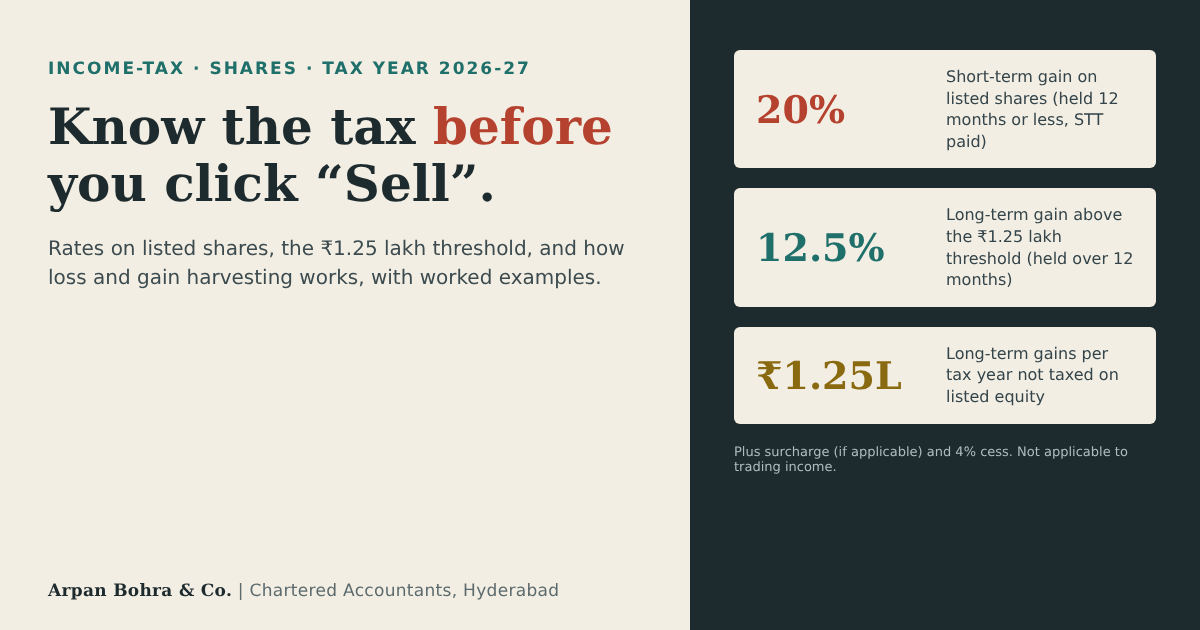
Illustrative scenario: It is February. An investor in Hyderabad looks at her demat account and sees one stock up by ₹2,50,000 and another down by ₹60,000. She asks the question every investor asks sooner or later: “If I sell now, how much tax will I pay, and can I use the loss to reduce it?”
Direct answer: For listed equity shares on which Securities Transaction Tax (STT) is paid, short-term gains (shares held for 12 months or less) are taxed at 20%, and long-term gains (held for more than 12 months) are taxed at 12.5% on the amount above ₹1,25,000 in a tax year. Surcharge, if applicable, and 4% health and education cess are added. “Tax harvesting” means booking losses and gains deliberately, within the law, so that these rules work in your favour. This article sets out the legal position in the Income-tax Act, 2025 in plain language and then walks through worked examples.
Which law applies from 1 April 2026?
The Income-tax Act, 2025 comes into force from 1 April 2026. It replaces the Income-tax Act, 1961 and speaks of a “tax year” instead of a “previous year” and “assessment year”. The provisions dealing with capital gains on listed equity were renumbered, but, as commentary on the new Act records, the rates and the basic scheme were carried over:
| Subject | Income-tax Act, 1961 | Income-tax Act, 2025 |
|---|---|---|
| Short-term gain on listed equity (STT paid) | Section 111A | Section 196 |
| Long-term gain on other assets | Section 112 | Section 197 |
| Long-term gain on listed equity (STT paid) | Section 112A | Section 198 |
| Set-off of losses within the same head | Section 70 | Section 108 |
| Carry forward of capital loss | Section 74 | Section 111 |
Tax rates on shares: legal language and what it means
| What the law says (in substance) | In simple words |
|---|---|
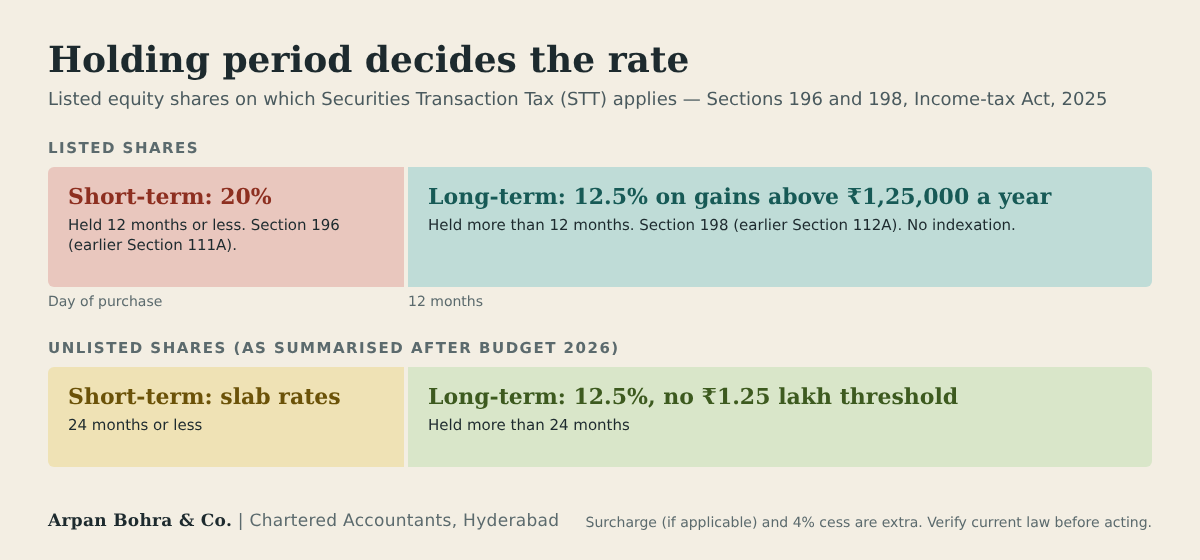
| Short-term capital gain arising from transfer of an equity share in a company, where the transaction is chargeable to STT, is taxed at 20% (Section 196; earlier Section 111A). | If you sell listed shares on the exchange within 12 months of buying them, the profit is taxed at 20%. |
| Long-term capital gain on transfer of an equity share, where STT has been paid, is taxed at 12.5% to the extent it exceeds ₹1,25,000 (Section 198; earlier Section 112A). | If you hold listed shares for more than 12 months, only the profit above ₹1.25 lakh in the tax year is taxed, at 12.5%. |
| No indexation benefit is available on such long-term gains. | Your cost is not inflated for the years you held the shares. |
| STT must have been paid on the transfer and, for equity shares, generally also on acquisition, subject to exceptions notified by the Government. | Ordinary exchange purchases and sales qualify. Off-market or certain special-case acquisitions need to be checked. |
| For shares acquired on or before 31 January 2018, the cost of acquisition is the higher of the actual cost and the lower of (i) fair market value on 31 January 2018 and (ii) the sale price. | Gains that built up till 31 January 2018 are protected (“grandfathering”). |
The ₹1,25,000 figure is a threshold, not a deduction from your income: only the excess is taxed. It applies per tax year and cannot be carried forward if unused. For unlisted shares, commentary on the Budget 2026 changes records that long-term gains (held more than 24 months) are taxed at 12.5% without the ₹1.25 lakh threshold, while short-term gains are taxed at normal slab rates. Gains on shares held as stock-in-trade, and income from intraday or futures and options trading, are business income and follow different rules.
Example 1: the same profit, two holding periods
Ankit buys 100 shares at ₹500 and sells them at ₹700. The gain is ₹20,000.
- Sold after 8 months (short-term): tax at 20% is ₹4,000; cess at 4% is ₹160; total ₹4,160.
- Sold after 14 months (long-term): the gain of ₹20,000 is below the ₹1,25,000 threshold, so there is no tax, assuming he has no other long-term gains on listed equity in that tax year.
Set-off and carry-forward of capital losses
The law allows capital losses to be set off against capital gains, but with a restriction:
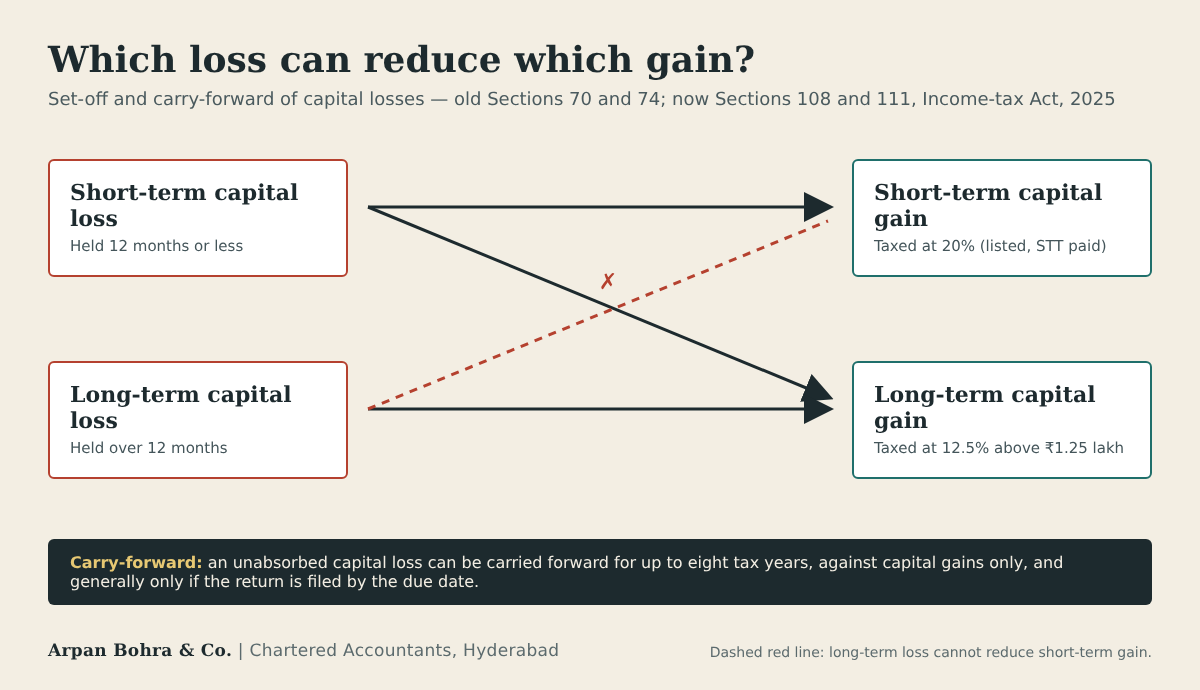
- A short-term capital loss can be set off against both short-term and long-term capital gains.
- A long-term capital loss can be set off only against long-term capital gains. As commentary on the 2025 Act notes, a proposed relaxation allowing it against short-term gains was not retained in the final Act.
- A loss that cannot be fully set off can be carried forward under Section 111 of the 2025 Act (earlier Section 74). Section 111(2) provides that no loss is carried forward for more than eight tax years from the year it was first computed. Carry-forward is against capital gains only, and secondary sources note that the return must be filed by the due date to preserve it.
Example 2: a long-term loss that cannot help
Divya has a short-term gain of ₹50,000 and a long-term loss of ₹30,000. The loss cannot reduce the short-term gain. Tax is ₹10,000 plus ₹400 cess, ₹10,400, and the ₹30,000 loss is carried forward for up to eight tax years against future long-term gains.
What is tax harvesting?
Tax harvesting is the planned realisation of losses or gains before the end of the tax year (31 March) to reduce the tax payable. It comes in two forms.
- Loss harvesting: selling a loss-making holding to book a capital loss that can be set off against gains.
- Gain harvesting: selling appreciated long-term holdings to use the ₹1,25,000 threshold each tax year, so that the cost of the shares is stepped up if they are bought back.
Example 3: loss harvesting
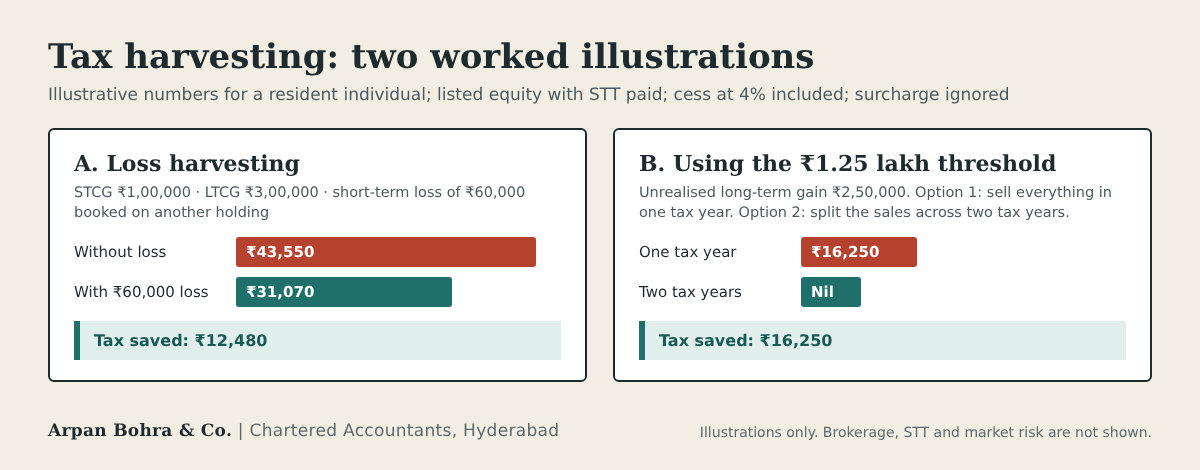
Meera has booked a short-term gain of ₹1,00,000 and a long-term gain of ₹3,00,000 on listed shares in the tax year. She also holds another stock with an unrealised short-term loss of ₹60,000.
| Without selling the loss-making stock | After booking the ₹60,000 loss | |
|---|---|---|
| Short-term gain taxed | ₹1,00,000 | ₹40,000 (after set-off of ₹60,000) |
| Tax at 20% | ₹20,000 | ₹8,000 |
| Long-term gain above ₹1,25,000 | ₹1,75,000 | ₹1,75,000 |
| Tax at 12.5% | ₹21,875 | ₹21,875 |
| Total before cess | ₹41,875 | ₹29,875 |
| Cess at 4% | ₹1,675 | ₹1,195 |
| Total tax | ₹43,550 | ₹31,070 |
The saving is ₹12,480, being ₹60,000 at 20% plus 4% cess. The assumption is that the loss is set off first against the short-term gain, which is taxed at the higher rate. Surcharge is ignored.
Example 4: using the ₹1,25,000 threshold
Priya holds listed shares bought for ₹3,00,000 more than 12 months ago, now worth ₹5,50,000. The unrealised long-term gain is ₹2,50,000 and she has no other long-term gains.
- Sell everything in one tax year: taxable gain is ₹2,50,000 minus ₹1,25,000, which is ₹1,25,000. Tax at 12.5% is ₹15,625, and cess is ₹625, a total of ₹16,250.
- Sell half in March (tax year 2026-27) and half in April (tax year 2027-28): each sale produces a gain of ₹1,25,000, which falls within the threshold of its own tax year. No tax is payable in either year.
If an investor wants to stay invested, shares sold to use the threshold can be bought back; the cost of the repurchased shares becomes the new purchase price, which reduces the gain on a later sale. Brokerage, STT and market movement between sale and repurchase are real costs and are not shown in the example.
Is tax harvesting legal?
Commentary notes that India has no specific wash-sale rule that disallows a loss merely because the same shares are bought back. That does not mean anything goes. The transactions must be genuine, must be carried out on the exchange, and must have economic substance. Points to keep in mind:
- General Anti-Avoidance Rule (GAAR): it applies to an “impermissible avoidance arrangement” and requires the authorities to establish that such an arrangement exists.
- Telangana High Court: in Smt. Anvida Bandi v. Deputy Commissioner of Income Tax [2025] 177 taxmann.com 726 (Telangana), a taxpayer who had earned long-term gains, bought shares and mutual fund units with the proceeds, and later in the year sold some shares at a short-term loss, which she set off. The GAAR Panel held this to be an impermissible avoidance arrangement. The High Court set that order aside because the department had not established an arrangement between parties, no link was shown between the purchase and sale on the exchange, and the taxpayer was a consistent investor. The decision turns on its own facts, and it does not give a licence for artificial transactions.
- Dividend and bonus stripping: the 1961 Act (Section 94) disallows losses in defined situations involving purchases shortly before a dividend or bonus issue and sales shortly after. Check the corresponding provisions of the 2025 Act before entering such trades.
- Intraday and F&O trades: these are not delivery-based capital gains and should not be mixed up with investment harvesting.
Practical checklist before 31 March
- Download your capital gains statement from the broker and cross-check with the Annual Information Statement (AIS).
- Separate short-term and long-term gains and losses, and note the holding period of each lot.
- Check whether the shares are listed and whether STT was paid on purchase and sale.
- Estimate the tax with and without each sale, including cess and any surcharge.
- Consider the transaction costs and the risk of being out of the market.
- Keep contract notes, and report any loss to be carried forward in the return filed within the due date.
A note on share buybacks
As summarised in post-Budget 2026 commentary, with effect from 1 April 2026 buyback proceeds are taxed as capital gains on the difference between the buyback price and the cost of acquisition, instead of as dividend income on the whole amount. Shareholders considering a buyback tender should compute the gain separately and check the position for promoters.
Local note for Hyderabad and Telangana investors
Investors in Hyderabad and the rest of Telangana file their returns on the same income-tax portal as everyone else. What is distinctive is that the Telangana High Court has already examined a GAAR challenge to year-end loss booking, as discussed above. That decision is binding in Telangana only in its own facts and reasoning; it is not a general assurance.
Frequently asked questions
1. What is the tax rate on listed shares sold within one year?
Short-term capital gains on listed equity shares on which STT is paid are taxed at 20% under Section 196 of the Income-tax Act, 2025 (earlier Section 111A), plus cess and any surcharge.
2. Is long-term gain on shares fully taxed at 12.5%?
No. For listed equity with STT paid, the 12.5% rate applies only to the long-term gain exceeding ₹1,25,000 in a tax year (Section 198; earlier Section 112A).
3. Can a long-term loss be set off against short-term gains?
No. A long-term capital loss can be set off only against long-term capital gains. A short-term capital loss can be set off against both.
4. For how long can capital losses be carried forward?
For up to eight tax years from the year in which the loss was first computed (Section 111(2) of the 2025 Act). The return should be filed by the due date to keep this benefit.
5. Can I sell shares and buy them back the next day?
There is no specific wash-sale prohibition in the provisions discussed, but genuine economic substance matters, and anti-avoidance rules, including GAAR, can apply to artificial arrangements. Obtain advice for large or repeated transactions.
Sources
- Section mapping (Sections 196, 197, 198) under the Income-tax Act, 2025: Vittsphere, SAG Infotech.
- Rates, threshold, holding period, grandfathering and loss rules: CAclubindia; HSBC tax reckoner FY 2026-27.
- Budget 2026 changes (buyback, unlisted shares): Tata Mutual Fund.
- Carry forward of capital loss, Section 111: TaxHeal; mapping of Sections 70 and 74: Patron Accounting.
- Tax-loss harvesting commentary: PhonePe Invest; eVaakil.
- Anvida Bandi v. DCIT (Telangana High Court): Khaitan & Co..
Conclusion
The structure is simple: 20% for short-term, 12.5% above ₹1.25 lakh for long-term, and losses that follow the order of set-off. The planning lies in timing, documentation and discipline. Harvesting should serve a genuine investment decision, not replace it.
This article is for general information and education. It is not professional advice, and the tax position in a particular case depends on its facts, the investor’s other income and any later amendments. The examples are illustrative, use round numbers, and ignore surcharge, brokerage and STT. Date of publication: 13 October 2026.
Arpan Bohra & Co., Chartered Accountants
Website: https://www.arpanbohra.co.in/