
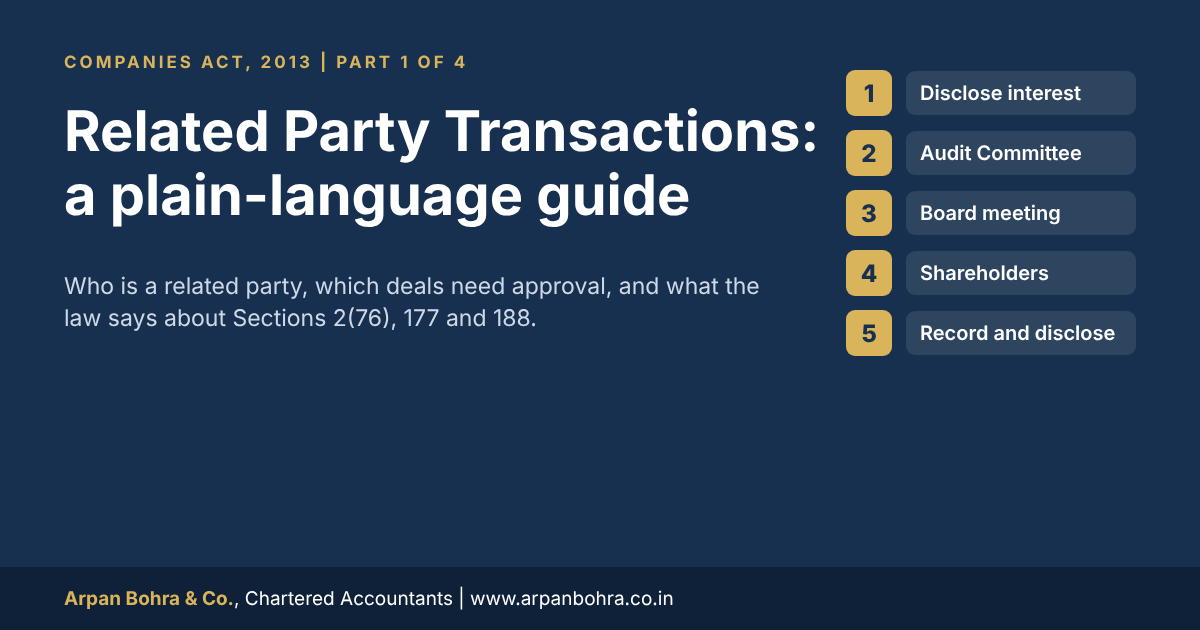
A company takes a floor on rent for its new office. The owner of that floor is the wife of one of its directors. Or a start-up buys its raw material from a firm in which a director’s brother is a partner. Is that illegal? Not necessarily. But it is exactly the kind of deal the Companies Act, 2013 wants the Board, and sometimes the shareholders, to examine first.
The short answer. A related party transaction (RPT) is a deal between a company and a person connected to it: its directors, its key managerial personnel, their close relatives, and businesses they own, control or influence. Section 2(76) says who counts as a “related party”. Section 188 says which deals need approval. Section 177 gives the Audit Committee a say. A fair, openly approved RPT is perfectly legal. An unapproved one can be treated as voidable by the company, and the director or employee who entered into or authorised it can be penalised: ₹5 lakh in an unlisted company and ₹25 lakh in a listed company.
This guide assumes you know nothing about company law. It starts with what “compliance” even means and ends with a working checklist. It is general educational information, not advice on any specific facts.
1. What does “compliance” mean in a company?
A company is a separate legal person created by law. It cannot think or sign by itself, so the law insists that decisions are taken by the right people, in the right way, and are recorded and reported. In practice, compliance in a company means four things:
- The right body decides. Day-to-day matters sit with the Board of Directors. Bigger matters need the shareholders (also called members). Specialised matters go to committees such as the Audit Committee.
- The decision is written down. Board minutes, resolutions and statutory registers are the company’s memory.
- The authorities are told. Many events must be reported to the Registrar of Companies (ROC) in prescribed forms within prescribed time limits.
- The shareholders are told. Important facts are disclosed in the Board’s report and the financial statements.
Related party rules are a good example of this chain. They ask: who approved the deal, on what information, and where is it recorded and disclosed?
Why does the law care about RPTs? Directors manage money that belongs to shareholders. If a director could sell his own goods to the company at an inflated price, profit would move from the shareholders’ pocket to the director’s pocket. The law does not ban dealing with connected persons. It requires transparency and independent approval so that the deal is on terms a stranger would also have got.
2. Words you will meet in this article
| Term | Plain meaning |
|---|---|
| Director | A person on the company’s Board who helps run it. An independent director has no material connection with the company. |
| Key Managerial Personnel (KMP) | Section 2(51): the CEO or managing director or manager, the company secretary, the whole-time director, the chief financial officer, and certain other designated senior officers. |
| Relative | Section 2(77) read with Rule 4 of the Companies (Specification of Definitions Details) Rules, 2014: see the list below. |
| Board / members | Board = the directors acting together at a meeting. Members = the shareholders. |
| Audit Committee | A Board committee, with independent directors in the majority, that reviews financial reporting and approves related party deals (Section 177). |
| Arm’s length transaction | Section 188 Explanation: a deal between two related parties conducted as if they were unrelated, so that there is no conflict of interest. |
| Ordinary course of business | The normal day-to-day business of the company, for example a manufacturer selling its goods. Companies usually judge this on facts such as the objects of the company, past practice and industry usage. |
| Registrar of Companies (ROC) | The government office with which the company files its returns and forms. |
3. Who is a “related party”? (Section 2(76))
The starting point is Section 2(76). The test is always applied “with reference to a company”, meaning from the point of view of the company that is entering into the deal. The categories are:
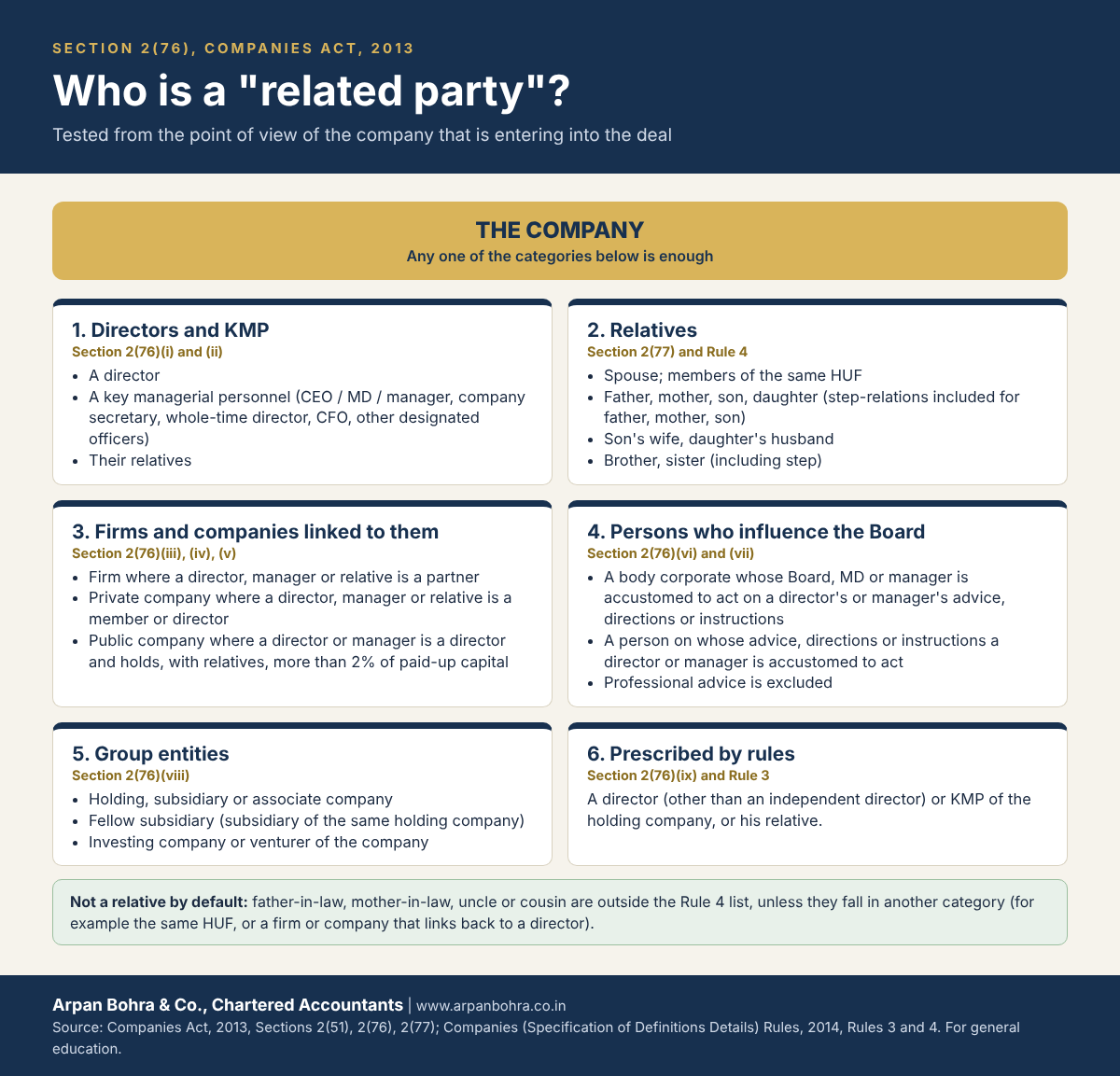
| Who | What the law says (in short) | Simple example |
|---|---|---|
| A director or his relative | Section 2(76)(i) | Director Ramesh, or his wife, son or brother |
| A KMP or his relative | Section 2(76)(ii) | The CFO’s father |
| A firm | A firm in which a director, manager or a relative is a partner – (iii) | A partnership firm where Ramesh’s brother is a partner |
| A private company | A private company in which a director, manager or a relative is a member or director – (iv) | A private limited company in which Ramesh’s wife holds even a few shares |
| A public company | A public company in which a director or manager is a director and holds, with relatives, more than 2% of paid-up share capital – (v) | A public company where Ramesh is a director and he and his family hold 3% |
| A company that follows a director’s lead | Any body corporate whose Board, managing director or manager is accustomed to act on the advice, directions or instructions of a director or manager – (vi) | A company whose management routinely does what Ramesh tells it |
| A person a director follows | Any person on whose advice, directions or instructions a director or manager is accustomed to act – (vii). Advice given in a professional capacity is excluded | A silent investor whose instructions the director habitually follows. A CA or lawyer giving professional advice is not caught |
| Group companies | A holding, subsidiary or associate company, a fellow subsidiary, and an investing company or venturer – (viii) | The parent company; a sister subsidiary |
| Persons prescribed by rules | Section 2(76)(ix) with Rule 3: a director (other than an independent director) or KMP of the holding company, or his relative | The managing director of the parent company, or his wife, when the subsidiary hires or buys from them |
Two points worth remembering. First, the tests overlap on purpose; a person only needs to fall in one category. Second, there is no minimum shareholding for the firm and private company categories: it is enough that the director or his relative is a partner, member or director. The 2% test applies only to public companies.
Who is a “relative”? (Section 2(77) and Rule 4)
Under Section 2(77), a person is a relative of another if they are members of the same Hindu Undivided Family (HUF), if they are husband and wife, or if they are related in a prescribed manner. Rule 4 prescribes: father (including step-father), mother (including step-mother), son (including step-son), son’s wife, daughter, daughter’s husband, brother (including step-brother) and sister (including step-sister).
Notice what is missing from the list: a father-in-law, a mother-in-law, an uncle or a cousin is not a “relative” for this purpose unless he or she is in the same HUF or falls in another category. This is a frequent source of confusion, and also the reason to keep a proper, updated list of related parties, which every director should declare.
4. Which deals does Section 188 cover?
Section 188(1) does not cover every dealing. It covers seven types of contracts or arrangements with a related party:
| Type of deal | Example |
|---|---|
| (a) Sale, purchase or supply of goods or materials | The company buys steel from a firm owned by a director’s brother |
| (b) Selling, disposing of or buying property of any kind | The company buys a flat from a director’s wife |
| (c) Leasing of property of any kind | The company takes its office on rent from a director |
| (d) Availing or rendering of services | The company pays a director’s firm for IT support |
| (e) Appointing an agent to buy or sell goods, materials, services or property | A related party is appointed as the company’s sales agent |
| (f) Appointing a related party to an office or place of profit in the company, its subsidiary or its associate | A director’s son is employed as a manager |
| (g) Underwriting the subscription of the company’s securities or derivatives | A related party underwrites the company’s issue |
Loans, guarantees, security and investments are not in this list. They are governed by Sections 185 and 186, which the next article in this series covers. Separately, the accounting standards (AS 18 and Ind AS 24) require a wider disclosure of related party dealings in the financial statements.
5. The approval ladder: what must happen, in order
Think of a related party deal as a staircase. Which steps apply depends on whether the company has an Audit Committee and on the size of the deal.
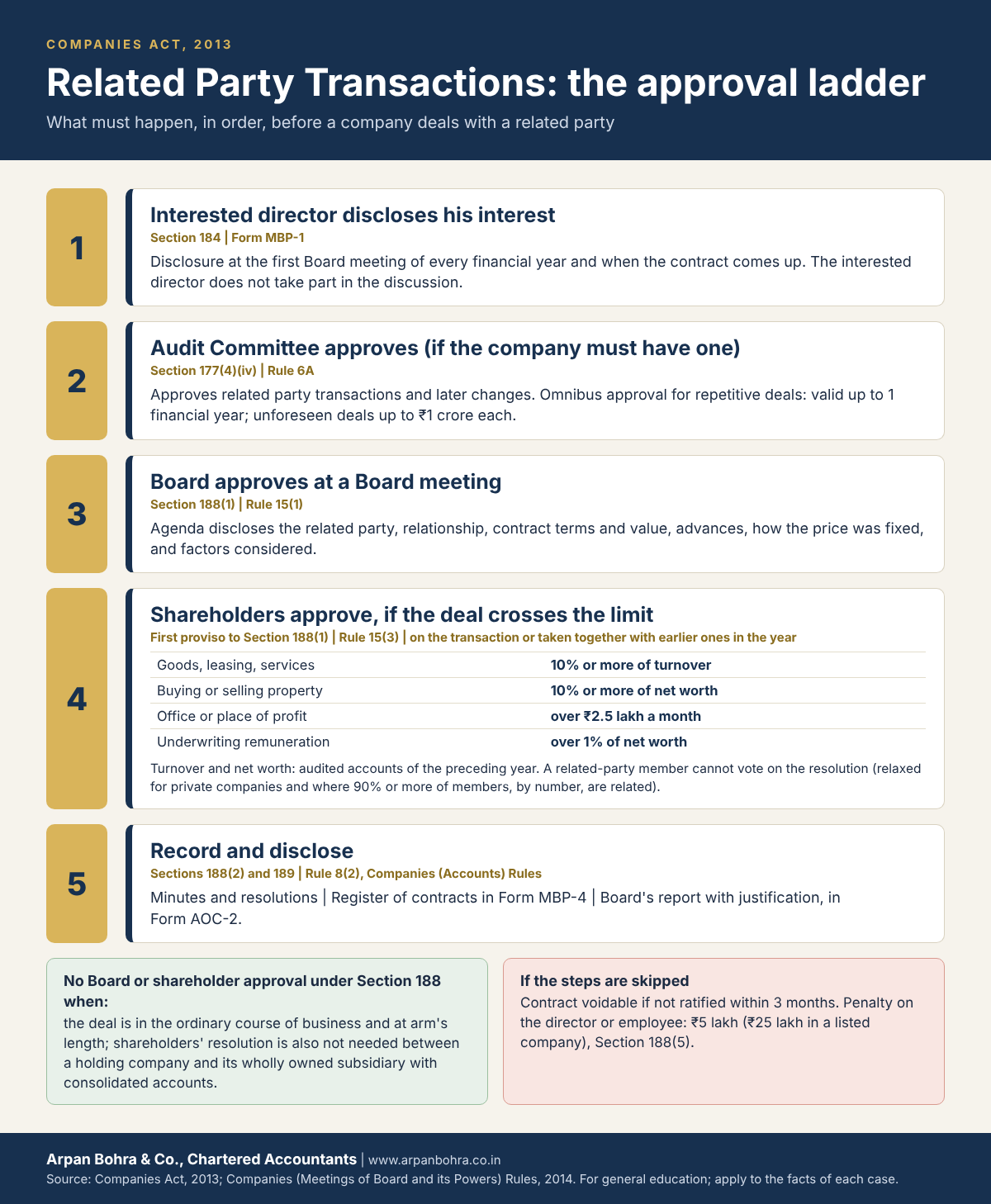
Step 1 – The interested director discloses his interest (Section 184)
Every director must disclose the companies, firms and bodies in which he is interested, at the first Board meeting in which he participates and then at the first meeting of every financial year (the notice is in Form MBP-1), and again when there is a change. When a particular contract is discussed, a director who is interested in it must disclose the nature of his interest at that meeting and must not participate in it. Rule 15(2) of the Companies (Meetings of Board and its Powers) Rules, 2014 adds that he is not to be present during the discussion on that resolution.
Step 2 – Audit Committee approval, where the company has one (Section 177(4)(iv))
See section 6 below. In short, a company that must have an Audit Committee needs its approval for related party transactions before the Board takes them up.
Step 3 – Board approval at a Board meeting (Section 188(1))
Unless an exemption applies, the company cannot enter into a Section 188 contract without the Board’s consent given by a resolution at a meeting of the Board. Because the Act says “at a meeting”, the safer practice is to place the matter before an actual Board meeting (physical or through video conferencing) rather than rely on a circular resolution.
Under Rule 15(1), the agenda for that meeting must disclose:
- the name of the related party and the nature of the relationship;
- the nature, duration and particulars of the contract or arrangement;
- the material terms, including the value;
- any advance paid or received;
- the manner of determining the pricing and other commercial terms, both those included in and those not included in the contract;
- whether all factors relevant to the contract have been considered and, if not, which have not been considered and why; and
- any other information relevant for the Board to take a decision.
Step 4 – Shareholders’ approval, if the deal crosses the thresholds (first proviso to Section 188(1) and Rule 15(3))
Above certain sizes, the Board’s approval is not enough. A prior resolution of the shareholders is also needed. The limits, tested on the individual transaction or taken together with previous transactions during the financial year, are:
| Type of transaction | Shareholders’ approval needed when the amount is |
|---|---|
| Sale, purchase or supply of goods or materials (directly or through an agent) | 10% or more of the company’s turnover |
| Selling, disposing of or buying property (directly or through an agent) | 10% or more of the company’s net worth |
| Leasing of property | 10% or more of the company’s turnover |
| Availing or rendering of services (directly or through an agent) | 10% or more of the company’s turnover |
| Appointment to an office or place of profit in the company, its subsidiary or associate | Monthly remuneration exceeding ₹2.5 lakh |
| Remuneration for underwriting the company’s securities | Exceeding 1% of the company’s net worth |
Turnover and net worth are taken from the audited financial statements of the preceding financial year. Since 18 November 2019 the earlier rupee caps (₹100 crore and ₹50 crore) on the first four limits no longer apply, so the percentage alone decides.
The notice of the general meeting must carry an explanatory statement giving the name of the related party, the name of the related director or KMP (if any), the nature of the relationship, the nature, material terms, monetary value and particulars of the contract, and any other information members need to decide.
Who may vote? Under the second proviso to Section 188(1), a member who is a related party cannot vote on that resolution. The Ministry of Corporate Affairs has clarified that this bar applies to the related party concerned with the particular contract, not to every related party of the company. There are two relaxations. The bar does not apply where 90% or more of the members, in number, are relatives of promoters or are related parties. And, under the MCA notification G.S.R. 464(E) dated 5 June 2015 (as amended in 2017), private companies are exempt from this voting bar, provided the private company has not defaulted in filing its financial statements (Section 137) or annual return (Section 92).
Step 5 – Record and disclose
- Minutes of the Board (and general) meeting and the resolutions passed.
- Register of contracts under Section 189, kept in Form MBP-4.
- Board’s report. Section 188(2) requires every Section 188(1) contract to be referred to in the Board’s report, with the justification for entering into it. Rule 8(2) of the Companies (Accounts) Rules, 2014 prescribes the particulars in Form AOC-2, which has one part for transactions not at arm’s length and another for material contracts at arm’s length.
When approval under Section 188 is not needed
- Ordinary course of business and at arm’s length. The fourth proviso to Section 188(1) says the sub-section does not apply to transactions in the ordinary course of business, other than transactions not on an arm’s length basis. Both conditions must be satisfied, and the company should keep evidence, such as comparable quotations or price lists charged to unrelated customers.
- Holding company and its wholly owned subsidiary. The shareholders’ resolution is not required for transactions between a holding company and its wholly owned subsidiary whose accounts are consolidated with the holding company and placed before the shareholders at a general meeting. Board and Audit Committee approvals remain relevant.
- Specified classes. Certain government companies and specified IFSC public companies have their own exemptions notified by the MCA.
Even where Section 188 approvals are not needed, Audit Committee approval (where the company has one) and Board’s report disclosure are still to be checked.
6. The Audit Committee’s role (Section 177)
Which companies need an Audit Committee? Every listed company, and public companies that fall in the classes covered by Rule 4 of the Companies (Appointment and Qualification of Directors) Rules, 2014, read with Rule 6 of the Meetings of Board Rules. Under Rule 4, these are public companies with paid-up share capital of ₹10 crore or more, or turnover of ₹100 crore or more, or outstanding loans, debentures and deposits exceeding ₹50 crore, tested on the last audited financial statements. A private company is not required to have an Audit Committee under Section 177. Section 177(2) requires at least three directors, with independent directors forming the majority.
What does it do for RPTs?
- Approval. Under Section 177(4)(iv) the committee approves related party transactions and any subsequent modification. Rule 6A states that all related party transactions require its approval.
- Omnibus approval. For repetitive transactions the committee may give an omnibus approval on the conditions in Rule 6A: after the Board approves the criteria, the committee fixes the annual cap, the maximum value per transaction, the disclosures required, the manner of periodic review, and the transactions that cannot be covered. For a need that could not be foreseen, omnibus approval is allowed only up to ₹1 crore per transaction. An omnibus approval is valid for not more than one financial year, and it cannot cover the sale or disposal of the company’s undertaking.
- If the committee does not approve. The proviso to Section 177(4)(iv) lets the committee send its recommendations to the Board only for transactions other than those referred to in Section 188. For Section 188 transactions, a refusal should be treated as final.
- Ratification up to ₹1 crore. If a director or officer enters into a transaction of not more than ₹1 crore without the committee’s approval, the committee may ratify it within three months. Otherwise it is voidable at the committee’s option, and if it involves a related party of any director or was authorised by another director, those directors must indemnify the company for any loss.
7. Four worked examples (figures are illustrative)
| Situation | Test | Result |
|---|---|---|
| A company with audited turnover of ₹40 crore in the preceding year buys ₹5 crore of goods in the year from a firm in which a director’s brother is a partner. The deal is not in the ordinary course or not at arm’s length | ₹5 crore is 12.5% of turnover, which is above the 10% limit | Audit Committee (if the company has one), Board and shareholders’ approval. The director concerned does not take part in the Board discussion. The firm’s related members cannot vote on the shareholders’ resolution, unless the company is a private company or the 90% relaxation applies |
| A company with net worth of ₹20 crore buys an office flat for ₹1.5 crore from a director’s wife | ₹1.5 crore is 7.5% of net worth, which is below the 10% limit | Board approval (and Audit Committee approval if the company has one). Shareholders’ approval is not triggered. Disclosure in the Board’s report |
| A director’s son is appointed as a manager at ₹3 lakh per month | ₹3 lakh exceeds ₹2.5 lakh per month | Board approval and shareholders’ approval, assuming no exemption applies |
| A manufacturer routinely sells its goods to a related company at the same price list it gives to unrelated customers | Ordinary course and arm’s length, if the evidence supports it | No Board or shareholders’ approval is needed under Section 188. Audit Committee approval (omnibus approval is useful here) and Board’s report disclosure still need to be checked |
8. What happens if the rules are ignored?
| Provision | Consequence |
|---|---|
| Section 188(3) | A contract entered into by a director or employee without Board consent or shareholders’ approval, and not ratified by the Board or shareholders within three months of the contract, is voidable at the option of the Board or, as the case may be, the shareholders. If it is with a related party of any director, or was authorised by another director, the directors concerned must indemnify the company for any loss |
| Section 188(4) | The company may proceed against the director or employee who entered into the contract in contravention of the section to recover the loss |
| Section 188(5) | The director or employee who entered into or authorised the contract is liable to a penalty of ₹25 lakh in a listed company and ₹5 lakh in any other company. These amounts apply from 21 December 2020; the earlier regime had imprisonment and smaller fines |
| Section 177(4)(iv) | Without Audit Committee approval or ratification within three months, a transaction up to ₹1 crore is voidable at the committee’s option, with the indemnity described above |
| Section 134(8) | Default in the Board’s report (which includes the related party disclosure) attracts a penalty of ₹3 lakh on the company and ₹50,000 on each officer in default |
| Section 450 | Where the Act names no specific penalty, the residual penalty is ₹10,000, plus ₹1,000 for each day of continuing default, up to ₹2 lakh for a company and ₹50,000 for an officer in default |
The practical cost is often larger than the penalty: a voidable contract creates uncertainty for the supplier, the lender and the auditor. It is cheaper to document the approval before signing.
9. Seven mistakes to avoid
- Reading “relative” too narrowly or too widely. Use the Section 2(77) and Rule 4 list, and also check firms and companies in which relatives are partners, members or directors.
- Claiming “ordinary course” without arm’s length evidence. The exemption needs both.
- Approving after the event. Ratification must be within three months of the contract (Section 188(3)).
- Testing only one invoice. The limits apply to the transaction individually or taken together with previous transactions during the financial year.
- Using the wrong numbers. Turnover and net worth come from the audited financial statements of the preceding financial year.
- Letting the interested director take part. He must disclose and stay out of the discussion on that resolution.
- Forgetting the paperwork. Minutes, the Section 189 register (Form MBP-4) and the Form AOC-2 disclosure complete the compliance.
A frequent assumption is that a private company can skip all of this. It cannot. Section 188 applies to private companies; only the voting bar on related-party members is relaxed, and only on the conditions mentioned above.
10. A one-page checklist
| Step | Who | Evidence to keep |
|---|---|---|
| Maintain a list of related parties (directors, KMP, relatives, their firms and companies, group companies) | Company secretary / finance head | Updated list; directors’ disclosures in Form MBP-1 |
| Check each proposed deal against the seven Section 188 categories | Finance and legal | Note on classification |
| Test the ordinary course and arm’s length conditions | Finance | Price comparison, quotations, valuation |
| Obtain Audit Committee approval, if the company has one | Audit Committee | Committee minutes; omnibus approval and review record |
| Place the deal before the Board with the Rule 15(1) details | Board | Agenda, minutes, interested director’s absence recorded |
| Test the thresholds and, if crossed, obtain shareholders’ resolution | Board / members | Notice with explanatory statement; voting record |
| Enter the contract in the register | Company secretary | Form MBP-4 entry |
| Report in the Board’s report | Board | Form AOC-2 |
11. Where the law stands today
The law described above is the Companies Act, 2013 as it applies today. The Corporate Laws (Amendment) Bill, 2026 was introduced in the Lok Sabha on 23 March 2026 and referred to a Joint Parliamentary Committee, which submitted its report on 3 August 2026. The PRS India summary of the Bill does not list any change to Sections 2(76), 177 or 188, and the sources we checked show that the Bill had not been enacted at the time of writing. Commentary on the committee hearings mentions a recommendation on director disqualification connected with related party transactions, so the final text should be read when it is passed. Until it is enacted and brought into force, the provisions in this article continue to apply. Listed companies must also follow Regulation 23 of the SEBI Listing Regulations, which is stricter and is outside the scope of this article.
12. Frequently asked questions
Q1. Is a transaction with a relative always a related party transaction under Section 188?
Only if the relative falls within Section 2(76) and the deal is one of the seven types in Section 188(1). A loan, for example, is not a Section 188 deal; it is governed by Sections 185 and 186.
Q2. Does Section 188 apply to a private limited company?
Yes. A private company has to obtain Board consent and follow the other requirements of the section. The relaxation for private companies concerns the bar on related-party members voting on the shareholders’ resolution, and it applies only if the company has not defaulted in filing its financial statements and annual return.
Q3. Are transactions between a holding company and its wholly owned subsidiary exempt?
The shareholders’ resolution under the first proviso to Section 188(1) is not required if the subsidiary’s accounts are consolidated with the holding company’s and placed before the shareholders at a general meeting. Board and Audit Committee approvals remain relevant.
Q4. What if a related party deal has already been signed without approval?
Section 188(3) allows ratification by the Board or the shareholders, as the case may be, within three months of the contract. After that, the contract remains voidable and the penalty exposure under Section 188(5) continues. The facts of the case decide the right course.
Q5. If approval is not needed, is disclosure also not needed?
Not necessarily. Section 188(2) requires the Board’s report to refer to Section 188(1) contracts with their justification, and the particulars go in Form AOC-2. Accounting standards require their own disclosures.
13. Primary sources
- Companies Act, 2013, Sections 2(51), 2(76), 2(77), 177, 184, 188, 189 and 134 – Ministry of Corporate Affairs and India Code.
- Companies (Specification of Definitions Details) Rules, 2014, Rules 3 and 4.
- Companies (Meetings of Board and its Powers) Rules, 2014, Rules 6, 6A and 15 (as amended, including the Second Amendment Rules, 2019 of 18 November 2019).
- Companies (Accounts) Rules, 2014, Rule 8(2) and Form AOC-2.
- MCA notification G.S.R. 464(E), 5 June 2015, as amended on 13 June 2017 (private company exemptions).
- PRS India – The Corporate Laws (Amendment) Bill, 2026.
14. Takeaway
Related party rules are not meant to stop a company from dealing with people it knows. They ask for three things: identify the related party, get the right people to approve the deal after seeing the real terms, and record and disclose it. A company that builds this routine early finds that audits, due diligence and investor questions become much easier.
This article is for general educational purposes and is not professional advice on any particular situation.
Arpan Bohra & Co., Chartered Accountants
Himayat Nagar, Hyderabad
Website: https://www.arpanbohra.co.in/ | Email: office@arpanbohra.co.in