
A private company has surplus cash. The directors decide to lend ₹50 lakh to a firm owned by a director’s brother “for six months, at bank rate”, and to park another ₹2 crore in the shares of a group company. Nobody signs a special resolution, nobody checks a limit. Two years later the auditor asks one question: were Sections 185 and 186 complied with?
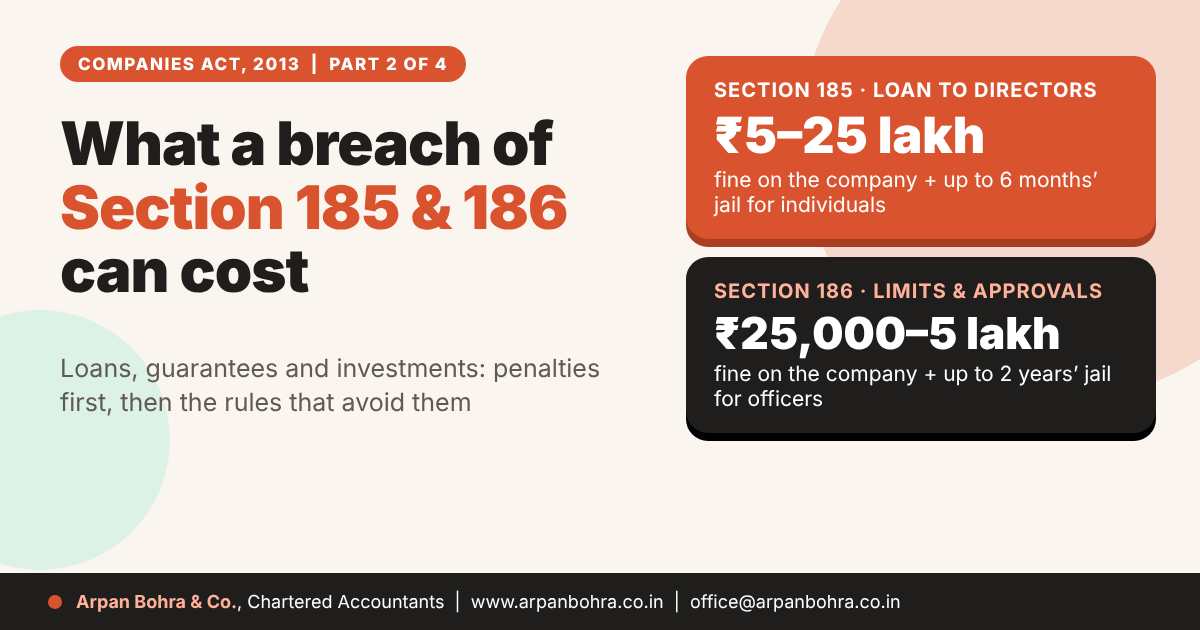
The short answer. Section 185 of the Companies Act, 2013 bars a company from lending to its directors and to persons closely connected with them, subject to narrow exceptions. Section 186 caps how much a company can lend, guarantee or invest in other bodies corporate, and lists the approvals needed. Breach of Section 185 carries a fine of ₹5 lakh to ₹25 lakh on the company and possible imprisonment of up to six months for the officers in default and for the director or other person who took the loan. Breach of Section 186 carries a fine of ₹25,000 to ₹5 lakh on the company and imprisonment of up to two years for the officers in default. The rest of this guide shows how these consequences arise and how to avoid them.
This is general educational information, not advice on specific facts. It is the second article in a series; the first covers related party transactions under Section 188.
1. What is at stake: the penalties
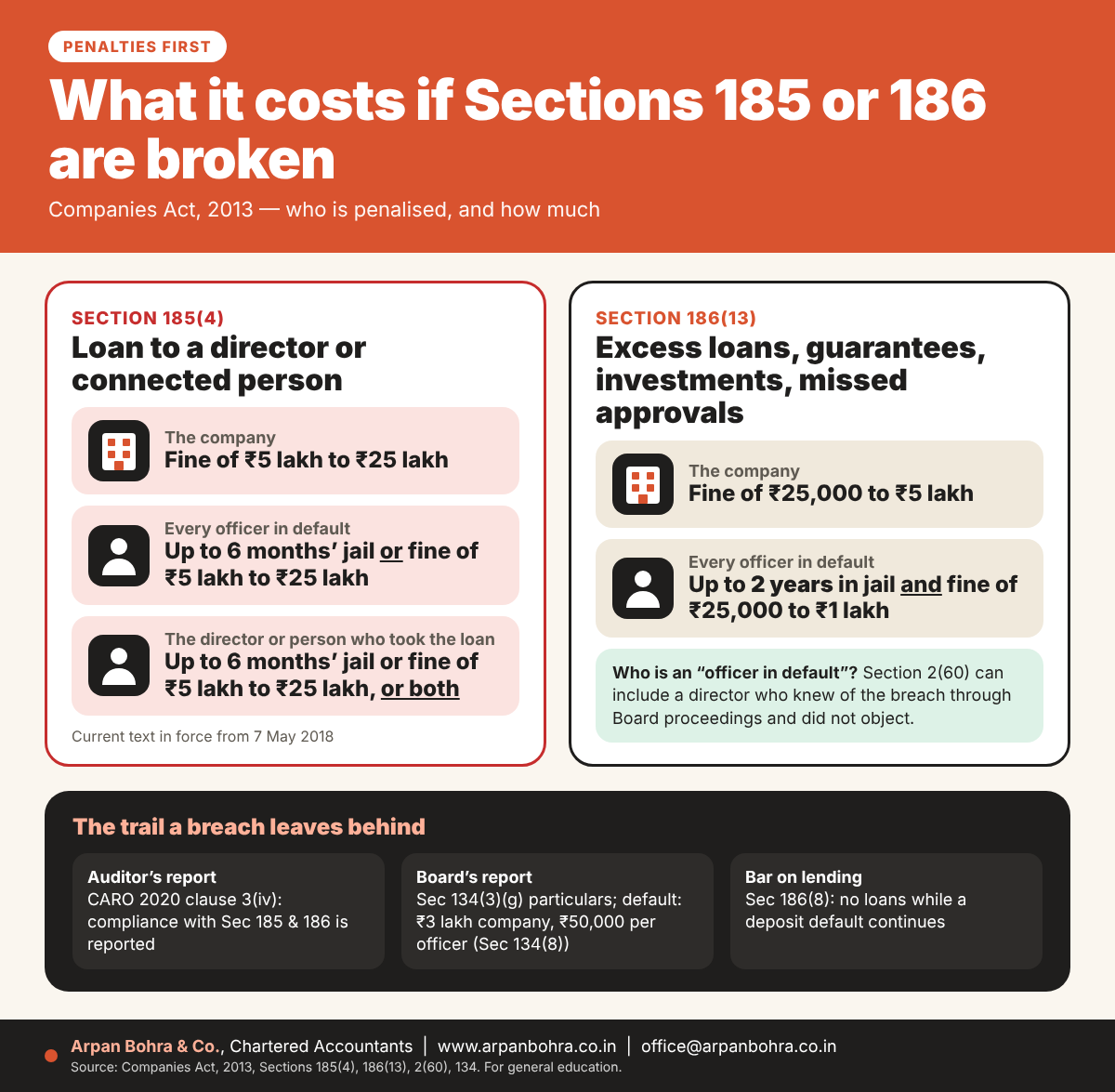
| Provision | Who is penalised | Penalty |
|---|---|---|
| Section 185(4) | The company | Fine of not less than ₹5 lakh, which may extend to ₹25 lakh |
| Section 185(4) | Every officer of the company in default | Imprisonment of up to six months or fine of ₹5 lakh to ₹25 lakh |
| Section 185(4) | The director or other person to whom the loan was advanced, or for whom the guarantee or security was given | Imprisonment of up to six months or fine of ₹5 lakh to ₹25 lakh, or both |
| Section 186(13) | The company | Fine of not less than ₹25,000, which may extend to ₹5 lakh |
| Section 186(13) | Every officer in default | Imprisonment of up to two years and fine of ₹25,000 to ₹1 lakh |
The Section 185 penalties in this form apply from 7 May 2018, when the Companies (Amendment) Act, 2017 substituted the section. Two features make these provisions more serious than most compliance defaults. First, they are not limited to a money penalty on the company: they reach individuals, and they include imprisonment. Second, the borrower himself can be punished under Section 185, so a director who takes a prohibited loan is exposed along with those who approved it.
Who is an “officer in default”?
Section 2(60) defines the term. It includes whole-time directors and key managerial personnel, and it can also reach a director who was aware of the contravention through the proceedings of the Board and did not object. In practice this means that a director who sits through a Board meeting where an unauthorised loan is approved cannot assume that only the managing director is exposed.
What else follows from non-compliance
- Auditor’s report. For companies covered by the Companies (Auditor’s Report) Order, 2020, the auditor reports under clause 3(iv) on whether Sections 185 and 186 have been complied with in respect of loans, investments, guarantees and security. A breach therefore surfaces in a document that shareholders, lenders and investors read.
- Board’s report. Particulars of loans, guarantees and investments under Section 186 are to be given in the Board’s report (Section 134(3)(g)). Default in the Board’s report attracts its own penalty under Section 134(8): ₹3 lakh on the company and ₹50,000 on each officer in default.
- Financial statements. Section 186(4) requires the financial statements to disclose full particulars of loans, guarantees, security and investments, including the purpose for which the recipient will use the amount.
- A bar on further lending. Under Section 186(8), a company that is in default in repaying deposits or paying interest on them cannot give loans, guarantees or security, or make acquisitions, while the default continues.
- Due diligence. Banks, investors and acquirers routinely ask for confirmation of compliance with Sections 185 and 186. An unresolved breach can delay a funding round or a sale.
2. Nine slips that cause most breaches
- Lending to a director, or to his or her relative or partner, because “the interest is being charged” (Section 185 does not allow it on that ground).
- Lending to, or guaranteeing the bank loan of, a private company in which a director is a member or director, without a special resolution.
- Treating a guarantee or security as “not a loan” and skipping the limit check.
- Investing in another company’s shares beyond the Section 186(2) limit without a prior special resolution.
- Passing the Board resolution when one director present at the meeting dissents. Section 186(5) needs the consent of all directors present.
- Charging interest below the prevailing Government security yield (Section 186(7)).
- Not maintaining the register of loans, guarantees, security and investments (Form MBP-2), or not updating it within seven days.
- Ignoring a term-loan lender’s prior approval where one is needed.
- Giving loans while a deposit default is continuing.
The next sections explain the rules behind each of these, starting with the plain meaning of the terms.
3. The terms in plain words
| Term | Plain meaning |
|---|---|
| Loan | Money lent by the company, including a book debt that is left outstanding. Section 185(1) refers to lending “directly or indirectly” |
| Guarantee | The company promises a bank or lender that it will repay if someone else does not |
| Security | The company puts up its assets (property, deposits, shares) as cover for someone else’s loan |
| Investment | The company buys shares, debentures or other securities of another body corporate |
| Body corporate | A company or other incorporated entity |
| Special resolution | A resolution of the shareholders passed by at least three-fourths of the votes cast at a general meeting, with an explanatory statement. It is filed with the Registrar in Form MGT-14 |
| Free reserves, securities premium | Accumulated profits available for distribution and the premium received on shares, as shown in the balance sheet |
Why does the law restrict these? The company’s money belongs to its shareholders and, in part, to its creditors. If directors could lend it to themselves, their families or their other businesses, the company could be emptied without a single sale or purchase. Section 185 shuts that door. Section 186 does not forbid lending or investing; it limits the total exposure and requires clear approvals.
4. Section 185: loans to directors and connected persons
The rule
Section 185(1) says a company shall not, directly or indirectly, advance any loan (including a book debt), or give any guarantee or provide any security in connection with a loan taken by:
- any director of the company, or of a company which is its holding company, or any partner or relative of any such director; or
- any firm in which any such director or relative is a partner.
The word “relative” has the meaning explained in the first article of this series (Section 2(77) and Rule 4): spouse, members of the same HUF, parents, children and their spouses, and brothers and sisters, with the step-relations specified in the Rule. Note that the ban extends to directors of the holding company, so a subsidiary cannot lend to the parent’s directors either.
The route that is allowed: persons in whom a director is interested (Section 185(2))
A company may give a loan, guarantee or security to “any person in whom any of the directors is interested” if two conditions are met: a special resolution is passed in a general meeting, with an explanatory statement disclosing the full particulars of the loan, guarantee or security and its purpose; and the borrowing company uses the loan for its principal business activities.
The Explanation says a person is one in whom a director is interested if it is:
- a private company of which the director is a director or member;
- a body corporate at whose general meeting the director, or two or more directors together, may exercise or control at least 25% of the total voting power; or
- a body corporate whose Board, managing director or manager is accustomed to act on the directions or instructions of the Board or of any director of the lending company.
Exceptions (Section 185(3))
Sections 185(1) and (2) do not apply to:
- a loan to a managing or whole-time director as part of the conditions of service extended to all employees, or under a scheme approved by the members by a special resolution;
- a loan or guarantee given in the ordinary course of business by a company that does so as part of its business, where interest is charged at not less than the prevailing yield of the one-year, three-year, five-year or ten-year Government security closest to the tenor of the loan;
- a loan by a holding company to its wholly owned subsidiary, or a guarantee or security by it for a loan to its wholly owned subsidiary; and
- a guarantee or security by a holding company for a loan taken by its subsidiary from a bank or financial institution.
The last two exceptions carry a condition: the subsidiary must use the loan for its principal business activities. They are exceptions to Section 185 only. Section 186 and the other provisions still have to be checked.
Relief for private companies
Under an MCA notification dated 5 June 2015, Section 185 does not apply to a private company that satisfies all three of these conditions: no other body corporate has invested in its share capital; its borrowings from banks, financial institutions or any body corporate are less than twice its paid-up share capital or ₹50 crore, whichever is lower; and it has no subsisting default in repaying such borrowings at the time of the transaction. A private company that fails even one condition falls back under the section. Being private is not, by itself, a defence.
Interest is not a defence
A common belief is that a loan to a director is fine “if interest is charged at market rate and repaid”. Section 185 does not work that way. The interest-rate floor appears only in the exception for companies that lend in the ordinary course of their business. A company whose business is not lending cannot rely on it.
5. Section 186: how much can a company lend, guarantee or invest?
Section 186 applies to loans, guarantees, security and investments in any other body corporate or person. Unlike Section 185, it does not prohibit them. It controls three things: the size, the approvals and the paperwork.
The limit (Section 186(2))
A company shall not, directly or indirectly, give any loan to any person or body corporate, give any guarantee or provide any security in connection with a loan to any other body corporate or person, or acquire the securities of any other body corporate, beyond the higher of:
- 60% of its paid-up share capital, free reserves and securities premium account; or
- 100% of its free reserves and securities premium account.
Beyond the limit: a special resolution first (Section 186(3))
If the total of loans, investments, guarantees and security already made, together with the new one proposed, exceeds that limit, the company needs a special resolution passed at a general meeting before it acts. Loans, guarantees or security to a wholly owned subsidiary or a joint venture company, and a holding company’s acquisition of securities of its wholly owned subsidiary, are exempt from this special resolution requirement, but the particulars must still be disclosed in the financial statements.
Every transaction: Board approval (Section 186(5))
A loan, guarantee, security or investment needs a Board resolution passed at a Board meeting with the consent of all the directors present at the meeting. If the company has a term loan outstanding, prior approval of the public financial institution concerned is also needed; that approval is not required where the Section 186(2) limit is not exceeded and the company is not in default in repaying instalments or interest on the term loan.
Pricing: interest floor (Section 186(7))
No loan can be given at a rate of interest lower than the prevailing yield of the one-year, three-year, five-year or ten-year Government security closest to the tenor of the loan.
Layers of investment companies (Section 186(1))
A company can make investments through not more than two layers of investment companies, with exceptions for the acquisition of a foreign company with more layers under its country’s law, and for a subsidiary that must have investment subsidiaries to meet a legal or regulatory requirement.
Paperwork
- Register. The company must keep a register of loans, guarantees, security and acquisitions at its registered office, in Form MBP-2. Rule 12 of the Meetings of Board Rules requires entries to be updated within seven days and the register to be preserved permanently. The register is open for inspection under Section 186(10).
- Disclosure. Full particulars, and the purpose for which the recipient will use the amount, go in the financial statements (Section 186(4)) and in the Board’s report (Section 134(3)(g)).
- Special resolutions are filed with the Registrar in Form MGT-14.
Who is outside Section 186
Section 186(11) exempts, apart from the layer rule in sub-section (1), banking, insurance and housing finance companies lending or investing in the ordinary course of their business, and companies engaged in financing industrial enterprises or infrastructure; investments by investment companies; shares allotted under Section 62(1)(a) and rights issues; and the investment and lending activities of RBI-registered NBFCs whose principal business is acquiring securities. By the Companies (Meetings of Board and its Powers) Amendment Rules, 2025, applicable from 6 November 2025, Rule 11 now defines “business of financing industrial enterprises” for Section 186(11)(a), covering lending and guarantees in the ordinary course by RBI-registered NBFCs and by finance companies registered with the IFSCA. Section 186 also does not apply to certain government companies and to specified IFSC companies on the conditions notified by the MCA. The MCA has also clarified (Clarification 04/2015) that loans to employees other than the managing or whole-time director, given in line with service conditions and the remuneration policy, are outside Section 186.
6. Section 185 and Section 186 together: one decision path
Before a company lends, guarantees or invests, ask these questions in this order:
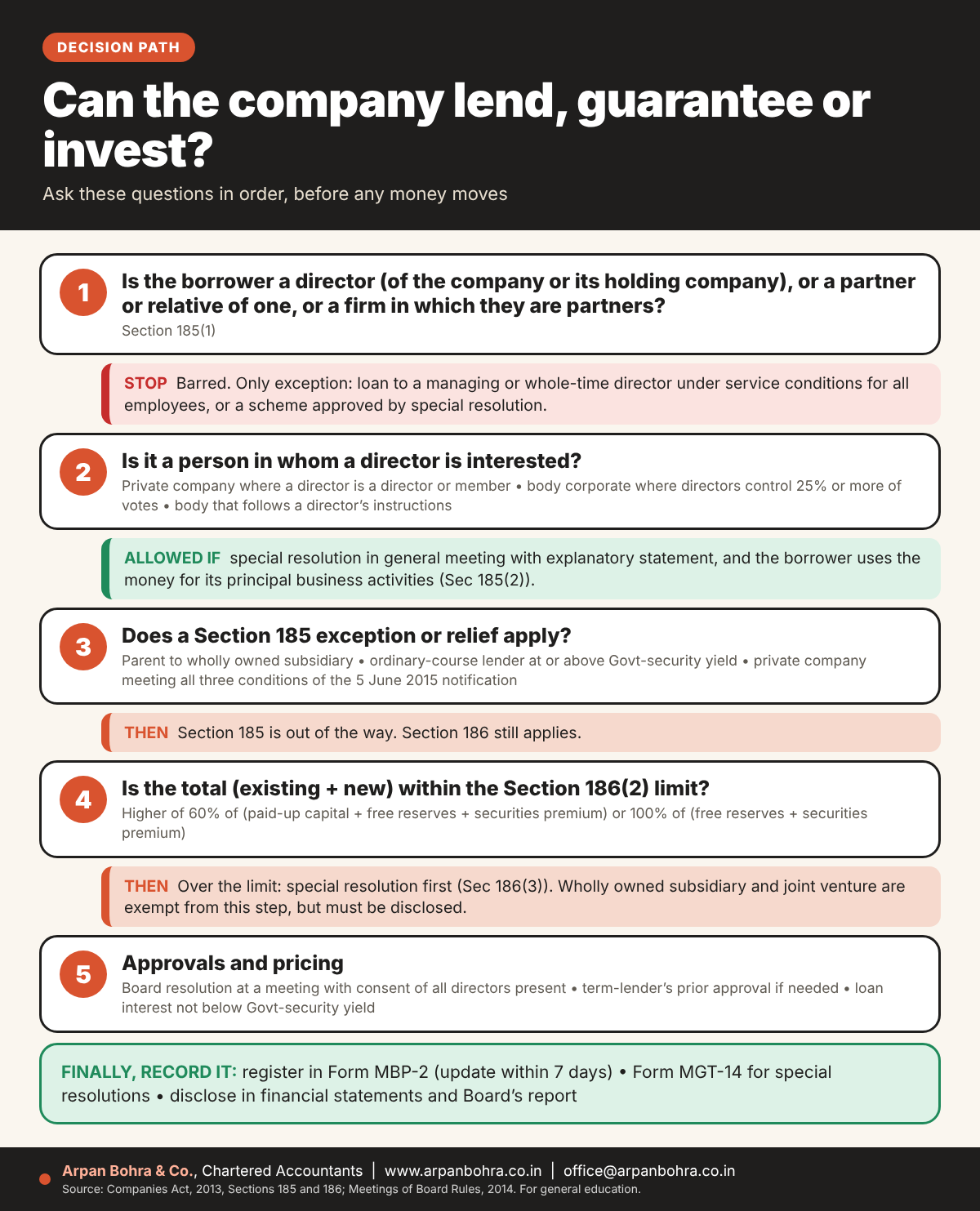
- Who is the borrower? If it is a director of the company or of its holding company, or a partner or relative of such a director, or a firm in which they are partners: Section 185(1) bars it, unless the managing or whole-time director service-condition exception applies.
- Is it a person in whom a director is interested (private company where a director is a director or member; body corporate where directors control 25% or more of the voting power; a body that follows a director’s instructions)? Then the Section 185(2) route is open: special resolution, explanatory statement, and use for the borrower’s principal business activities.
- Is an exception available (holding company to wholly owned subsidiary; ordinary-course lender with the interest floor; private company relief on the three conditions)?
- Now apply Section 186. Compute the limit, check whether the aggregate crosses it, and obtain the special resolution if it does.
- Board approval with the consent of all directors present, and the term-lender’s prior approval if needed.
- Price at or above the Government security yield for loans.
- Record and disclose: register in Form MBP-2, financial statements, Board’s report and Form MGT-14 for special resolutions.
7. Four worked examples (figures are illustrative)
| Situation | Analysis | Outcome |
|---|---|---|
| A company lends ₹25 lakh at 12% interest to the brother of one of its directors | The brother is a relative of a director. Section 185(1) bars the loan, and no exception applies. Interest does not change this | Prohibited. Penalty exposure under Section 185(4) for the company, the officers in default and the borrower |
| A company lends ₹40 lakh to a private company in which a director is a member. The borrower will use it for its main business | A person in whom a director is interested (Section 185(2)) | Allowed only with a special resolution passed in general meeting, an explanatory statement and use for principal business activities. Then check the Section 186 limit |
| Paid-up capital ₹2 crore, free reserves ₹3 crore, securities premium ₹1 crore. Existing loans and investments ₹3 crore. The Board proposes a new ₹1.5 crore investment | 60% of ₹6 crore is ₹3.6 crore; 100% of ₹4 crore is ₹4 crore; the higher figure, ₹4 crore, is the limit. Existing ₹3 crore plus ₹1.5 crore is ₹4.5 crore | Limit exceeded. Special resolution first, then Board approval with the consent of all directors present. A ₹0.8 crore investment (total ₹3.8 crore) would need only the Board approval |
| A parent company lends ₹5 crore to its wholly owned subsidiary for the subsidiary’s main business | Exception under Section 185(3); exempt from the Section 186(3) special resolution | Board approval with the consent of all directors present, interest floor under Section 186(7), entry in Form MBP-2 and disclosure in the financial statements |
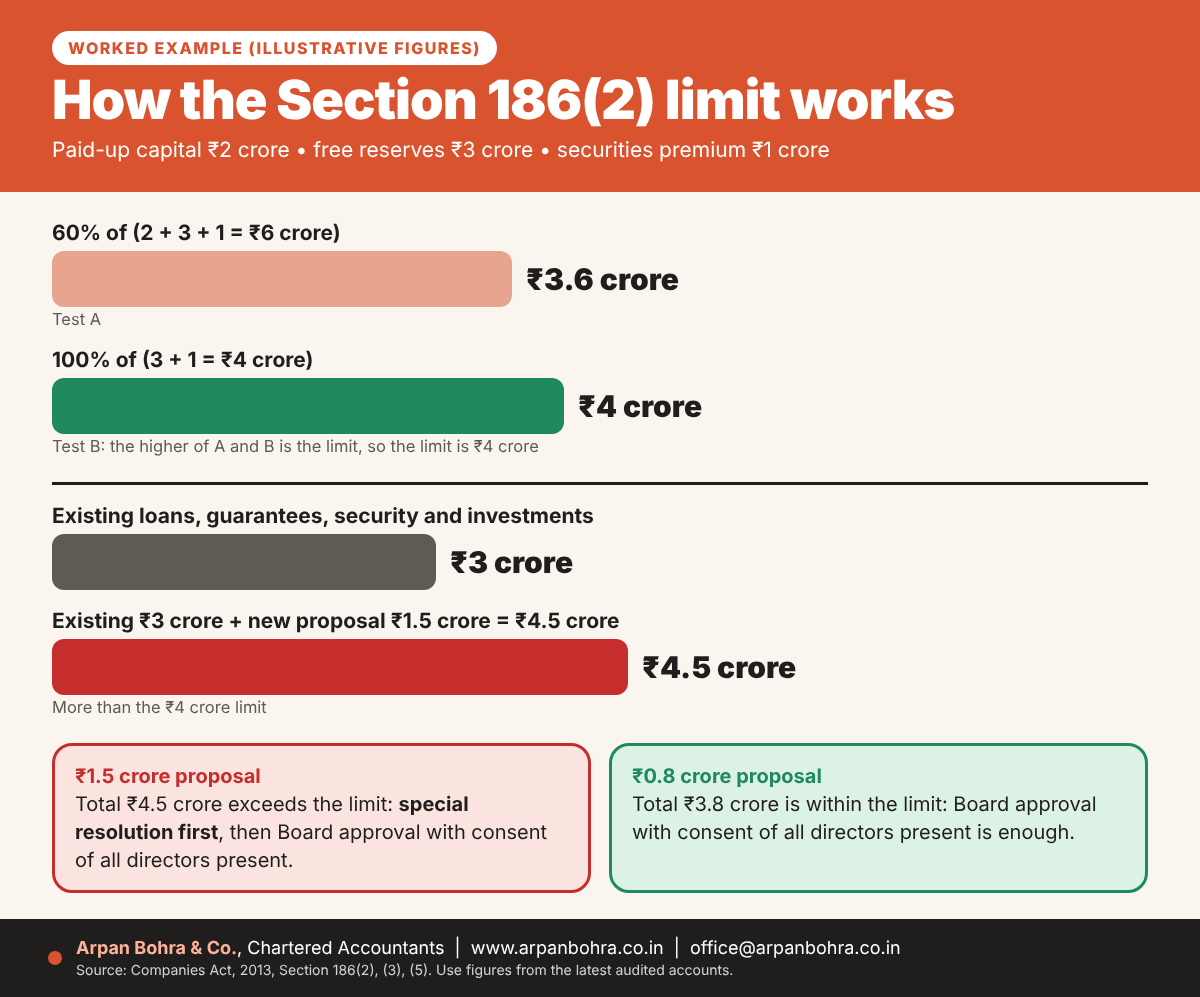
The third example assumes the figures come from the company’s balance sheet and ignores any employee-loan or exempt category. Always confirm the base figures from the latest audited accounts.
8. A one-page compliance checklist
| Step | Who | Evidence to keep |
|---|---|---|
| Identify the borrower or investee and test against Section 185(1) and the Section 185(2) Explanation | Company secretary / finance head | Note listing directors, relatives, firms and companies checked |
| Check the Section 185(3) exceptions and the private company relief conditions | Finance and legal | Working of the three conditions where relied on |
| Compute the Section 186(2) limit and the running aggregate | Finance | Limit workings from the balance sheet |
| Obtain a special resolution where Section 185(2) or Section 186(3) requires one | Board / members | Notice with explanatory statement; Form MGT-14 filing |
| Obtain prior approval of the term-loan lender where needed | Finance | Lender’s written approval |
| Pass a Board resolution with the consent of all directors present | Board | Minutes recording each director’s consent |
| Fix the interest rate at or above the Government security yield | Finance | Yield reference and tenor |
| Update Form MBP-2 within seven days | Company secretary | Register entry |
| Disclose in financial statements and the Board’s report | Finance / Board | Notes to accounts; Board’s report |
9. Where the law stands today
The penalties and conditions above are those of the Companies Act, 2013 as it applies today. The Corporate Laws (Amendment) Bill, 2026 was introduced in the Lok Sabha on 23 March 2026 and referred to a Joint Parliamentary Committee, which submitted its report on 3 August 2026. The PRS India page on the Bill does not list changes to Sections 185 or 186, and the sources we checked show that the Bill was not enacted at the time of writing. Commentary on the Bill reports three points relevant to this topic: that contraventions connected with the register of inter-corporate loans and investments under Section 186(9) and (10) would attract civil monetary penalties instead of criminal consequences; that the monetary threshold for compounding of offences under Section 441 would rise from ₹25 lakh to ₹1 crore; and that a settlement mechanism would be introduced for proceedings under Section 454. These are reported proposals, and the final text of the Act will control. Until it is enacted and brought into force, the penalties in section 1 of this article apply.
10. Frequently asked questions
Q1. Can a company lend to its director if it charges interest at the market rate?
Not under Section 185(1), unless an exception applies, such as a loan to a managing or whole-time director under service conditions extended to all employees or under a scheme approved by a special resolution. Charging interest is not an exception for a company whose business is not lending.
Q2. Does Section 186 apply to guarantees and security, or only to loans?
To both, and to investments as well. Section 186(2) covers loans, guarantees, security and the acquisition of securities.
Q3. Does Section 186 apply to loans to a wholly owned subsidiary?
Yes, but the special resolution under Section 186(3) is not required. Board approval with the consent of all directors present, the interest floor for loans, the register and the disclosures still apply.
Q4. Do Sections 185 and 186 apply to private companies?
Yes. A private company escapes Section 185 only if it meets all three conditions of the MCA notification of 5 June 2015. Section 186 applies to private companies in the same way as to others, subject to the exemptions in the section and the notifications.
Q5. Who can be punished for a breach?
Under Section 185(4) the company, the officers in default, and the director or other person who received the loan. Under Section 186(13) the company and the officers in default.
11. Primary sources
- Companies Act, 2013, Sections 2(60), 134, 185 and 186 – Ministry of Corporate Affairs and India Code.
- Companies (Meetings of Board and its Powers) Rules, 2014, Rules 11 and 12, as amended, including the Amendment Rules, 2025 (applicable from 6 November 2025).
- MCA notification dated 5 June 2015 on exemptions to private companies and government companies; MCA General Clarification 04/2015 on loans to employees.
- Companies (Auditor’s Report) Order, 2020, clause 3(iv).
- PRS India – The Corporate Laws (Amendment) Bill, 2026.
12. Takeaway
Section 185 is a prohibition with narrow exceptions; Section 186 is a limit with approvals. The cost of getting either wrong is personal as well as corporate. The safest habit is a single sign-off sheet, completed before any money moves, that answers the questions in section 6 and records the approvals in section 8.
This article is for general educational purposes and is not professional advice on any particular situation.
Arpan Bohra & Co., Chartered Accountants
Himayat Nagar, Hyderabad
Website: https://www.arpanbohra.co.in/ | Email: office@arpanbohra.co.in