

By CA Arpan Bohra (FCA, CS), Arpan Bohra & Co., Chartered Accountants, Hyderabad. Position of law as at 20 October 2026.
Foreign money in, forms on time: the FEMA reports every investee must file.
A start-up receives foreign funds, issues shares and moves on. A year later its bank asks for an FC-GPR acknowledgement that was never filed. Reporting under the Foreign Exchange Management Act, 1999 is a fact-based compliance with fixed deadlines, and delay is regularised through a late submission fee or, in some cases, compounding.
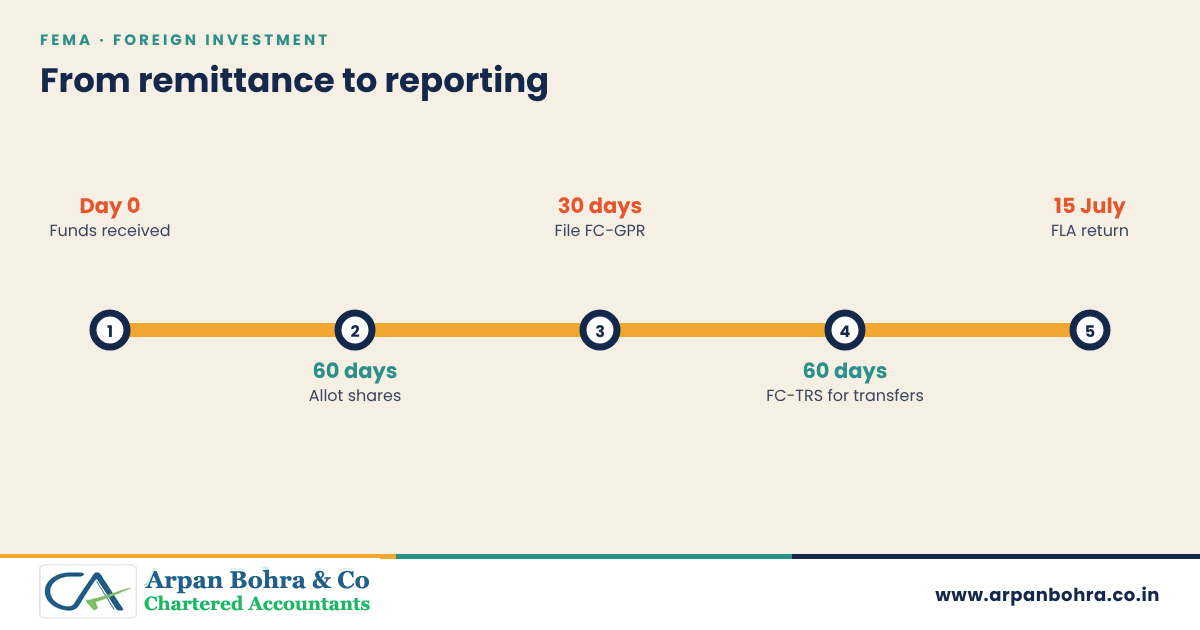
Indian companies receiving foreign investment must report under the Foreign Exchange Management (Non-debt Instruments) Rules, 2019 and the RBI directions: Form FC-GPR within 30 days of allotment of shares, Form FC-TRS within 60 days of a transfer between a resident and a non-resident (reporting is generally through the Single Master Form on the FIRMS portal), Form DI within 30 days of downstream investment, and the FLA return by 15 July every year. Delays attract a late submission fee and, for serious contraventions, penalty under section 13 of FEMA. Verify the current forms and fee schedule.
Key reports
| Report | Trigger | Time limit |
|---|---|---|
| FC-GPR | Allotment of equity instruments to a person resident outside India | 30 days from allotment; funds must be received through banking channels before allotment, and shares allotted within 60 days of receipt |
| FC-TRS | Transfer of equity instruments between a resident and a non-resident | 60 days from the earlier of transfer or receipt or remittance of funds |
| Form DI | Downstream investment by an Indian entity owned or controlled by non-residents | 30 days from allotment |
| FLA return | Annual Foreign Liabilities and Assets return on the RBI portal | 15 July each year |
| ECB reporting | External commercial borrowing: Form ECB 2 monthly | Within 7 working days from the end of the month (verify) |
| APR | Annual Performance Report for overseas direct investment | By 31 December each year (verify) |
Pricing and compliance conditions
- Equity instruments of an unlisted Indian company must be issued to non-residents at or above fair value, determined by a chartered accountant, a SEBI-registered merchant banker or a practising cost accountant, under internationally accepted methodology (verify the current rule).
- Transfers from residents to non-residents must be at or above fair value, and from non-residents to residents at or below it, subject to the exceptions.
- Sectoral caps, entry route and conditions apply; investment in a prohibited sector is not allowed.
- The company must obtain KYC of the investor and the foreign inward remittance certificate (FIRC) or equivalent from the bank.
Consequences of delay
| Item | Position |
|---|---|
| Late submission fee (LSF) | A fee is charged by the AD bank on late filing, computed on the amount involved and the delay, under the RBI directions; verify the current schedule and the fee applicable to your filing |
| Compounding | Contraventions can be compounded by the RBI under the FEMA (Compounding Proceedings) Rules, 2024 (verify); a compounding order follows an application and payment |
| Penalty under section 13 | Up to three times the sum involved where quantifiable, or up to ₹2 lakh where not quantifiable, with up to ₹5,000 a day for continuing contraventions |
| Adjudication | By the Authority under section 16, with appeals to the Appellate Tribunal |
Worked example
A company receives ₹2 crore from a foreign investor on 5 June 2026 and allots shares on 10 July 2026.
- Allotment within 60 days of receipt: satisfied.
- FC-GPR due within 30 days of allotment, by 9 August 2026.
- If filed on 20 September 2026, it is late by 42 days; the AD bank will process it with a late submission fee under the RBI scheme, after the company explains the delay.
- The FLA return for the year is due 15 July of the next year and must show the investment.
Checklist
- Obtain the investor KYC and the remittance details and confirm the sector and route.
- Get the valuation certificate before allotment or transfer.
- Allot shares within 60 days of receipt of funds.
- File FC-GPR or FC-TRS on the portal within the time limit with the supporting documents.
- File the FLA return by 15 July, and Form DI where the company invests downstream.
- Keep a FEMA register and proof of filings for audit and due diligence.
Frequently asked questions
What is the time limit for FC-GPR?
Is FC-TRS required for every share transfer to a non-resident?
What is the FLA return?
What if I miss the due date?
Is a CA certificate needed?
Does FEMA apply to a startup receiving a convertible note?
Arpan Bohra & Co., Chartered Accountants, Himayat Nagar, Hyderabad.
This article is shared for general professional education. Readers may write to the firm for information about its practice areas.
General educational information as at 20 October 2026. It is not legal or tax advice and does not create a professional relationship. Provisions, rates and thresholds change; verify the current law and notifications before acting. References to the 57th GST Council (8 October 2026) are to recommendations that need amendments or notifications before they have legal effect.