
By CA Arpan Bohra (FCA, CS), Arpan Bohra & Co., Chartered Accountants, Hyderabad. Position of law as at 20 October 2026.
A start-up in Hyderabad has crossed ₹18 lakh in its first year, and the founder asks three questions in one breath: do we need a GST registration yet, can we opt for the composition scheme, and when does e-invoicing start? Each answer turns on a different limit, measured on a different base and checked at a different time. Missing one of them produces a late registration, a lost composition option or a blocked e-way bill. This article collects the limits a growing business meets in order, with the provision behind each.
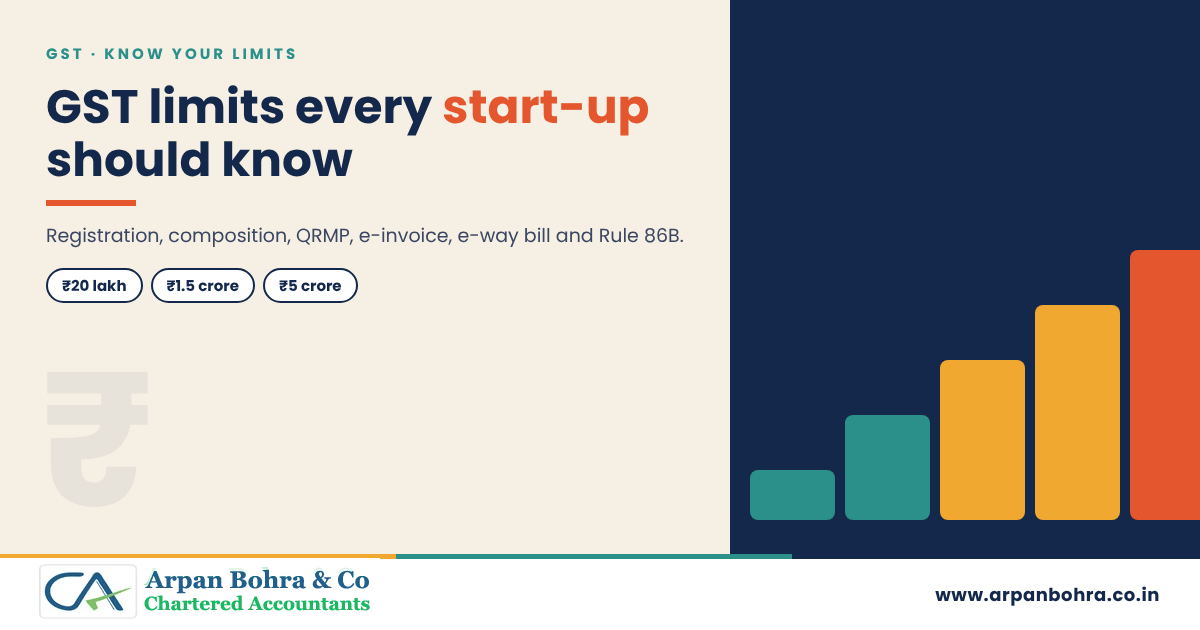
The limits that matter most: registration at aggregate turnover above ₹20 lakh (services or mixed supplies) and ₹40 lakh (exclusive supply of goods, but ₹20 lakh in Telangana); composition for goods and restaurants up to ₹1.5 crore and for services up to ₹50 lakh (the goods limit is ₹75 lakh in Uttarakhand and the North-Eastern States); quarterly returns under QRMP up to ₹5 crore; e-invoicing above ₹5 crore; an e-way bill for consignments above ₹50,000; and the Rule 86B cash restriction where taxable supplies exceed ₹50 lakh in a month. Aggregate turnover is computed on an all-India basis for the PAN. Thresholds can change by notification; confirm the current position before relying on any figure.
The limits at a glance
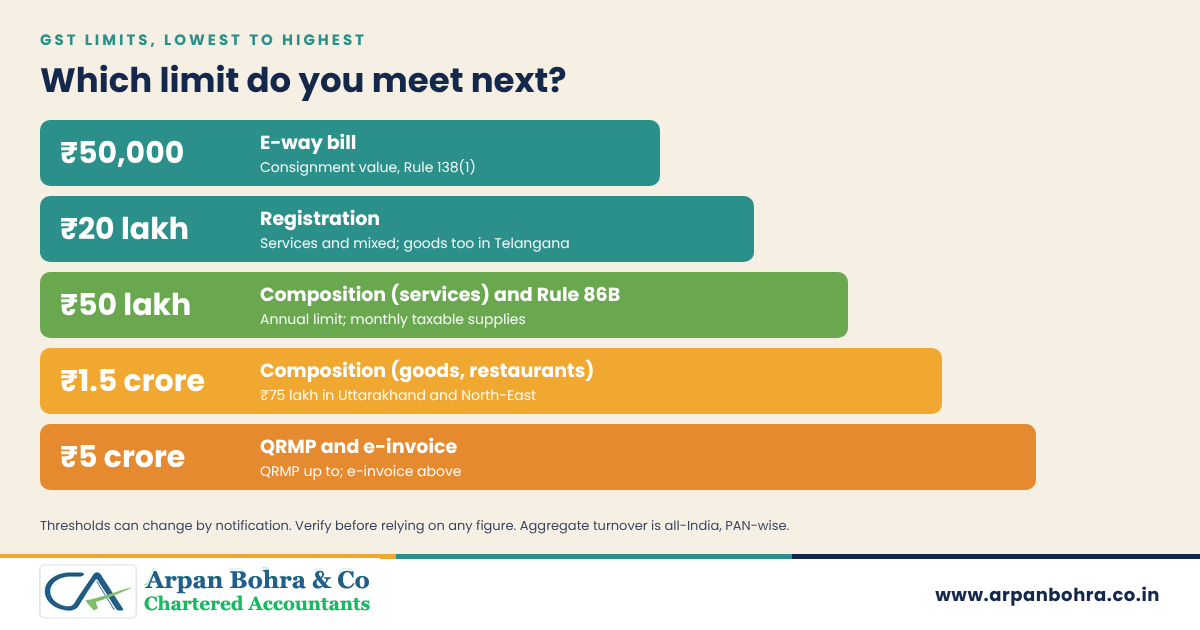
| Limit | Threshold | Applies to | Provision or source |
|---|---|---|---|
| E-way bill | Consignment value above ₹50,000 | Movement of goods | Rule 138(1), CGST Rules |
| Registration, services or mixed | Aggregate turnover above ₹20 lakh (₹10 lakh in notified special category States) | Service providers; suppliers of goods and services | Section 22(1), CGST Act |
| Registration, goods only | ₹40 lakh (₹20 lakh in Telangana and the other listed States) | Exclusive suppliers of goods | Notification 10/2019-Central Tax |
| Composition, services | Up to ₹50 lakh | Eligible service providers | Section 10(2A), CGST Act |
| Rule 86B | Taxable supplies above ₹50 lakh in a month | Restricts credit ledger use to 99% of output tax | Rule 86B, CGST Rules |
| Composition, goods and restaurants | Up to ₹1.5 crore (₹75 lakh in Uttarakhand and North-Eastern States) | Eligible manufacturers, traders and restaurants | Section 10(1), CGST Act |
| QRMP | Aggregate turnover up to ₹5 crore | Quarterly GSTR-1 and GSTR-3B | Notification and GST portal FAQs |
| E-invoice | Aggregate turnover above ₹5 crore | B2B and export invoices | Notification 10/2023-Central Tax (1 August 2023) |
Registration
Aggregate turnover is the all-India total, on the same PAN, of taxable supplies, exempt supplies and exports, excluding tax. Registration is required once the threshold is crossed, and the application must be made within 30 days (section 25). Some persons must register regardless of turnover under section 24, including inter-State suppliers of goods, persons liable under reverse charge, casual and non-resident taxable persons, agents, and e-commerce operators and suppliers through them where tax is to be collected at source. Inter-State taxable services are exempt from registration up to ₹20 lakh (₹10 lakh in the four North-Eastern States listed in the notification).
In Telangana the goods limit is ₹20 lakh, because Telangana is excluded from the ₹40 lakh relief. See our note on GST registration in Hyderabad and the ₹20 lakh limit.
Composition scheme
- Turnover. Preceding-year turnover up to ₹1.5 crore for goods and restaurants, and up to ₹50 lakh for eligible services.
- Rates. The GST Council flyer lists 1% for manufacturers and traders, 5% for restaurants and 6% for service providers, on turnover (verify the current notified rates).
- Who cannot opt. Persons making inter-State supplies, casual and non-resident taxable persons, those supplying through an e-commerce operator liable to collect tax at source, and others listed in section 10.
- Consequences. No input tax credit, no tax collected from customers, a bill of supply instead of a tax invoice, and tax on reverse-charge inward supplies still payable.
- Compliance. Payment through Form CMP-08 by the 18th of the month after each quarter, and annual return GSTR-4 by 30 April.
QRMP and e-invoicing
Taxpayers with aggregate turnover up to ₹5 crore at PAN level can opt for the Quarterly Return Monthly Payment scheme if their last due GSTR-3B has been filed. Tax for the first two months of a quarter is paid by challan in Form PMT-06 by the 25th of the next month, either on a fixed 35% basis or on actual self-assessment. The optional Invoice Furnishing Facility lets quarterly filers pass credit to recipients in the first two months. E-invoicing is mandatory above ₹5 crore of aggregate turnover under Notification 10/2023-Central Tax with effect from 1 August 2023; verify the turnover test across preceding years in the notification.
E-way bill and Rule 86B
A registered person moving goods with consignment value above ₹50,000 must furnish Part A of Form GST EWB-01 before movement (Rule 138(1)). Value includes the taxes charged. Below the limit the bill is optional; certain job-work movements are covered regardless of value, and a list of goods and movements is exempt under Rule 138(14). Validity is one day for each 200 km or part thereof. For interception issues, see our note on e-way bill interception.
Rule 86B restricts use of the electronic credit ledger to 99% of output tax where taxable supplies (excluding exempt and zero-rated supplies) exceed ₹50 lakh in a month, with at least 1% payable in cash. The Rule has exceptions, for example income tax paid above ₹1 lakh in each of the last two years, refund of more than ₹1 lakh in the preceding year under section 54(3), and cash payment already above 1% cumulatively. Read our Rule 86B article for the litigation position.
Worked example: crossing the registration limit
A Hyderabad start-up sells subscriptions (services) of ₹14 lakh and a small hardware accessory (goods) of ₹8 lakh in a financial year. It has no other business on the same PAN.
- Aggregate turnover = ₹14 lakh + ₹8 lakh = ₹22 lakh, above the ₹20 lakh limit for services and mixed supplies.
- Registration was due when aggregate turnover crossed ₹20 lakh, with the application within 30 days of that date, not at year end.
- Composition is not available to a person making inter-State supplies, so a start-up that sells to customers in other States will usually not qualify, whatever its turnover.
- Once it exceeds ₹5 crore, e-invoicing applies; below ₹5 crore it can opt for QRMP.
Had all ₹22 lakh been inter-State services, the exemption for inter-State taxable services up to ₹20 lakh would not have applied either, because turnover exceeds ₹20 lakh.
What the 57th GST Council recommended
The 8 October 2026 recommendations touching these limits include simplified registration for small e-commerce goods suppliers under a proposed Rule 14B, an optional quarterly scheme for B2C-only taxpayers with turnover up to ₹5 crore (concept approved in principle, framework pending), and e-invoicing for specified reverse-charge supplies from unregistered persons and imports of services for taxpayers with turnover of ₹5 crore or more. These are recommendations only and need amendments and notifications. See our summary of the 57th meeting.
Frequently asked questions
What is the GST registration limit for a start-up in Telangana?
Does turnover include exports and exempt supplies?
What is the composition scheme limit?
When is e-invoicing mandatory?
Is an e-way bill needed for goods below ₹50,000?
What is Rule 86B?
Arpan Bohra & Co., Chartered Accountants, Himayat Nagar, Hyderabad.
This article is shared for general professional education. Readers may write to the firm for information about its practice areas.
General educational information as at 20 October 2026. It is not legal or tax advice and does not create a professional relationship. Provisions, rates and thresholds change; verify the current law and notifications before acting. References to the 57th GST Council (8 October 2026) are to recommendations that need amendments or notifications before they have legal effect.