
By CA Arpan Bohra (FCA, CS), Arpan Bohra & Co., Chartered Accountants, Hyderabad. Position of law as at 20 October 2026.
A founder in Hyderabad is choosing between a private limited company, an LLP and a partnership firm for a new business expected to earn ₹80 lakh in its first full year. A CFO of a foreign group is reviewing the tax cost of a branch versus a subsidiary. Both need one table: the rate for each type of person for tax year 2026-27, with the surcharge and cess that sit on top. Since 1 April 2026 those rates are charged under the Income-tax Act, 2025, with new section numbers but largely the same rates.
For tax year 2026-27: individuals, HUFs and similar persons pay under section 202 (nil to ₹4 lakh rising to 30% above ₹24 lakh in the default regime); domestic companies pay 25% if base-year turnover was up to ₹400 crore and they stay in the normal regime (section 199), otherwise 30%, or 22% under section 200 and 15% for qualifying new manufacturing companies under section 201, each with a 10% flat surcharge; foreign companies pay 35%; firms and LLPs pay 30%; co-operative societies pay slab rates of 10%, 20% and 30%, or 22% under section 203. Add surcharge and 4% cess. Rates reported unchanged by the Finance Bill, 2026, except the proposed MAT cut, which needs verification against the Finance Act.
Rates by type of person
| Person | Rate, tax year 2026-27 | Provision (Income-tax Act, 2025) |
|---|---|---|
| Individual, HUF, AOP (not co-operative), BOI, artificial juridical person | Default slabs: nil to ₹4 lakh, then 5% to 30%. Optional old slabs by opt-out | Section 202; opt-out under 202(4). See our slabs article |
| Domestic company, normal regime | 25% if base-year turnover or gross receipts did not exceed ₹400 crore (tax year 2024-25) and the company continues under section 199; otherwise 30% | Section 199 |
| Domestic company, concessional | 22% with 10% surcharge, subject to conditions such as no specified deductions | Section 200 |
| New manufacturing company | 15% with 10% surcharge, subject to conditions | Section 201 (verify conditions and commencement deadline) |
| Foreign company | 35% on income taxed at normal rates | Normal regime; cannot opt for sections 200 or 201 |
| Firm (including LLP) | 30% | Normal rates |
| Local authority | 30% | Normal rates |
| Co-operative society | 10% to ₹10,000; 20% to ₹20,000; 30% above. Or 22% with 10% surcharge | Normal rates; option in section 203 |
Capital gains and other income taxed at special rates sit outside these headline rates. See our note on tax rates on shares.
Effective rates with surcharge and cess
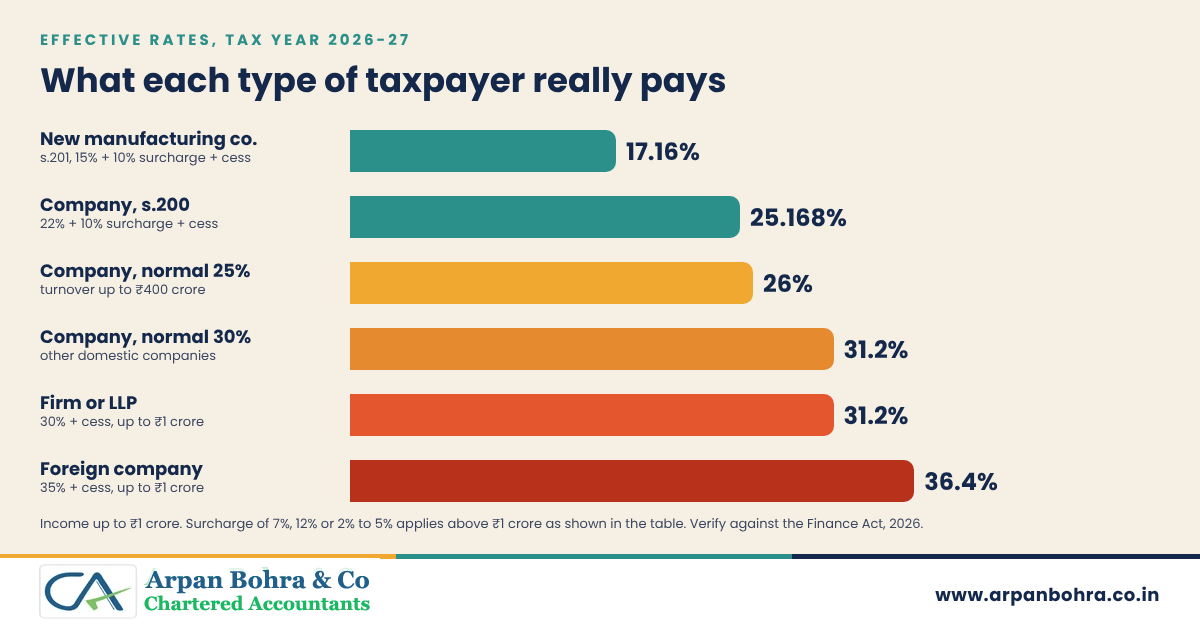
| Person | Base rate | Surcharge | Effective rate (with 4% cess) |
|---|---|---|---|
| New manufacturing company (s.201) | 15% | 10% flat | 17.16% |
| Domestic company, s.200 | 22% | 10% flat | 25.168% |
| Domestic company, normal, turnover up to ₹400 crore | 25% | Nil to ₹1 crore; 7% for ₹1 to 10 crore; 12% above | 26% / 27.82% / 29.12% |
| Domestic company, normal, other | 30% | Same | 31.2% / 33.384% / 34.944% |
| Firm or LLP | 30% | 12% above ₹1 crore (marginal relief) | 31.2% / 34.944% |
| Foreign company | 35% | Nil to ₹1 crore; 2% for ₹1 to 10 crore; 5% above | 36.4% / 37.128% / 38.22% |
| Co-operative society, normal top slab | 30% | 7% for ₹1 to 10 crore; 12% above | 31.2% / 33.384% / 34.944% |
| Co-operative society, s.203 | 22% | 10% flat | 25.168% |
Marginal relief applies wherever surcharge applies. Cess is 4% on tax plus surcharge, with no marginal relief.
Companies
The choice for a domestic company is between the normal regime (25% or 30% with MAT) and the concessional section 200 regime (22% plus surcharge, no MAT, but without specified deductions and incentives). Section 201 is for qualifying new manufacturing companies and depends on conditions and a commencement deadline; verify them before relying on 15%. A foreign company is taxed at 35% on normal income and cannot opt for sections 200 or 201; treaty or special rates may apply to royalty, interest and fees for technical services.
Firms and LLPs
A firm, including an LLP, pays a flat 30% with no basic exemption. A 12% surcharge applies above ₹1 crore of income with marginal relief, and cess is 4%. Interest on capital and remuneration to working partners are deductible only within the limits of the partnership provisions and only if the deed authorises them (earlier section 40(b); verify the 2025 Act section). Alternate minimum tax at 18.5% of adjusted total income can apply to a firm or LLP claiming specified profit-linked deductions (verify the 2025 Act section).
Co-operative societies
Under normal rates, a co-operative society pays 10% on income up to ₹10,000, 20% on the next ₹10,000 and 30% above ₹20,000. A concessional 22% rate with 10% surcharge is available under section 203 on conditions. Surcharge for the normal regime is 7% for ₹1 crore to ₹10 crore and 12% above ₹10 crore. A 15% regime for new manufacturing co-operatives existed under the 1961 Act; verify its section and status under the 2025 Act.
Worked example: ₹80 lakh profit
Taxable income ₹80 lakh in each case, before any dividend or partner-level tax and ignoring deductions and incentives.
- LLP or firm: 30% × ₹80 lakh = ₹24 lakh; cess ₹96,000. Total ₹24.96 lakh.
- Company, normal, 25%: ₹20 lakh; no surcharge up to ₹1 crore; cess ₹80,000. Total ₹20.80 lakh.
- Company, section 200: 22% = ₹17.6 lakh; surcharge 10% = ₹1.76 lakh; cess 4% on ₹19.36 lakh = ₹77,440. Total ₹20.13 lakh.
The entity-level tax is lowest for the section 200 company, but dividends distributed to shareholders are taxed in their hands, and conditions apply. Structure on the basis of the whole tax and compliance picture, not the entity rate alone.
On profit distribution, see our note on how a private limited company can distribute profits to shareholders.
MAT and AMT
Minimum alternate tax on companies is in section 206 of the 2025 Act. The Finance Bill, 2026 proposed reducing the MAT rate from 15% to 14% of book profit, treating MAT under the normal regime as final tax with no fresh MAT credit, and allowing accumulated credit to be used by a company that moves to the section 200 regime, capped at 25% of its tax liability (as reported; verify against the Finance Act, 2026 and the commencement date). MAT does not apply to companies under sections 200 and 201. Non-corporate AMT is unchanged on the reports reviewed.
Frequently asked questions
What is the corporate tax rate for tax year 2026-27?
What is the income tax rate for an LLP?
What is the tax rate for a foreign company?
What are the tax rates for co-operative societies?
Did the Finance Bill 2026 change income tax rates?
What is MAT for tax year 2026-27?
Arpan Bohra & Co., Chartered Accountants, Himayat Nagar, Hyderabad.
This article is shared for general professional education. Readers may write to the firm for information about its practice areas.
General educational information as at 20 October 2026. It is not legal or tax advice and does not create a professional relationship. Provisions, rates and thresholds change; verify the current law and notifications before acting.