
By CA Arpan Bohra (FCA, CS), Arpan Bohra & Co., Chartered Accountants, Hyderabad. Position of law as at 20 October 2026.
A Hyderabad vendor is owed ₹1.4 crore by a company that has stopped answering calls. A lender wants to know whether a default of a few lakhs is enough to move the NCLT. A promoter receives a demand notice and wants to know whether to pay, dispute or settle. All three questions turn on the same thresholds, notices and timelines under the Insolvency and Bankruptcy Code, 2016, which the IBC (Amendment) Act, 2026 has now changed in parts. This guide sets out the limits that matter in practice.
An application to start corporate insolvency under sections 7, 9 or 10 needs a default of at least ₹1 crore (minimum default threshold under section 4, as raised by the notification dated 24 March 2020; verify there is no later change). A financial creditor files under section 7, an operational creditor under section 9 after a demand notice under section 8 (the debtor has 10 days to pay or raise a pre-existing dispute), and the company itself under section 10. The application must be within limitation, normally three years from default. The IBC (Amendment) Act, 2026 changed admission, withdrawal, liquidation and avoidance provisions and added a creditor-initiated process; several provisions were notified with effect from 26 May 2026, and others depend on further notification or rules, so verify the status of each provision before relying on it.
Who can file and at what threshold
| Applicant | Section | Threshold and conditions |
|---|---|---|
| Financial creditor (bank, NBFC, debenture holder) | Section 7 | Default of ₹1 crore or more. Real-estate allottees must file jointly: at least 100 allottees or 10% of the allottees in the same project, whichever is less (proviso, as upheld by the Supreme Court in Manish Kumar v. Union of India, 2021). |
| Operational creditor (supplier, service provider) | Section 9 | Unpaid operational debt of ₹1 crore or more, after the section 8 demand notice period and with no notice of pre-existing dispute. |
| Corporate applicant (the company or its members) | Section 10 | Default of ₹1 crore or more, with the board or members’ authority and a proposed resolution professional. |
| Creditor-initiated process (new) | Sections 58A to 58K, introduced by the 2026 Amendment | Specified financial creditors holding at least 51% of the financial debt; 30 days’ notice to the debtor. Verify which creditors are notified as eligible. |
The section 8 demand notice
- Compute the default. Principal and contractual interest of an operational debt, supported by invoices and delivery or service records.
- Serve a demand notice (Form 3) or invoice-based notice (Form 4) on the corporate debtor at its registered office, with a copy to the delivery proof.
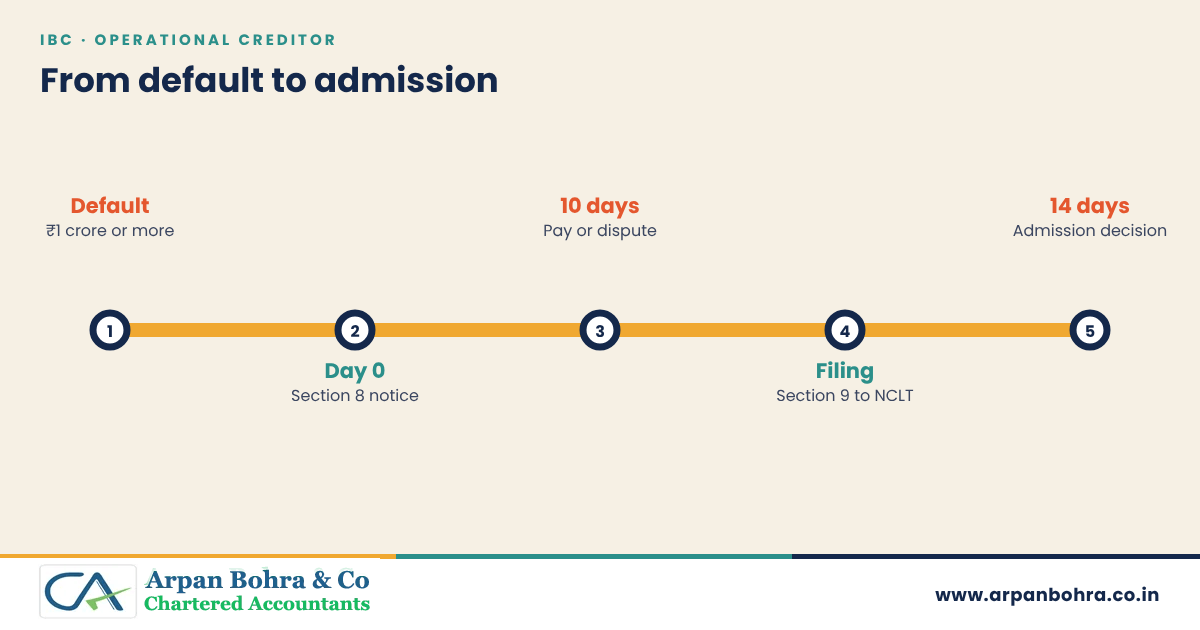
- Wait 10 days. The debtor must pay, or reply showing a pre-existing dispute or a pending suit or arbitration, within 10 days of receipt (section 8(2)).
- File under section 9 if there is no payment and no genuine dispute, with the section 9(3) documents including the bank certificate of non-payment.
- Await admission or rejection. The Adjudicating Authority must decide within 14 days of receipt under section 9(5), and the 2026 Amendment requires reasons where it does not (verify the text as notified).
The “pre-existing dispute” test comes from the Supreme Court in Mobilox Innovations Pvt. Ltd. v. Kirusa Software Pvt. Ltd. (2017): the court looks at whether a plausible dispute existed before the notice, not whether it will succeed. A dispute raised for the first time after the notice is weak.
The timeline
| Stage | Period | Source |
|---|---|---|
| Limitation to file | Three years from default (Article 137, Limitation Act, 1963, applied by section 238A) | B.K. Educational Services v. Parag Gupta (2018) |
| Demand notice reply | 10 days | Section 8(2) |
| Admission decision | 14 days from receipt of the application (reasons required if delayed, per the 2026 Amendment) | Sections 7(4), 9(5), 10(4) |
| Moratorium | From admission until the end of the process | Section 14 |
| Resolution period | 180 days, extendable by 90 days; outer limit of 330 days held directory by the Supreme Court in Essar Steel (India) Ltd. v. Satish Kumar Gupta (2019) | Section 12 (verify the 2026 text) |
| Committee of Creditors approval of plan | 66% of voting share | Section 30(4) |
| Liquidation | Follows if no plan is approved | Part II; 2026 Amendment allows revival into resolution in limited cases (verify) |
What the 2026 Amendment changed
| Area | Change (as reported; verify in the notified text) |
|---|---|
| Admission (ss. 7, 9, 10) | Admission or rejection within 14 days; reasons in writing if not decided; financial creditor to be given a 7-day rectification window before rejection |
| Withdrawal (s. 12A) | Permitted after the committee of creditors is formed and before the first invitation for resolution plans, with 90% voting approval |
| Liquidation | Order to be passed within 30 days where no plan is approved; limited revival into resolution within 120 days; liquidator’s dissolution timelines of 180 days, extendable by 90 days |
| Avoidance transactions | Look-back period extended and creditors allowed to apply where the professional does not |
| Creditor-initiated insolvency (Chapter IV-A) | 150-day process, extendable once by 45 days, with existing management under a resolution professional |
| Group insolvency and cross-border | Rule-making powers added; frameworks await rules (verify status) |
Debtor-side defences
- Pre-existing dispute. Reply within 10 days with correspondence, a quality complaint, a suit or an arbitration notice dated before the demand notice.
- Limitation. Check the date of default and any acknowledgement under section 18 of the Limitation Act that could extend it.
- Threshold. Confirm the default meets ₹1 crore and that the claim is a debt and a default, not an unliquidated damages claim.
- Section 10A window. A default arising in the protected period cannot found an application.
- Payment or settlement. Payment of the admitted amount before admission, or a settlement filed with the Adjudicating Authority, ends the matter; after admission, withdrawal needs section 12A approval.
- Wrong forum or party. Authority, registered office and the nature of the debt should be examined.
Worked example
A supplier delivered goods worth ₹1.2 crore to a company. Invoices were due on 15 January 2026 and remain unpaid with interest of ₹14 lakh accrued under the contract.
- Debt for threshold purposes: ₹1.2 crore principal plus contractual interest of ₹14 lakh, ₹1.34 crore, above ₹1 crore.
- Limitation runs from default, so the last date to file is around 15 January 2029 (three years), subject to acknowledgements.
- Demand notice served on 1 March 2026. The company has until 11 March 2026 to pay or show a pre-existing dispute.
- If it neither pays nor shows a dispute, the supplier may file under section 9. The Adjudicating Authority should decide on admission within 14 days of receipt, subject to defects being rectified.
If the real balance in dispute is less than ₹1 crore after reconciled credit notes, the threshold fails and a civil suit or summary suit is the proper route.
Litigation view and risk
| Question | View | Risk |
|---|---|---|
| Is IBC a recovery tool? | The Supreme Court has repeatedly said it is not; admission is refused where a genuine dispute exists. Using it as pressure invites penalty under the new provisions for malicious or vexatious filing (verify). | Moderate to high for a weak claim |
| Operational creditor with a clear unpaid invoice | Strong where no pre-existing dispute exists and the debt exceeds the threshold | Low to moderate |
| Debtor ignoring the notice | Silence can lead to admission and loss of management control | High |
| Applicability of the 2026 changes to pending matters | Unsettled; depends on the notification and transitional provisions | Litigative |
Frequently asked questions
What is the minimum default amount to file under the IBC?
How many days does a company have to reply to a section 8 demand notice?
What is the limitation for filing an application under the IBC?
Can a company settle after the application is filed?
What is creditor-initiated insolvency under the 2026 Amendment?
Does the 2026 Amendment apply to pending cases?
Arpan Bohra & Co., Chartered Accountants, Himayat Nagar, Hyderabad.
This article is shared for general professional education. Readers may write to the firm for information about its practice areas.
General educational information as at 20 October 2026. It is not legal or tax advice and does not create a professional relationship. Provisions, rates and thresholds change; verify the current law and notifications before acting. References to the 57th GST Council (8 October 2026) are to recommendations that need amendments or notifications before they have legal effect.