

By CA Arpan Bohra (FCA, CS), Arpan Bohra & Co., Chartered Accountants, Hyderabad. Position of law as at 20 October 2026.
Setting up a Global Capability Centre? Get the tax structure right first.
A multinational plans a captive technology and operations centre in Hyderabad. The business case is clear. The legal questions come next: should the centre be a subsidiary or a branch, how is its income taxed, can it export services under GST and claim refunds, and what are its transfer pricing obligations? These choices are expensive to reverse.
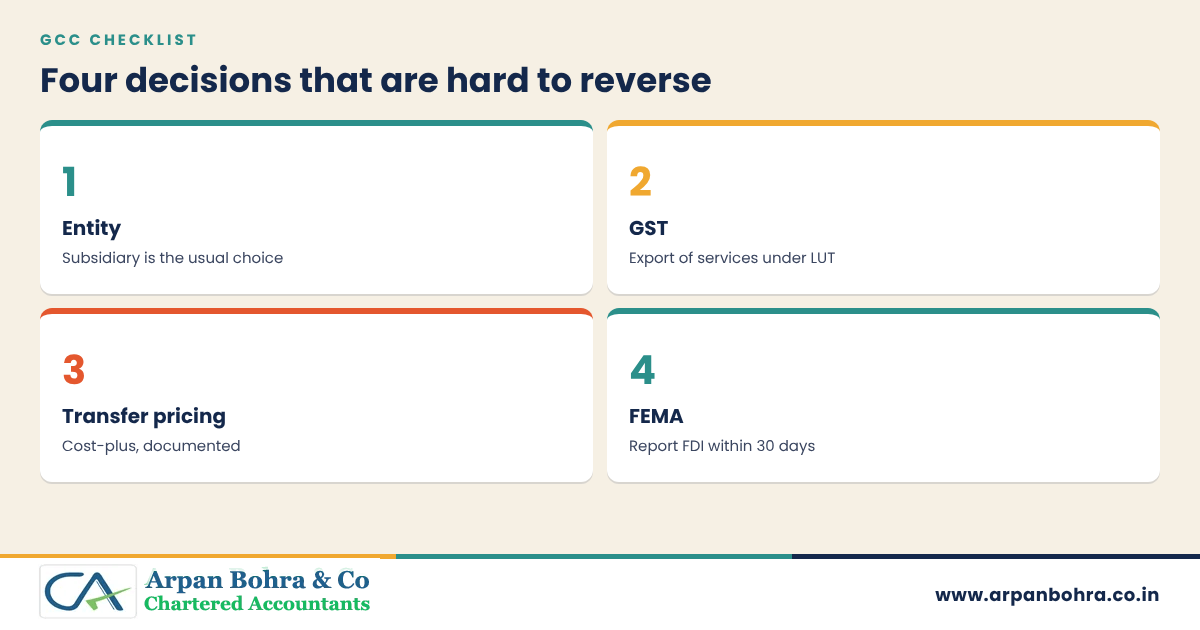
A Global Capability Centre (GCC) serving its foreign parent is usually set up as a wholly owned subsidiary, since a separate legal entity qualifies for export of services under section 2(6) of the IGST Act, 2017, while a branch of the foreign company is a distinct person only for some purposes and the export condition needs care. Income is taxed as a service provider under a cost-plus arrangement supported by transfer pricing documentation, and the margin is tested under the arm’s length principle (a safe harbour is available for eligible IT services under Rule 10TD, with margins to be verified). FEMA reporting, GST compliance and permanent establishment risk need planning from day one.
Choosing the entity
| Option | Features | Points to check |
|---|---|---|
| Private limited subsidiary | Separate legal entity; 100% FDI in IT services under the automatic route (verify the current sector position) | Annual ROC, audit and FEMA filings; at least one resident director |
| Branch or liaison office of the foreign company | Requires RBI approval and conditions; income taxed at the rate applicable to foreign companies | Narrow permitted activities; export of services claim needs care because the branch is not a separate legal entity |
| LLP | Partnership flexibility; FDI permitted in the sectors under the automatic route | Taxed at 30% plus surcharge; fewer investor-friendly features |
GST: export of services and refund
- Section 2(6) of the IGST Act treats a supply as export of services only if five conditions are met: the supplier is in India, the recipient is outside India, the place of supply is outside India, payment is received in convertible foreign exchange (or Indian rupees where RBI permits), and the supplier and recipient are not merely establishments of a distinct person under Explanation 1 to section 8.
- A subsidiary and its parent are separate persons, so the services can be exports; the supply is zero-rated under section 16 of the IGST Act.
- The GCC can export under a Letter of Undertaking without paying IGST and claim a refund of unutilised input tax credit under section 54 of the CGST Act and Rule 89(4), within two years from the relevant date. See our guides on exports under LUT versus IGST payment and the types of refund.
- Receipt of consideration in convertible foreign exchange is essential; delayed receipt and adjustments against intercompany balances need tracking.
Transfer pricing and income tax
| Topic | Position |
|---|---|
| Method | Typically the Transactional Net Margin Method with a cost-plus mark-up on total operating cost |
| Documentation | Form 3CEB report by the due date, with a transfer pricing study maintained under section 92D (verify the current due dates) |
| Safe harbour | Rule 10TD provides safe-harbour margins for eligible IT and ITeS services, with margins and turnover bands as notified; verify the margin and any recent change |
| Advance pricing agreement | Available under section 92CC to fix the margin for up to five years (and rollback) if the group wants certainty |
| Tax rate | Domestic company rates under the Act, including the concessional regime under section 115BAA, if opted (verify the current rate and surcharge) |
For tax years beginning on or after 1 April 2026 the Income-tax Act, 2025 applies; verify the section numbers.
Permanent establishment and other risks
- A subsidiary is not automatically a permanent establishment of the foreign parent, but one can arise where the subsidiary acts as a dependent agent concluding contracts or where the parent’s personnel have a fixed place or control the operations. Review the service agreement and reporting lines.
- Secondment of foreign employees may create service PE or withholding tax exposure.
- Payments to the parent for shared services and royalties need transfer pricing support and withholding under the treaty.
Worked example
A Hyderabad GCC incurs operating costs of ₹100 crore in a year and the group agrees a 15% mark-up on cost.
- Revenue from the parent: ₹100 crore × 1.15 = ₹115 crore.
- Operating profit: ₹15 crore, which is tested against the arm’s length range.
- If a comparable set shows a median of 18%, the department may propose an adjustment of 3% of cost, ₹3 crore, absent safe-harbour or an agreed APA.
- GST: exports of ₹115 crore under LUT with no IGST. The credit on input services such as rent and software is claimed as a refund.
The figures are illustrative and not a recommended margin.
Set-up checklist
- Decide the entity and the shareholding of the parent in consultation with the group tax team.
- Incorporate the company, obtain PAN, TAN, GST registration, and Shops and Establishment licence.
- File FEMA reporting for the foreign investment (FC-GPR within 30 days of allotment) on the portal.
- Sign an intercompany service agreement defining services, cost base, mark-up and payment terms.
- Apply for LUT under GST and plan refund claims.
- Appoint auditors and file ADT-1; maintain transfer pricing documentation.
- Plan employee compliances under the Labour Codes, including PF and ESI.
Frequently asked questions
Why are GCCs usually subsidiaries?
Can a GCC claim a GST refund?
What is the transfer pricing method for a captive service centre?
Does a GCC create a permanent establishment?
Is FDI permitted in IT services?
Does the Income-tax Act, 2025 change this?
Arpan Bohra & Co., Chartered Accountants, Himayat Nagar, Hyderabad.
This article is shared for general professional education. Readers may write to the firm for information about its practice areas.
General educational information as at 20 October 2026. It is not legal or tax advice and does not create a professional relationship. Provisions, rates and thresholds change; verify the current law and notifications before acting. References to the 57th GST Council (8 October 2026) are to recommendations that need amendments or notifications before they have legal effect.