
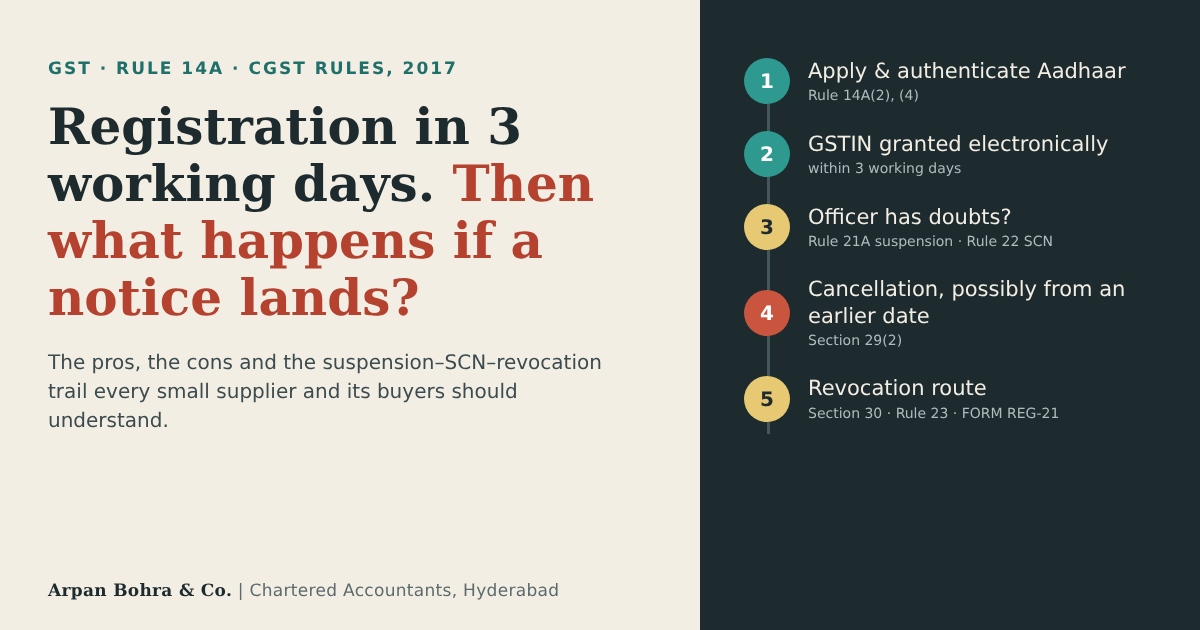
Illustrative scenario, not a client matter: A small trader in Hyderabad needs a GSTIN to be onboarded as a vendor. In the old days, getting one meant queries, clarifications and weeks of waiting. Under Rule 14A, the GSTIN arrives within days. The vendor is onboarded, invoices are raised, and then the buyer’s accounts team searches the GSTIN on the portal and finds the status “Suspended”. Nobody feels they did anything wrong, yet business stops.
Direct answer: Rule 14A of the CGST Rules, 2017 makes the entry into GST faster for eligible small suppliers, but it does not change the exit rules. Suspension (Rule 21A), show-cause notices (Rule 22), cancellation (Section 29) and revocation (Section 30 and Rule 23) work exactly as before. This article explains what Rule 14A actually provides, its real advantages and limits, and what a supplier and its buyers should do when a notice arrives.
A word on evidence: We did not find any official published data on how many Rule 14A registrations have been suspended or cancelled. The risk analysis below is therefore a professional reading of how the provisions fit together, not a statistical claim.
What is Rule 14A and when did it start?
Rule 14A was inserted into the CGST Rules, 2017 by Notification No. 18/2025-Central Tax dated 31 October 2025 (the Central Goods and Services Tax (Fourth Amendment) Rules, 2025). It came into force on 1 November 2025. The same notification also inserted Rule 9A, a separate provision under which the common portal may grant registration electronically within three working days to applicants it identifies through data analysis and risk parameters.
| Feature | What the rule provides |
|---|---|
| Who may opt | A person whose output tax liability on supplies to registered persons does not exceed ₹2,50,000 per month |
| What the limit measures | Output tax (CGST, SGST/UTGST, IGST and cess), not turnover; supplies to unregistered persons are excluded from the computation |
| Aadhaar | Applicants who have not opted for Aadhaar authentication are ineligible, unless covered by a Section 25(6D) notification |
| One registration per PAN | Only one Rule 14A registration per State or Union Territory against the same PAN |
| Timeline | Registration is granted electronically within three working days after successful Aadhaar authentication |
| Exit | Withdrawal in FORM GST REG-32; the officer allows it in FORM GST REG-33 or rejects it in FORM GST REG-05 |
GSTN operationalised the scheme by an advisory dated 1 November 2025 and, by a later advisory dated 21 February 2026, enabled online withdrawal. For withdrawal, returns for at least three months are needed if the application is filed before 1 April 2026, or at least one tax period if filed on or after that date, along with all returns due up to the application. A withdrawal application is rejected if cancellation proceedings are pending.
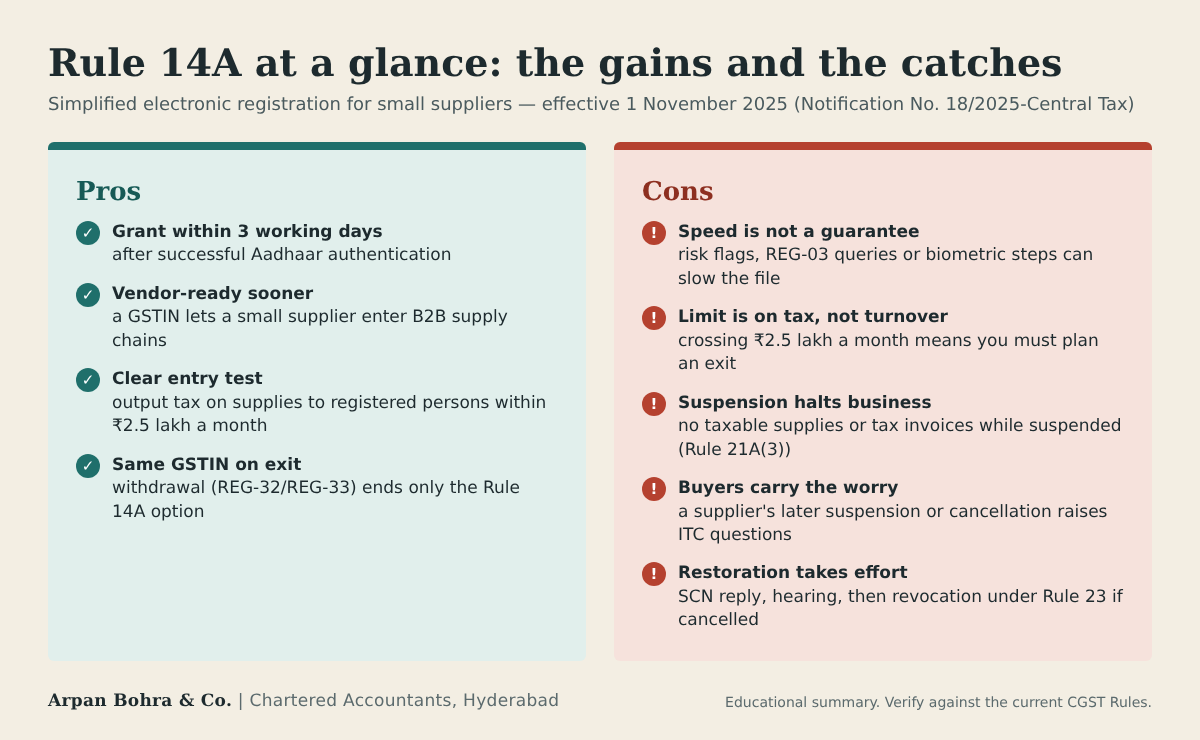
Rule 14A: the pros and cons at a glance
The pros
- Speed of grant. The rule contemplates grant within three working days after successful Aadhaar authentication.
- Supply-chain readiness. Larger buyers usually insist on a GSTIN before onboarding a vendor, so a quicker GSTIN helps a small supplier enter B2B trade.
- A clear eligibility test. The ₹2.5 lakh monthly limit is based on output tax on supplies to registered persons, which a supplier can estimate in advance.
- Same GSTIN on exit. Withdrawal ends only the Rule 14A option; the GSTIN continues in the normal category.
The cons
- Speed is not a legal guarantee. The three-day period applies after successful authentication. If authentication is not completed, the application follows the ordinary Rule 9 verification process, and risk flags or clarification requests can slow it down.
- The limit is on tax, not sales. A supplier selling ₹15 lakh of taxable goods at 18% GST to registered buyers has ₹2.7 lakh of output tax and is already above the limit. Growth can cross the line quickly, and a plan for exit is needed.
- Entry is easy; scrutiny is not removed. Rule 14A changes how registration is granted. It does not take away the officer’s powers to examine whether the registration is genuine.
- Suspension stops trading. While a registration is suspended under Rule 21A, the person cannot make any taxable supply and cannot issue a tax invoice. A person suspended under Rule 21A(2) or (2A) also cannot obtain a refund under Section 54 during the suspension.
- The counterparty feels it too. Buyers worry about Input Tax Credit (ITC) when a supplier’s status changes.
Where the “mess” begins: suspension, show-cause notice and cancellation
Rule 14A is a front-door rule. Everything that follows is governed by the general machinery, and this is where small taxpayers often struggle.
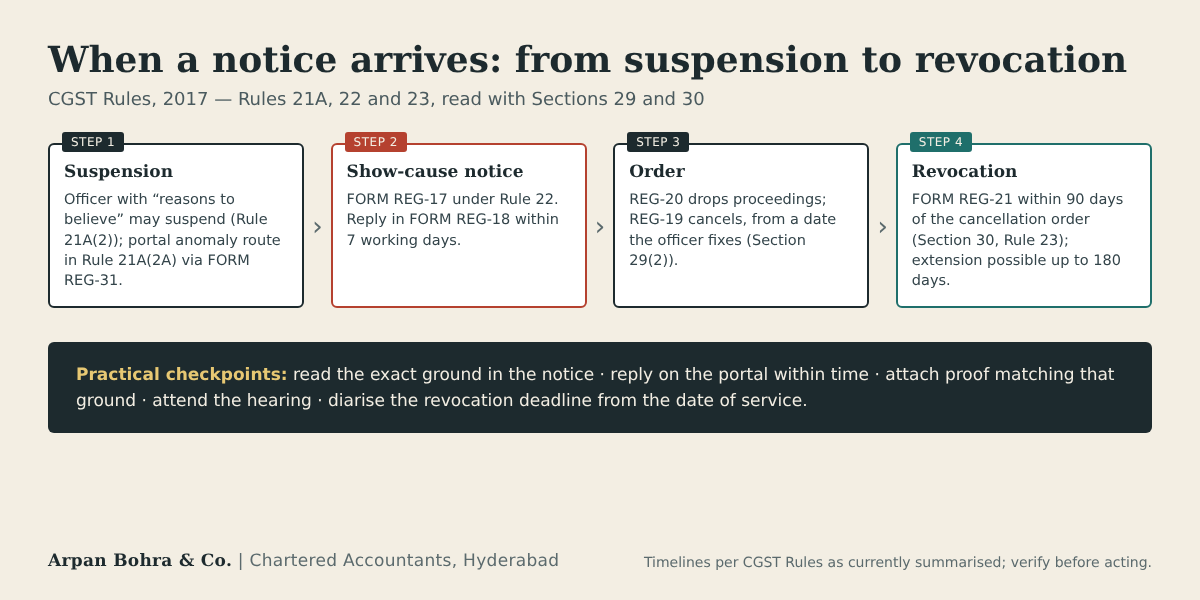
- Suspension. Under Rule 21A(2), where the proper officer has reasons to believe the registration is liable to be cancelled under Section 29 or Rule 21, the officer may suspend it from a date fixed by the officer, pending Rule 22 proceedings. Under Rule 21A(2A), suspension can also follow a comparison of returns with GSTR-1 or inward supply details that shows significant differences or anomalies, or a contravention of Rule 10A. Notice is given in FORM GST REG-31, asking the person to explain within thirty days why the registration should not be cancelled.
- Show-cause notice. Rule 22 provides for a notice in FORM GST REG-17. The reply is filed in FORM GST REG-18 within seven working days.
- Order. If the officer is satisfied, proceedings are dropped by an order in FORM GST REG-20. Otherwise, the registration is cancelled by an order in FORM GST REG-19.
- Effective date. Section 29 allows cancellation from such date, including a retrospective date, as the officer deems fit. Commentary on the case law stresses that retrospective cancellation is not automatic: the ground must be made out, the proposal of retrospective effect must be put to the taxpayer, and reasons must be recorded.
- Revocation. If the registration is cancelled by the officer, an application for revocation is made in FORM GST REG-21 under Section 30 read with Rule 23. The period is 90 days from service of the cancellation order, extendable by up to a further 180 days by the competent authority for sufficient cause.
Under Rule 21A(4), a suspension is deemed revoked when Rule 22 proceedings are completed, with effect from the date the suspension started. For suspension under Rule 21A(2A), the rule also provides for deemed revocation once pending returns are filed (for the relevant contravention) or once Rule 10A is complied with, provided the registration has not been cancelled in the meantime.
Why do genuine small taxpayers get caught?
The rules above do not distinguish between a careless taxpayer and a genuine one who has been flagged. Possible reasons include a mismatch between returns and auto-populated data, an address or premises that could not be verified, or non-compliance with a notified requirement. The point to remember is that a notice is an allegation, not a finding. The response, filed on time and supported by documents that match the stated ground, is the taxpayer’s main protection.
Aadhaar biometrics: a recent Delhi High Court direction
On the entry side, the Delhi High Court (Division Bench of Justices Anil Khetarpal and Shail Jain) in Neha v. Union of India, W.P.(C) 12210/2026 (reported as 2026 LiveLaw (Del) 836), passed an interim direction in the second week of September 2026 that authorities should not allow any GST registration henceforth without biometric-based Aadhaar authentication. The Bench permitted the authorities to point out practical difficulties and listed the matter for 22 September 2026. The order is interim and applies to fresh registrations. We have not been able to verify what happened at later hearings, so readers should check the current status before relying on it.
For Rule 14A applicants, the practical lesson is simple: the Aadhaar step is not a formality, and the applicant’s identity documents must be consistent across PAN, Aadhaar and the application.
Vendors and buyers: what to check
- Check status before onboarding. Use the “Search Taxpayer” facility on the GST portal and note the registration status and any cancellation or suspension date.
- Recheck periodically. A GSTIN that was active at onboarding may not remain so; recheck before large payments and at return-filing time.
- Keep evidence. Retain the vendor’s registration certificate, invoices, proof of payment of tax-inclusive value, e-way bills where applicable and GSTR-2B reconciliations.
- Understand the ITC position. Eligibility depends on the conditions in Section 16 and the facts of each case, including the supplier’s status on the date of supply and whether the supplier has actually reported the supply. Where a supplier’s registration is cancelled retrospectively, the position needs case-specific advice.
- If you are the supplier: open the notice immediately, read the exact ground, collect the matching documents, file the reply on the portal within time, and diarise the revocation window from the date of service of any cancellation order.
Local note for Hyderabad and Telangana businesses
The Rule 14A application, the notices and the revocation applications are all handled on the common GST portal, so the procedure is the same for a supplier in Himayat Nagar or elsewhere in Telangana. What can differ is the practice of the jurisdictional officer and the way the High Court of Telangana has treated cancellation matters. Check the orders of your own High Court before relying on any decision from another State.
Frequently asked questions
1. Is Rule 14A the same as Rule 9A?
No. Both were inserted by Notification No. 18/2025-Central Tax. Rule 14A is applicant-initiated: the person opts for it in the application. Rule 9A is system-driven: the common portal grants registration within three working days to applicants identified through data analysis and risk parameters.
2. Does the ₹2.5 lakh limit refer to turnover?
No. It refers to output tax liability per month on supplies to registered persons, aggregating CGST, SGST/UTGST, IGST and cess.
3. Can a Rule 14A registration be suspended?
The Rule 14A provisions are about grant and withdrawal. Suspension and cancellation are governed by Rule 21A, Rule 22 and Section 29, which apply to registrations generally. A Rule 14A GSTIN is therefore not exempt from them.
4. Can I withdraw from Rule 14A while a notice is pending?
No. Under the rule, a withdrawal application is rejected if cancellation proceedings are pending. Suspended or cancelled registrations are also outside the online withdrawal facility, as reported in commentary on GSTN’s advisory of 21 February 2026.
5. My vendor’s GSTIN shows as cancelled. Is my ITC automatically lost?
Not automatically. ITC eligibility depends on Section 16 and the facts of the transaction, and cancellation can have a retrospective date only if the officer has validly ordered it. Each case should be examined separately with the documents in hand.
Sources
- Notification No. 18/2025-Central Tax dated 31 October 2025 (CGST Fourth Amendment Rules, 2025) as reproduced at GSTLearn; the official text is available on the CBIC and GST Council websites.
- GSTN advisory dated 1 November 2025, as summarised by Taxmann.
- Rule 14A withdrawal facility (advisory dated 21 February 2026), as summarised by TaxGuru.
- Rule 21A of the CGST Rules, 2017, as summarised by GST Gyaan.
- Delhi High Court order in Neha v. Union of India, as reported by LiveLaw.
Related reading on this website
- GST Registration Threshold Limit
- Reporting unauthorised use of your PAN for GST registration
- 57th GST Council FAQs: official clarifications on refunds, ITC, arrest and notices
- GSTAT Guide: A to Z of appeal before the Appellate Tribunal
Conclusion
Rule 14A removes friction at the point of registration, which is a genuine improvement for small suppliers. It does not remove the duty to remain compliant, nor the officer’s powers of suspension and cancellation. The sensible approach is to treat the three-day GSTIN as the beginning of a compliance relationship: file returns on time, keep documents ready, monitor the portal, and respond to every notice within its deadline.
This article is for general information and education. It is not professional advice, and the position in a particular case depends on its facts. Laws, rules and procedures may change after the date of publication (13 October 2026).
Arpan Bohra & Co., Chartered Accountants
Website: https://www.arpanbohra.co.in/