
By CA Arpan Bohra (FCA, CS), Arpan Bohra & Co., Chartered Accountants, Hyderabad. Position of law as at 20 October 2026.
Not every GST paid is a credit earned.
A hotel owner builds a banquet hall and claims the GST on cement, steel and contractor bills as input tax credit. The department disallows it under section 17(5)(d). A software firm buys a car for directors and does the same. Both are in the blocked-credit list, but one has a statutory exception and the other may not. The details decide the outcome.
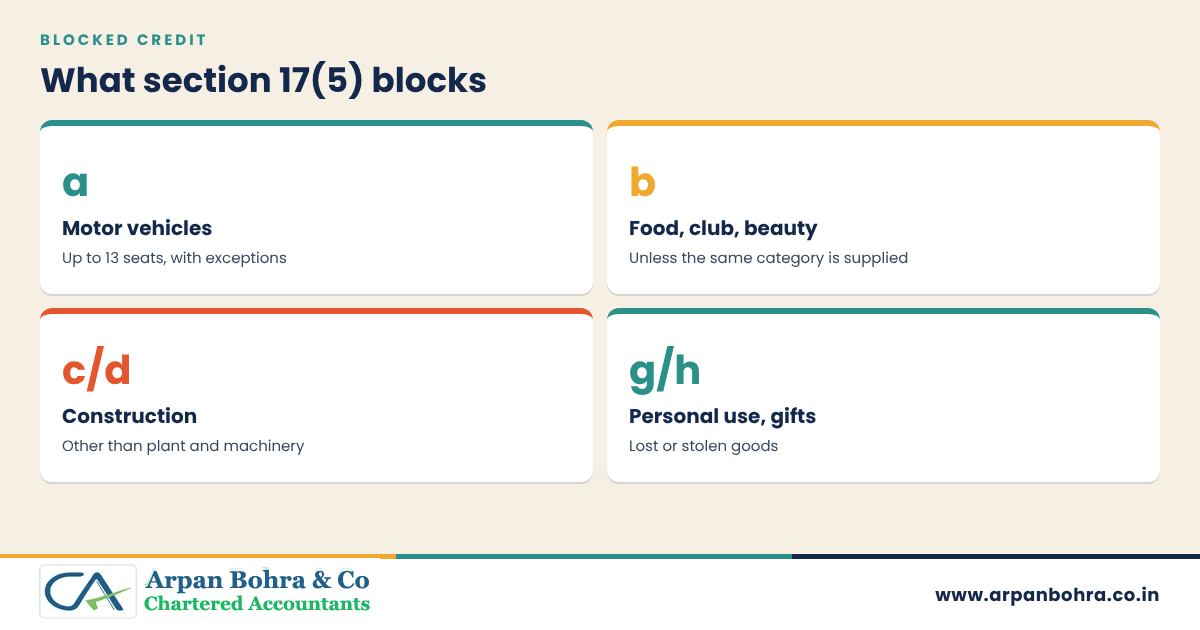
Section 17(5) of the CGST Act, 2017 lists goods and services on which input tax credit is blocked even if used for business, including motor vehicles (with exceptions), food and beverages, outdoor catering, beauty treatment, health services and club memberships (with exceptions), works contract and construction of immovable property (other than plant and machinery), goods or services for personal consumption, goods lost, stolen or given as gifts or free samples, and tax paid in demand cases under sections 74, 129 and 130 (and, from FY 2024-25, 74A). The Supreme Court in Safari Retreats (October 2024) applied the “functionality test” to “plant or machinery”, and the Finance Act, 2025 amended the clause with effect from 1 July 2017 (verify).
What is blocked, and the exceptions
| Clause | Blocked item | Main exceptions |
|---|---|---|
| (a) | Motor vehicles for up to 13 persons | Used for supplying vehicles, transport of passengers, driving training, or transport of goods |
| (b)(i) | Food and beverages, outdoor catering, beauty treatment, health services, cosmetic and plastic surgery | Where the outward supply is of the same category or part of a taxable composite or mixed supply, or where the law obliges the employer to provide it |
| (b)(ii) | Membership of a club, health and fitness centre | Not available even when obligatory under law, unless outward supply is of the same category |
| (b)(iii) | Travel benefits to employees on vacation (leave or home travel concession) | None |
| (c) | Works contract service for construction of immovable property other than plant and machinery | Where the input service is used for further works contract service |
| (d) | Goods or services for construction of immovable property (other than plant or machinery) on own account | Plant or machinery is excluded from the block |
| (e),(f),(g) | Composition taxpayers, non-resident taxable persons (except on imports), personal consumption | None |
| (h) | Goods lost, stolen, destroyed, written off, disposed of by gift or free samples | None |
| (i) | Tax paid under sections 74, 129 and 130 | None |
“Plant or machinery” after Safari Retreats
- The Explanation to section 17 defines plant and machinery to exclude land, building, civil structures, telecom towers and pipelines outside the factory premises.
- The Supreme Court in Safari Retreats Pvt. Ltd. v. Chief Commissioner of CGST (2024) held that whether a building is “plant” depends on the functionality test, and that the credit in a rental mall or similar case is a question of facts.
- The Finance Act, 2025 substituted the word “or” with “and” in clause (d), retrospectively from 1 July 2017 (verify the text and the validity of the retrospective effect), which is intended to restrict the benefit.
- The position is litigative; documentation of functionality and a conservative position on new claims is the prudent course.
Worked example
A company spends ₹1 crore on a banquet hall and pays GST of ₹18 lakh on cement, steel and contractor services. It also buys a car for ₹15 lakh with GST of ₹4.2 lakh for employee pick-up.
- Banquet hall: clause (c) and (d) block the ₹18 lakh, because it is construction of immovable property on its own account, unless the structure qualifies as plant or machinery on the functionality test. That position is litigative after the Finance Act, 2025 amendment.
- Car: clause (a) blocks the credit unless the car is used for the exceptions. Staff pick-up is not one of them, so ₹4.2 lakh is blocked.
- The blocked amount becomes part of the cost, and the business can claim depreciation on the gross cost.
Compliance steps
- Tag every ledger account for ITC eligibility: eligible, blocked or partly eligible.
- Review capital-expenditure invoices before claiming credit on them.
- Reverse the credit under Rule 42 and Rule 43 where blocked items are part of a common input.
- Document the use of vehicles and the case for plant and machinery.
- Reply to notices with the facts of use and legal exceptions.
Frequently asked questions
Is credit on a car for directors allowed?
Can a builder claim credit on construction services?
Is credit on employee meals blocked?
What is the functionality test?
Is the Finance Act, 2025 amendment valid?
Is credit on tax paid under section 74A also blocked?
Arpan Bohra & Co., Chartered Accountants, Himayat Nagar, Hyderabad.
This article is shared for general professional education. Readers may write to the firm for information about its practice areas.
General educational information as at 20 October 2026. It is not legal or tax advice and does not create a professional relationship. Provisions, rates and thresholds change; verify the current law and notifications before acting. References to the 57th GST Council (8 October 2026) are to recommendations that need amendments or notifications before they have legal effect.