
By CA Arpan Bohra (FCA, CS), Arpan Bohra & Co., Chartered Accountants, Hyderabad. Position of law as at 20 October 2026.
Your supplier’s default can become your notice, here is the defence.
A buyer claims input tax credit of ₹12 lakh in GSTR-3B. The department later issues a notice because the supplier did not file GSTR-1 for two months and the credit does not appear in GSTR-2B. The buyer has the invoices and has paid the supplier. Is the credit lost? The answer depends on the period, the documents and how the reply is framed.
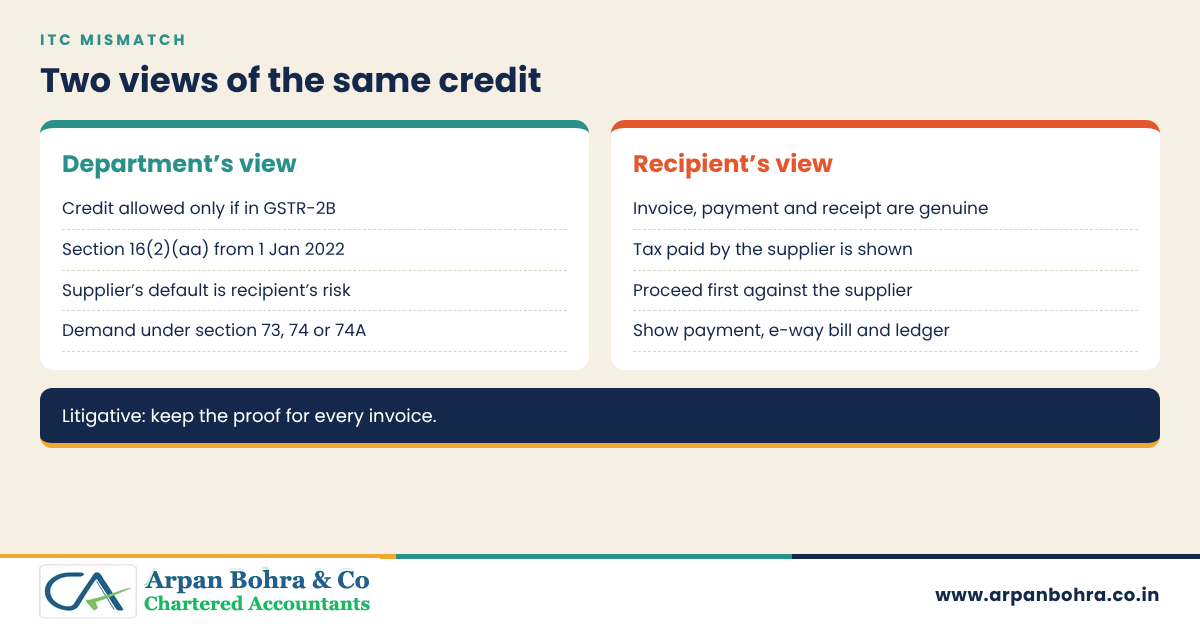
From 1 January 2022, section 16(2)(aa) of the CGST Act, 2017 allows credit only if the details of the invoice are furnished by the supplier and communicated to the recipient, which the department tests through GSTR-2B. Mismatch cases usually begin with a notice in ASMT-10 (scrutiny of returns under section 61), a pre-show cause intimation in DRC-01A or a show cause notice under section 73, 74 or 74A. Recipients commonly defend on the ground that they paid the supplier, hold valid invoices and cannot be penalised for the supplier’s default, subject to the conditions of section 16(2). The position is litigative.
The legal conditions for credit
| Condition | Provision |
|---|---|
| Possession of tax invoice or debit note | Section 16(2)(a) |
| Receipt of goods or services | Section 16(2)(b) |
| Tax actually paid to the Government by the supplier | Section 16(2)(c) |
| Return furnished by the recipient | Section 16(2)(d) |
| Details appear in the recipient’s auto-drafted statement (GSTR-2B) | Section 16(2)(aa), from 1 January 2022 |
| Payment to the supplier within 180 days | Second proviso to section 16(2) and Rule 37 |
| Time limit for claiming credit | Section 16(4): 30 November following the financial year, or annual return date if earlier |
Defence themes
- Supplier default. The Madras High Court in D.Y. Beathel Enterprises v. State Tax Officer (2021) held that the department should proceed first against the defaulting supplier where the buyer shows genuine transactions. The Calcutta High Court in Suncraft Energy Pvt. Ltd. v. Assistant Commissioner (2023) took a similar view for the period before section 16(2)(aa). Both are persuasive outside their jurisdictions; check the Telangana High Court position (verify).
- Bona fide purchaser. Show bank payment, e-way bills, transport receipts, supplier’s GST registration status on the date of supply and the supplier’s later filing of the return.
- Period. Section 16(2)(aa) applies from 1 January 2022. For earlier periods, the 5% provisional-credit rule and the condition in section 16(2)(c) govern.
- Procedure. A mismatch notice must state the amounts and the reasons; blanket demands are open to challenge.
- Late reply protocol. Rule 142(1A) allows payment through DRC-03 on the pre-SCN intimation to close the matter without penalty if the buyer decides not to contest.
Worked example
A buyer claimed credit of ₹12,00,000 in FY 2023-24. The supplier filed GSTR-1 late, and the invoice did not appear in GSTR-2B for the month.
- Under section 16(2)(aa), the claim in the month is ineligible. If the supplier files GSTR-1 later, the invoice appears in a later GSTR-2B and credit can be claimed in that month, subject to section 16(4).
- If the supplier never files, the buyer relies on proof of payment and the persuasive decisions above.
- If a demand under section 73 is made, the amount at stake is ₹12,00,000 plus interest, and a penalty is not leviable if tax and interest are paid within the statutory window.
Reply roadmap
- Reconcile books with GSTR-2B and list each mismatched invoice by supplier and month.
- Check the supplier’s registration and return status on the portal for each period.
- Collect the tax invoice, e-way bill, transport proof, bank payment and ledger confirmation.
- Write to the supplier asking it to file or amend GSTR-1, and keep the evidence.
- Reply on the portal within the period in the notice and request a personal hearing.
- Pay under protest where cost of litigation exceeds the amount, and record the reservation of rights.
Frequently asked questions
Is ITC allowed if it does not appear in GSTR-2B?
Can the department deny credit because the supplier defaulted?
What is the time limit for claiming ITC?
What is DRC-01A?
Should I pay under protest?
Does the 57th GST Council affect this?
Arpan Bohra & Co., Chartered Accountants, Himayat Nagar, Hyderabad.
This article is shared for general professional education. Readers may write to the firm for information about its practice areas.
General educational information as at 20 October 2026. It is not legal or tax advice and does not create a professional relationship. Provisions, rates and thresholds change; verify the current law and notifications before acting. References to the 57th GST Council (8 October 2026) are to recommendations that need amendments or notifications before they have legal effect.