
By CA Arpan Bohra (FCA, CS), Arpan Bohra & Co., Chartered Accountants, Hyderabad. Position of law as at 20 October 2026.
GSTR-9 is not just a return, it is the department’s last look at your year.
A company files twelve GSTR-3B returns and assumes the year is closed. Months later a notice points to a difference between the credit in the annual return and the credit in GSTR-2B, and the books do not match either. The annual return is where all these figures meet.
Section 44 of the CGST Act, 2017 requires registered persons to file an annual return, GSTR-9, by 31 December following the financial year (for FY 2025-26, 31 December 2026, subject to any notified extension). Filing is exempted or optional for small taxpayers by notification (turnover up to ₹2 crore for recent years; verify for FY 2025-26). The reconciliation statement GSTR-9C is required above ₹5 crore of turnover and is self-certified since FY 2020-21 (verify). The late fee under section 47(2) depends on turnover and is levied per day subject to a cap on turnover. Annual-return figures are routinely used by the department to start notices.
Who files what
| Taxpayer | GSTR-9 | GSTR-9C |
|---|---|---|
| Turnover up to ₹2 crore | Optional or exempted by notification (verify) | Not required |
| ₹2 crore to ₹5 crore | Required | Not required |
| Above ₹5 crore | Required | Required, self-certified reconciliation of audited accounts and the annual return (verify) |
| Composition taxpayers | GSTR-9A, as notified (verify) | Not required |
| Input service distributors, casual and non-resident taxable persons, TDS and TCS deductors | Not required to file GSTR-9 | Not applicable |
Late fee under section 47(2)
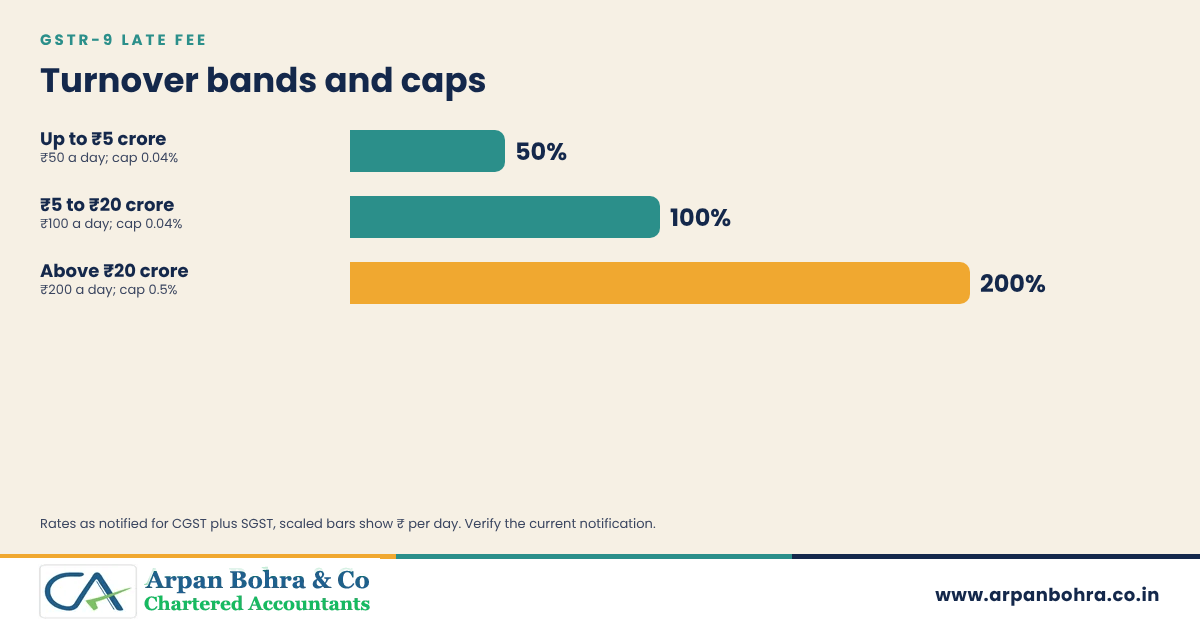
| Aggregate turnover | Late fee per day (CGST plus SGST) | Cap on turnover in the State |
|---|---|---|
| Up to ₹5 crore | ₹50 | 0.04% |
| ₹5 crore to ₹20 crore | ₹100 | 0.04% |
| Above ₹20 crore | ₹200 | 0.5% |
The rates are as notified; verify the current notification before computing. Fee for the delay in filing GSTR-9C has no separate late fee but the reconciliation may be called for in the notice.
Where the mismatches arise
- Tables 4 and 5: outward supplies against GSTR-1 and the sales ledger, including credit notes and amendments of the next year.
- Table 6: input tax credit availed against GSTR-3B, with the split between inputs, capital goods and input services.
- Table 7: reversals under section 17(5) and Rules 37, 42, 43, and the blocked list. See our guide to blocked credit under section 17(5).
- Table 8: the comparison of credit availed with the details in GSTR-2B; mismatches invite notices. See our guide to ITC mismatch notices.
- Tables 14 and 15: tax and refund information for the next year, and demands and refunds.
Worked example
A company with turnover of ₹12 crore files GSTR-9 for FY 2025-26 on 15 January 2027.
- Delay: 31 December 2026 to 15 January 2027 is 15 days.
- Late fee: ₹100 × 15 = ₹1,500 (₹750 each under CGST and SGST), well within the cap of 0.04% of ₹12 crore, which is ₹48,000 (split equally between CGST and SGST).
- GSTR-9C is required (above ₹5 crore), and the reconciliation shows ₹2.4 lakh of credit in the books that is missing in GSTR-2B.
- The difference should be explained, reversed or supported before the notice stage.
Filing steps
- Reconcile sales between the books, GSTR-1 and GSTR-3B for the year.
- Reconcile credit with GSTR-2B, ITC claimed and ITC reversed.
- Compute the HSN-wise summary and the demand and refund details.
- Complete GSTR-9 on the portal and pay any additional liability through Form DRC-03 before filing.
- If turnover exceeds ₹5 crore, prepare GSTR-9C with the audited accounts and explain each difference.
- Keep the working papers for the notice stage.
Frequently asked questions
What is the due date for GSTR-9 for FY 2025-26?
Is GSTR-9 mandatory for small taxpayers?
Who must file GSTR-9C?
What is the late fee for GSTR-9?
Can I revise GSTR-9?
Can additional tax be paid through GSTR-9?
Arpan Bohra & Co., Chartered Accountants, Himayat Nagar, Hyderabad.
This article is shared for general professional education. Readers may write to the firm for information about its practice areas.
General educational information as at 20 October 2026. It is not legal or tax advice and does not create a professional relationship. Provisions, rates and thresholds change; verify the current law and notifications before acting. References to the 57th GST Council (8 October 2026) are to recommendations that need amendments or notifications before they have legal effect.