
By CA Arpan Bohra (FCA, CS), Arpan Bohra & Co., Chartered Accountants, Hyderabad. Position of law as at 20 October 2026.
Deducted but not deposited? The cost compounds every month.
A company deducts TDS from contractor payments in June but deposits it only in August, and files the quarterly statement a month late. Nothing is lost in the bank, yet the company now faces interest, a daily late fee and a possible disallowance of the expense itself. TDS defaults carry more layers of cost than most businesses expect.
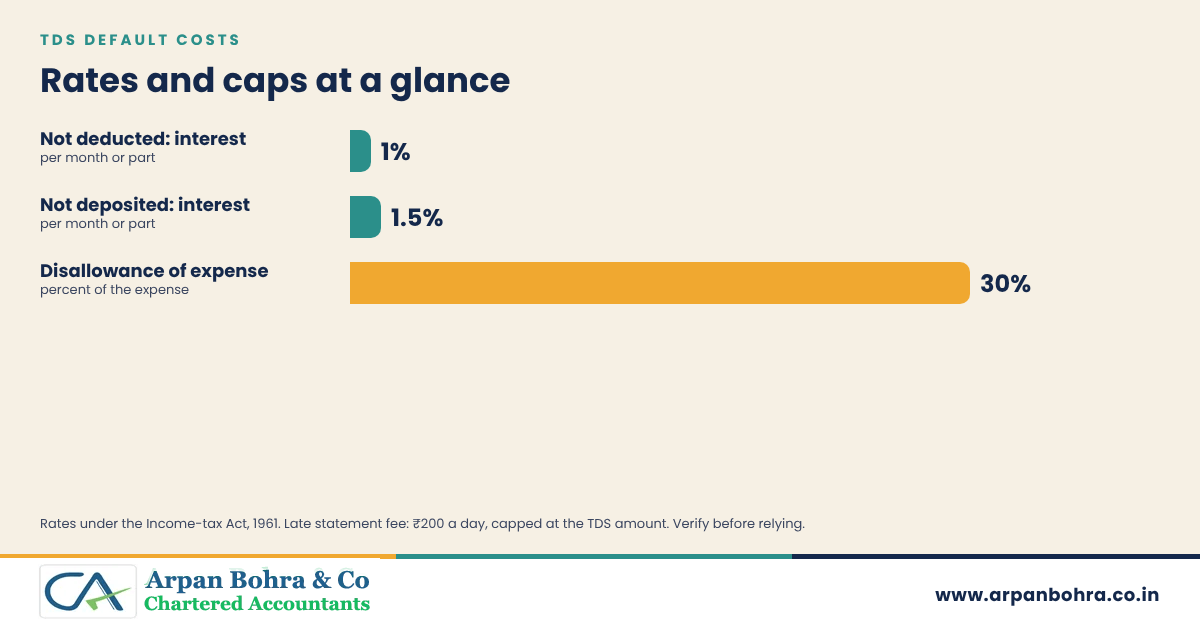
A TDS default can trigger interest under section 201(1A) (1% per month where tax is not deducted, 1.5% per month where deducted but not paid), a late fee of ₹200 a day under section 234E for late statements, penalty under sections 271C and 271H, a 30% disallowance of the expense under section 40(a)(ia), and, for tax deducted but not deposited, prosecution under section 276B. These are provisions of the Income-tax Act, 1961 for FY 2025-26; verify the corresponding sections of the 2025 Act for later years.
Consequences at a glance
| Default | Provision | Consequence |
|---|---|---|
| Tax not deducted | Section 201(1A)(i) | Interest at 1% per month or part of a month from the date it was deductible to the date of deduction |
| Tax deducted but not paid | Section 201(1A)(ii) | Interest at 1.5% per month or part of a month from the date of deduction to the date of payment |
| Late TDS statement | Section 234E | ₹200 a day until filed, not exceeding the TDS amount |
| Late or incorrect statement | Section 271H | Penalty of ₹10,000 to ₹1,00,000, with relief if tax, interest and fee are paid and the statement is filed within a year of the due date |
| Failure to deduct or pay | Section 271C | Penalty equal to the amount not deducted or paid |
| Expense on which tax was not deducted | Section 40(a)(ia) | 30% of the expense disallowed; allowed in the year the tax is deposited |
| Tax deducted but not deposited | Section 276B | Rigorous imprisonment of three months to seven years and fine |
Deposit and filing dates
| Item | Date |
|---|---|
| Deposit of tax deducted in a month (non-government) | 7th of the following month |
| Deposit of tax deducted in March | 30 April |
| Quarterly statements (24Q, 26Q, 27Q) | 31 July, 31 October, 31 January, 31 May |
| Issue of Form 16A | 15 days from the due date of the statement |
| Form 16 | 15 June after the financial year |
Verify the current dates and any extension for the quarter.
Worked example
A company deducts ₹50,000 on 10 June 2026 and deposits it on 20 August 2026. The June deposit was due on 7 July 2026. The Q1 statement due 31 July is filed on 31 August 2026.
- Interest under section 201(1A)(ii): from 10 June to 20 August spans three months or parts of a month, so 3 × 1.5% × ₹50,000 = ₹2,250.
- Late fee under section 234E: 31 days × ₹200 = ₹6,200, but capped at the TDS amount of ₹50,000 and so ₹6,200 applies.
- Section 40(a)(ia): if the expense is disallowed in the year of accrual because the tax is deposited after the due date of the return, 30% of the expense is lost for that year.
Practical approach
- Deposit first, and compute interest before the TDS statement is filed, since the portal checks for it.
- File the statement within one year of the due date to reduce exposure to the penalty under section 271H.
- Reconcile the TDS credit with Form 26AS and rectify mismatches through a correction statement.
- Where tax was not deducted because the payee paid the tax, obtain the accountant’s certificate in Form 26A (verify the current form) to avoid the interest and disallowance.
- Pay the tax and interest before the notice to argue reasonable cause under section 273B for penalty.
Frequently asked questions
What is the interest for late payment of TDS?
Is the late fee under section 234E refundable?
Is the 30% disallowance permanent?
Can a director be prosecuted for TDS default?
Is there any relief for a small delay?
Does the 2025 Act change this?
Arpan Bohra & Co., Chartered Accountants, Himayat Nagar, Hyderabad.
This article is shared for general professional education. Readers may write to the firm for information about its practice areas.
General educational information as at 20 October 2026. It is not legal or tax advice and does not create a professional relationship. Provisions, rates and thresholds change; verify the current law and notifications before acting. References to the 57th GST Council (8 October 2026) are to recommendations that need amendments or notifications before they have legal effect.