

By CA Arpan Bohra (FCA, CS), Arpan Bohra & Co., Chartered Accountants, Hyderabad. Position of law as at 20 October 2026.
Udyam registration is free, and so are several protections you may be missing.
A small manufacturer supplies goods to a large buyer and is paid after 120 days. She does not know that Udyam registration would have given her a statutory right to payment within 45 days and to interest for delay. Registration costs nothing, and the benefits are real.
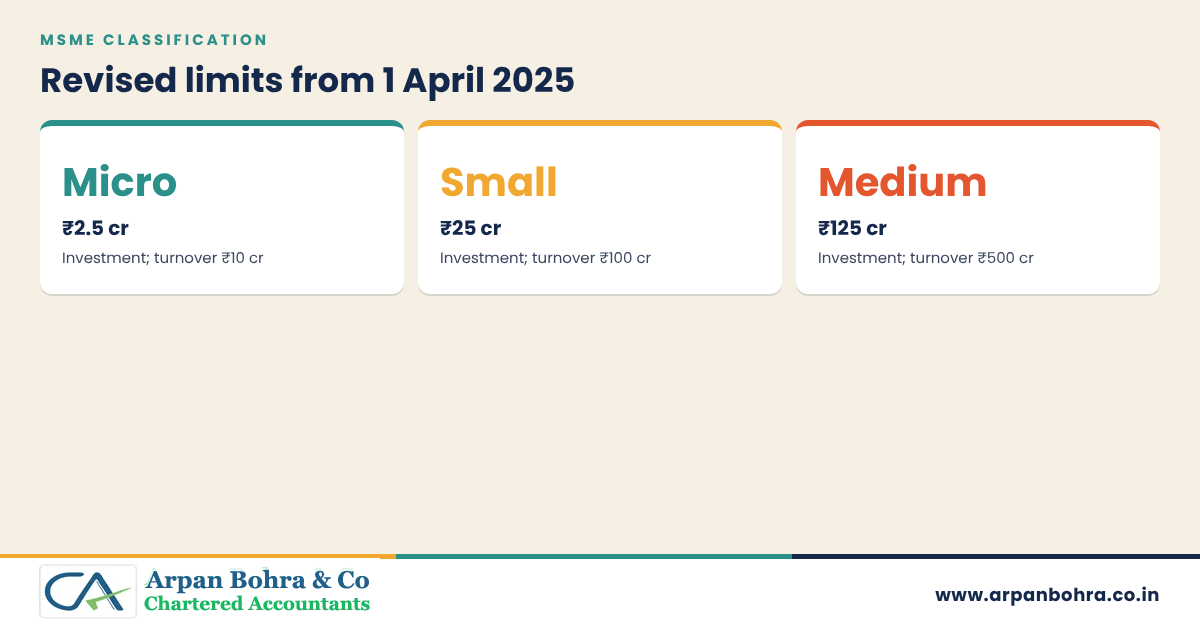
Udyam registration is a free, online registration on the Udyam portal, based on Aadhaar and PAN, for micro, small and medium enterprises. Under the classification revised from 1 April 2025, a micro enterprise has investment up to ₹2.5 crore and turnover up to ₹10 crore, a small enterprise up to ₹25 crore and ₹100 crore, and a medium enterprise up to ₹125 crore and ₹500 crore (verify the notification). Registered micro and small enterprises are protected by sections 15 to 19 of the MSMED Act, 2006: payment within 45 days (or 15 days with no agreement), compound interest at three times the bank rate on delay, and a reference to the Micro and Small Enterprises Facilitation Council. The same limits drive the tax rule on payments under section 43B(h); see our guide to the MSME 45-day rule.
Classification
| Category | Investment in plant and machinery or equipment | Turnover |
|---|---|---|
| Micro | Up to ₹2.5 crore | Up to ₹10 crore |
| Small | Up to ₹25 crore | Up to ₹100 crore |
| Medium | Up to ₹125 crore | Up to ₹500 crore |
Both conditions must be met. Exports are excluded from the turnover calculation. Verify the notified limits.
Benefits
- Payment protection: sections 15 to 19, MSMED Act, including the Facilitation Council route for delayed payments.
- Credit: eligibility for priority sector lending, and collateral-free loans through the credit guarantee scheme, subject to its limits and conditions (verify).
- Public procurement: reserved share of procurement from micro and small enterprises, and exemptions from earnest money in tenders, subject to the policy.
- Fee concessions: reduced fees for patents, trademarks and some government schemes.
- Tax: benefits under the Income-tax Act and the payment rule in section 43B(h) are linked to the MSME status of suppliers.
Recovering delayed payments
- Register on the Udyam portal and keep the certificate with the invoices.
- Record the date of acceptance of goods or services and a written agreement with a period of 45 days or less.
- Send a reminder and a notice for payment with interest under section 16.
- File an application on the MSME Samadhaan portal, or with the Facilitation Council, for conciliation and, if needed, arbitration.
- If the buyer disputes the award, it must deposit 75% of the awarded amount to apply to set it aside under section 19 (verify).
Worked example
A micro enterprise supplies goods worth ₹5,00,000 on 1 April with no written agreement. The buyer pays on 31 July.
- The 15-day limit under section 15 ended on 16 April. The delay is 106 days.
- Interest under section 16 at three times the bank rate, compounded monthly (illustrative: bank rate 6.5% gives 19.5% a year).
- Approximate interest on ₹5,00,000 for about 3.5 months at 19.5%: ₹5,00,000 × 19.5% × 106 ÷ 365 ≈ ₹28,300 on simple basis; the Act provides for monthly compounding, so the claim is slightly higher.
- The buyer cannot deduct this interest for tax under section 23 of the MSMED Act.
The rates shown are assumed. Use the RBI bank rate in force.
Registration checklist
- Check whether Aadhaar, PAN and GSTIN are ready (GSTIN is needed for those with GST registration).
- Register at udyamregistration.gov.in; the certificate is free.
- Update the details annually, since investment and turnover are taken from the tax and GST data.
- Collect a certificate from your suppliers if you are a buyer, to apply the 45-day rule.
- Add the Udyam number to quotes, invoices and agreements.
Frequently asked questions
Is Udyam registration free?
Do traders qualify as MSMEs?
What is the delayed payment interest?
Where do I file a delayed payment claim?
Do medium enterprises get payment protection?
Do I need to renew Udyam registration?
Arpan Bohra & Co., Chartered Accountants, Himayat Nagar, Hyderabad.
This article is shared for general professional education. Readers may write to the firm for information about its practice areas.
General educational information as at 20 October 2026. It is not legal or tax advice and does not create a professional relationship. Provisions, rates and thresholds change; verify the current law and notifications before acting. References to the 57th GST Council (8 October 2026) are to recommendations that need amendments or notifications before they have legal effect.