
By CA Arpan Bohra (FCA, CS), Arpan Bohra & Co., Chartered Accountants, Hyderabad. Position of law as at 20 October 2026.
A Hyderabad software company invoices overseas clients and pays input GST on cloud, rent and professional services every month. A pharma formulation unit buys inputs at a higher rate than it charges on its sales. A two-year-old start-up has ₹4 lakh of input tax credit sitting in its ledger and no sales yet. All three describe a “GST refund problem”, but only two of them have a refund route in law. Knowing which route applies is the first step to a claim that survives scrutiny.
GST refunds are governed by section 54 of the CGST Act, 2017 and Rules 89 to 97A of the CGST Rules, 2017. The RFD-01 application lists the grounds on which a refund can be claimed. Grouped by ground, they come to 14 working routes: excess cash ledger balance, exports with and without payment of tax, supplies to SEZs, deemed exports, inverted duty, excess payment, change of place of supply, tax on a supply not provided, and refunds flowing from assessments, appeals or other orders, plus a residuary ground. The general time limit is two years from the “relevant date”. Unutilised input tax credit is refundable only for zero-rated supplies and for inverted duty; it is not refundable merely because it has accumulated.
The 14 routes at a glance
The grounds below follow the refund-ground list in Form GST RFD-01. The form groups some grounds under sub-heads; for working purposes we split deemed exports into recipient and supplier claims, and treat provisional-assessment finalisation separately from appeal and other orders. The relevant-date column refers to Explanation (2) to section 54.
| # | Ground in RFD-01 | Core provision | Key point |
|---|---|---|---|
| 1 | Excess balance in electronic cash ledger | s.54(1) with s.49(6) | Cash balance not needed for liability. Part 4. |
| 2 | Export of services with payment of tax | s.54(1); Rule 89 | IGST paid on export of services. Relevant date: Expl. 2(c). Part 2. |
| 3 | Export of goods or services without payment of tax (accumulated ITC) | s.54(3)(i); Rule 89(4) | Under LUT or bond. Provisional 90% possible under s.54(6). Part 2. |
| 4 | Supplies to SEZ unit or developer with payment of tax | s.54(1); Rule 89 | Relevant date: Expl. 2(ba). |
| 5 | Supplies to SEZ unit or developer without payment of tax | s.54(3)(i) | Accumulated ITC claim. |
| 6 | Recipient of deemed exports | s.54(1); Rule 89 | Relevant date: Expl. 2(b). |
| 7 | Supplier of deemed exports | s.54(1); Rule 89 | Relevant date: Expl. 2(b). |
| 8 | ITC accumulated due to inverted tax structure | s.54(3)(ii); Rule 89(5) | Input rate higher than output rate; nil-rated and fully exempt outward supplies excluded except as notified. Part 3. |
| 9 | Excess payment of tax | s.54(1) | Relevant date: Expl. 2(h), the date of payment of tax. Part 4. |
| 10 | Tax paid on intra-State supply later held inter-State, or the reverse | s.77 CGST Act; s.19 IGST Act | Change of place of supply. Part 4. |
| 11 | Tax paid on a supply not provided, wholly or partly, with no invoice issued | s.54(8)(c) | Paid to the applicant, not the Consumer Welfare Fund. |
| 12 | Finalisation of provisional assessment or assessment-related order | s.54; Expl. 2(f) | Relevant date: date of adjustment of tax after final assessment. |
| 13 | Order in appeal or any other order | s.54; Expl. 2(d) | Relevant date: date of communication of the judgment, decree or order. |
| 14 | Any other ground (to be specified) | s.54; Expl. 2(h) | Residuary; the portal asks for a short reason. |
Route map and who uses which
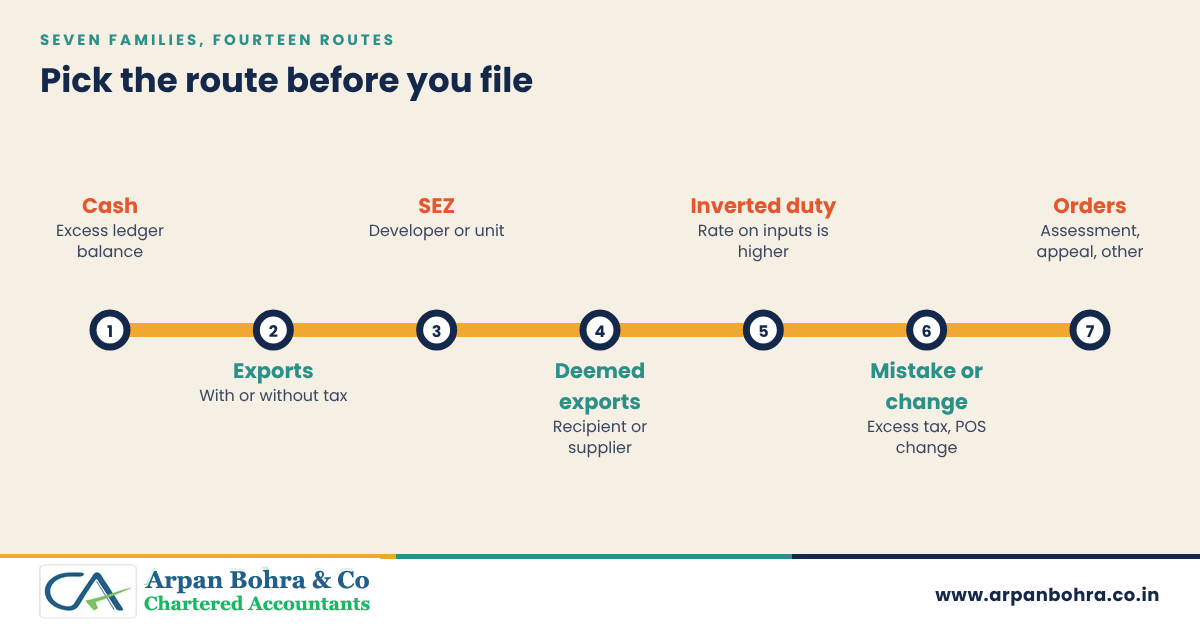
| Family | Routes | Typical claimant |
|---|---|---|
| Cash | 1 | Any registered person with surplus cash balance |
| Exports | 2, 3 | IT, SaaS, pharma and merchant exporters |
| SEZ | 4, 5 | Suppliers to SEZ units and developers |
| Deemed exports | 6, 7 | EPC and notified-supply suppliers; recipients |
| Inverted duty | 8 | Pharma, textiles, footwear and other rate-inverted sectors |
| Mistake or change | 9, 10, 11 | Anyone who paid tax in error |
| Orders | 12, 13, 14 | Taxpayers with an assessment, appeal or court order |
Three claims that sit outside the drop-down
- IGST paid on export of goods. No separate RFD-01 is filed. The shipping bill is treated as the refund application, based on GSTR-1 and GSTR-3B data (Rule 96). Part 2 explains the mismatches that stall these refunds.
- Notified bodies and consulates. Persons covered by section 54(2) and section 55, such as UN agencies and embassies, claim tax paid on inward supplies in Form RFD-10 within two years from the last day of the quarter in which the supply was received.
- Unregistered persons. Where the law allows a refund to a person without registration, the claim is supported by Statement 8. Confirm the specific entitlement against Rule 89 before filing.
Conditions common to every claim
- Time limit. Two years from the relevant date (s.54(1)). The clause that applies differs by route, as the table shows.
- Minimum amount. No refund is paid where the amount is below ₹1,000 (s.54(14)).
- Unjust enrichment. The applicant must show the tax was not passed on to another person (s.54(4)(b)). For claims below ₹2 lakh a declaration replaces the detailed evidence. Zero-rated supplies and unutilised ITC are paid directly to the applicant under s.54(8); other claims can be credited to the Consumer Welfare Fund.
- Withholding. The officer may withhold a refund where a return is pending or a demand is outstanding beyond the stay or appeal period, and may set off dues against the refund (s.54(10)).
- One claim, one formation. The claim is lodged with one jurisdictional authority only.
- No double benefit. Refund of unutilised ITC on zero-rated supplies is not available if the supplier has availed drawback of central tax or claimed an IGST refund on the same supplies (s.54(3) proviso).
- Timeline. The refund order is due within 60 days of a complete application (s.54(7)); interest follows if the period is exceeded (s.56). Part 5 sets out the full sequence.
Start-ups, pharma, IT and exporters
| Taxpayer | Usual route | Watch-point |
|---|---|---|
| Start-up with no or low sales | Usually none. Accumulated ITC is carried forward. | A refund needs zero-rated supplies or an inverted rate structure. Pre-revenue credit is not refundable. |
| Pharma formulation maker | Route 8 (inverted duty); route 3 for export sales | Rule 89(5) formula, the notified-goods list, and the treatment of input services. Part 3. |
| IT or SaaS exporter | Routes 3 or 2 | LUT or IGST payment, receipt of foreign exchange, and place-of-supply position. Part 2. |
| Merchant or manufacturer-exporter | Route 3 or the shipping-bill route | Drawback and IGST refund cannot both be taken on the same goods. |
Worked example: choosing the route
A Hyderabad company supplies software development services to a US client under an LUT and also sells licences to Indian customers. In a quarter, it has ₹9 lakh of input tax credit on cloud, rent and professional fees. Its zero-rated turnover is large relative to its adjusted total turnover.
- The export of services without payment of tax is a zero-rated supply, so route 3 is available under s.54(3)(i).
- The claim is computed under Rule 89(4); only the portion of net ITC attributable to zero-rated turnover is refundable. The ITC attributable to Indian sales stays in the ledger.
- The relevant date for services is fixed by Expl. 2(c). The two-year period is counted from receipt of the foreign exchange, or from the invoice date where payment came in advance.
- If the company had instead paid IGST on the export, route 2 would apply; the ITC would then be used for the IGST payment and the IGST itself is what is refunded.
The start-up in our opening has no zero-rated supplies and no rate inversion, so there is no route. Its ₹4 lakh is carried forward and set against future output tax.
Litigation angle
Refund disputes usually arise at three points: a deficiency memo (RFD-03) issued on a technical ground, a rejection order that adopts a restrictive reading of “inputs” or of the formula, and an adjustment of an unrelated demand under s.54(10). A deficiency memo is not a rejection order; the correct step is to rectify and file afresh. A rejection order is appealable to the Appellate Authority, and a further appeal lies to the GST Appellate Tribunal under section 112, subject to the Tribunal’s procedural framework (verify current procedure). Departmental positions on input services, on timing of the relevant date and on place of supply are often contested; treat those issues as litigative and document the position at the time of filing.
What the 57th GST Council recommended
The 57th GST Council meeting of 8 October 2026 recommended, among other things, a 10-day acknowledgement window with deemed acknowledgement, automatic sanction of excess cash ledger refunds, provisional sanction of 90% for eligible zero-rated and inverted duty claims, and a minimum of ₹1,000 to be applied on the aggregate across taxes. These are recommendations. They have legal effect only after amendment of the Act or Rules or issue of notifications. Our detailed note is at Decoding the refund reforms of the 57th GST Council; the official clarifications are summarised in this FAQ post.
Related reading on this site: refund of ITC under inverted duty structure and EDF replacing SOFTEX. Next in the series: Part 2, exports: LUT versus IGST payment.
Frequently asked questions
What is the time limit to claim a GST refund?
Can a start-up claim refund of accumulated input tax credit?
Is there a minimum refund amount?
Which form is used to claim a refund?
Can I claim both IGST refund and ITC refund on the same export?
Are the 57th GST Council refund changes already in force?
Arpan Bohra & Co., Chartered Accountants, Himayat Nagar, Hyderabad.
This article is shared for general professional education. Readers may write to the firm for information about its practice areas.
General educational information as at 20 October 2026. It is not legal or tax advice and does not create a professional relationship. Provisions, rates and thresholds change; verify the current law and notifications before acting. References to the 57th GST Council (8 October 2026) are to recommendations that need amendments or notifications before they have legal effect.