
By CA Arpan Bohra (FCA, CS), Arpan Bohra & Co., Chartered Accountants, Hyderabad. Position of law as at 20 October 2026.
A SaaS company in HITEC City bills its clients in the United States every month, pays 18% GST on its office rent, cloud services and consultants, and charges no GST on its exports. Credit keeps building up in the ledger. Its finance head asks the question every exporter eventually asks: should we keep exporting under a Letter of Undertaking and claim refund of the accumulated credit, or pay IGST and claim that back? The answer depends on what you export, how the refund formula treats your turnover, and how much liquidity you can afford to lock up.
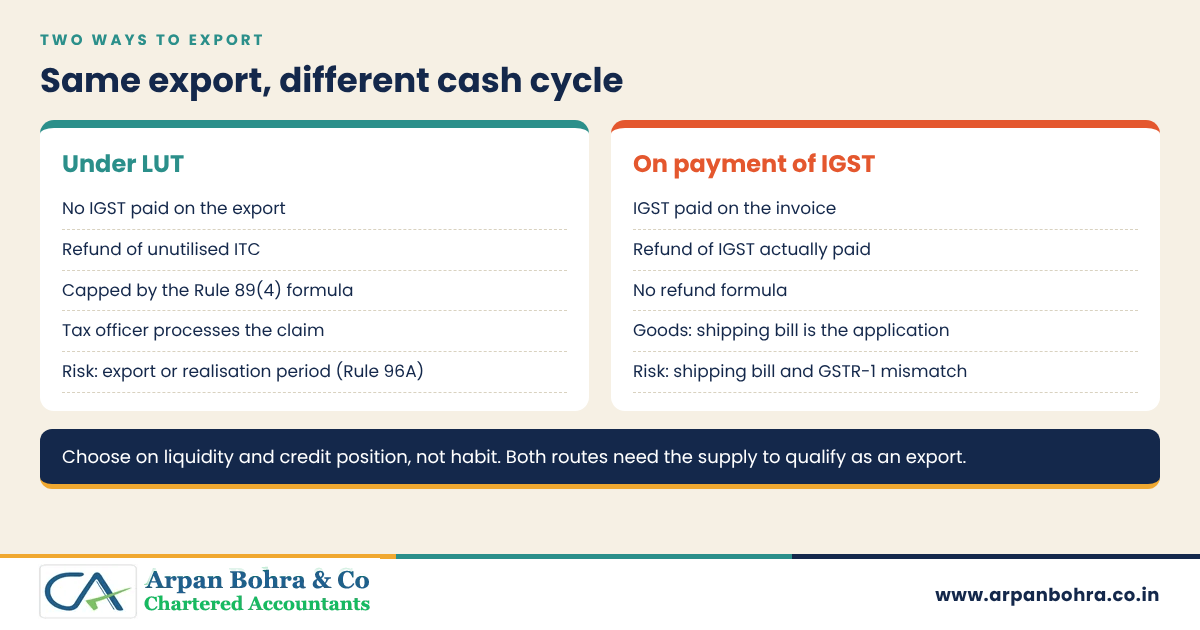
An export is a zero-rated supply under section 16 of the IGST Act, 2017. The exporter can supply under a bond or Letter of Undertaking (LUT) without paying IGST and claim refund of unutilised input tax credit under section 54(3) of the CGST Act, computed under Rule 89(4). Alternatively, goods and services (other than the goods excluded by Notification 01/2023-Integrated Tax) can be exported on payment of IGST, with refund of the IGST paid. For exported goods, the shipping bill itself is the refund application under Rule 96; for services, the claim is made in Form GST RFD-01. LUT keeps cash in the business but caps the refund by a formula; IGST payment gives a direct refund of tax paid but needs funding first.
The legal frame
| Provision | What it does |
|---|---|
| Section 16, IGST Act, 2017 | Defines zero-rated supply (exports and authorised supplies to SEZ units or developers) and gives the two refund routes. Sub-section (3) covers supply under bond or LUT; sub-section (4) covers supply on payment of IGST for classes notified by the Government. Sub-section (5) bars refund where the goods attract export duty. |
| Section 54, CGST Act, 2017 | Refund of unutilised ITC on zero-rated supplies without payment of tax is allowed under s.54(3)(i). A refund cannot be taken if the supplier has availed drawback of central tax or claimed IGST refund on the same supplies. |
| Rule 89(4), CGST Rules | Formula for the refund of accumulated ITC on exports under LUT. |
| Rule 96 | IGST paid on export of goods: the shipping bill is treated as the refund application. Services are claimed through RFD-01 under Rule 89. |
| Rule 96A and Notification 37/2017-CT | Furnishing of the bond or LUT (Form RFD-11) and the consequences of non-export or non-realisation. |
| Notification 01/2023-Integrated Tax | Permits exports on payment of IGST for all goods and services except the goods listed in its table (it lists pan masala, tobacco products and certain mint oils). Effective 1 October 2023. |
Is it an export at all?
The route you choose is irrelevant if the supply is not an export. For services, section 2(6) of the IGST Act sets five cumulative conditions: the supplier is in India, the recipient is outside India, the place of supply is outside India, payment is received in convertible foreign exchange (or in Indian rupees where the Reserve Bank permits), and the supplier and recipient are not merely establishments of a distinct person. Software and IT-enabled services often fail on place of supply or on the “intermediary” characterisation under section 13(8)(b), which fixes the place of supply at the supplier’s location. Whether a particular arrangement is intermediary service is a recurring dispute; treat it as litigative and examine contracts, invoicing and the role actually played.
Route A: export under LUT
- File the LUT in Form GST RFD-11 on the portal before the export, for the financial year. Notification 37/2017-CT makes it available to all registered exporters, except a person prosecuted for an offence under the GST laws where the tax evaded exceeds ₹250 lakh.
- Export without paying IGST and report the supplies in GSTR-1. Export data flows to Customs and is confirmed back to the portal (Rule 96A(2)).
- Watch the clock. For goods not exported, tax with interest under section 50(1) is payable within 15 days after three months from the invoice date. For services where payment is not received, the period is 15 days after the later of one year from the invoice date or the FEMA period, including any RBI extension. The Commissioner may allow a further period. On default, the LUT benefit is withdrawn until payment (Rule 96A(3)-(4)).
- Claim the refund in RFD-01 for the tax period, with the statements required for zero-rated claims. The refund is the lower of what Rule 89(4) yields and the ITC available.
Route B: export on payment of IGST
Goods. The exporter pays IGST on the shipping bill, files GSTR-3B and GSTR-1, and the shipping bill is treated as the refund application once the manifest is filed, a valid GSTR-3B is furnished and Aadhaar authentication under Rule 10B is complete. Customs processes the claim and credits the bank account. If the shipping bill and GSTR-1 data differ, the application is treated as filed only on the date the mismatch is rectified. Refund can be withheld on a request under section 54(10) or 54(11), where Customs finds a violation, or on risk-based verification of ITC (Rule 96(4)).
Services. IGST is paid on the export invoice, usually through the credit ledger, and the exporter claims refund of the IGST in RFD-01. Because the credit ledger is debited, ITC that would otherwise be stuck is effectively recycled once the refund is sanctioned.
LUT versus IGST payment
| Factor | Under LUT | On payment of IGST |
|---|---|---|
| Cash outflow | No IGST paid | IGST paid from credit ledger, with cash for any shortfall |
| What is refunded | Unutilised ITC, capped by the Rule 89(4) formula | IGST actually paid |
| Formula risk | High: turnover definitions, 1.5 times value cap for goods, adjusted total turnover | Low: refund is of tax paid |
| Who processes | Jurisdictional tax officer (goods and services) | Customs for goods; tax officer for services |
| Main exposure | Failure to export or realise within the Rule 96A period; tax and interest payable | Data mismatch between shipping bill and GSTR-1; withholding under Rule 96(4) |
| Not available for | Goods attracting export duty (s.16(5)) | The goods in the table to Notification 01/2023-IT, and goods attracting export duty |
| ITC use limits | Not applicable | Check Rule 86B if monthly taxable turnover exceeds ₹50 lakh, subject to its exceptions |
Worked example: SaaS exporter
A Hyderabad SaaS company receives ₹80 lakh in a month for exports of services and has ₹20 lakh of domestic taxable turnover (all services). Net ITC on inputs and input services is ₹9 lakh.
- LUT route. Adjusted total turnover is ₹80 lakh + ₹20 lakh = ₹100 lakh. Refund under Rule 89(4) = ₹80 lakh × ₹9 lakh ÷ ₹100 lakh = ₹7.2 lakh. The balance ₹1.8 lakh of credit remains for domestic output tax.
- IGST route. IGST at 18% on ₹80 lakh is ₹14.4 lakh. If ₹9 lakh of credit and ₹5.4 lakh of cash are used, the refund claimed is ₹14.4 lakh. The ₹9 lakh credit comes back in the refund, but only after the claim is sanctioned, and the ₹5.4 lakh cash is funded in the meantime.
Domestic liability, ledger-utilisation order and Rule 86B are ignored to keep the arithmetic visible. For goods under LUT, the turnover of zero-rated supply is the lower of the FOB value in the shipping bill and the invoice value, and is further capped at 1.5 times the value of like goods sold domestically by the same or a similarly placed supplier, as declared.
IT, SaaS, pharma and start-ups
- IT and SaaS. The turnover of zero-rated services is measured by payments received in the period, not by invoices raised, and advances for services not yet completed are excluded. See our note on EDF replacing SOFTEX for the foreign exchange paperwork.
- Pharma exporters. Exports claim under Rule 89(4); the inverted-duty claim for domestic sales is separate (Part 3). Do not claim the same ITC twice. Avoid taking drawback and IGST refund on the same goods.
- Start-ups. A start-up with its first export contract can claim only after zero-rated supplies are actually made. File the LUT before the first export invoice.
Pitfalls and litigation angle
- Mismatch rejections. A difference between GSTR-1 and the shipping bill defers the deemed filing date, which affects the 60-day clock and interest under section 56.
- Place of supply and intermediary. Departments may deny zero-rating and recover tax on services treated as intermediary; this is an unsettled area.
- Rejection orders. A rejection is appealable to the Appellate Authority, with a second appeal to the GST Appellate Tribunal (verify procedure).
What the 57th GST Council recommended
The 8 October 2026 recommendations relevant to exporters are: removal of the 1.5-times domestic-value cap in Rule 89(4)(C), omission of the distinct-person exclusion in section 2(6) of the IGST Act, omission of section 13(3)(a), an Explanation to section 16(1) on goods delivered in an SEZ or FTWZ to an overseas buyer, 90% provisional sanction in eligible cases, and a circular on receipt of export proceeds. None of these is law until amended or notified. There was no LUT-specific recommendation in the material we reviewed. See our detailed note.
Back to Part 1: the 14 routes. Next: Part 3: inverted duty refund and Rule 89(5).
Frequently asked questions
Is LUT or IGST payment better for an IT or SaaS exporter?
Who can furnish an LUT?
What happens if export proceeds are not realised?
Do I need to file RFD-01 for IGST paid on export of goods?
Can goods that attract export duty get refund?
Have the 57th GST Council export changes been notified?
Arpan Bohra & Co., Chartered Accountants, Himayat Nagar, Hyderabad.
This article is shared for general professional education. Readers may write to the firm for information about its practice areas.
General educational information as at 20 October 2026. It is not legal or tax advice and does not create a professional relationship. Provisions, rates and thresholds change; verify the current law and notifications before acting. References to the 57th GST Council (8 October 2026) are to recommendations that need amendments or notifications before they have legal effect.