
By CA Arpan Bohra (FCA, CS), Arpan Bohra & Co., Chartered Accountants, Hyderabad. Position of law as at 20 October 2026.
A Hyderabad IT services company files its monthly return, and a few weeks later its accountant notices that CGST and SGST were charged on an invoice to a customer in Bengaluru. The supply was inter-State; IGST should have been paid. In the same office, a pharma client has ₹15 lakh locked as pre-deposit for an appeal it has just won, and a third client has a large balance sitting in the cash ledger after a one-off payment. All three are refund claims, and none of them is an export or an inverted duty claim. Each has its own provision, clock and form.
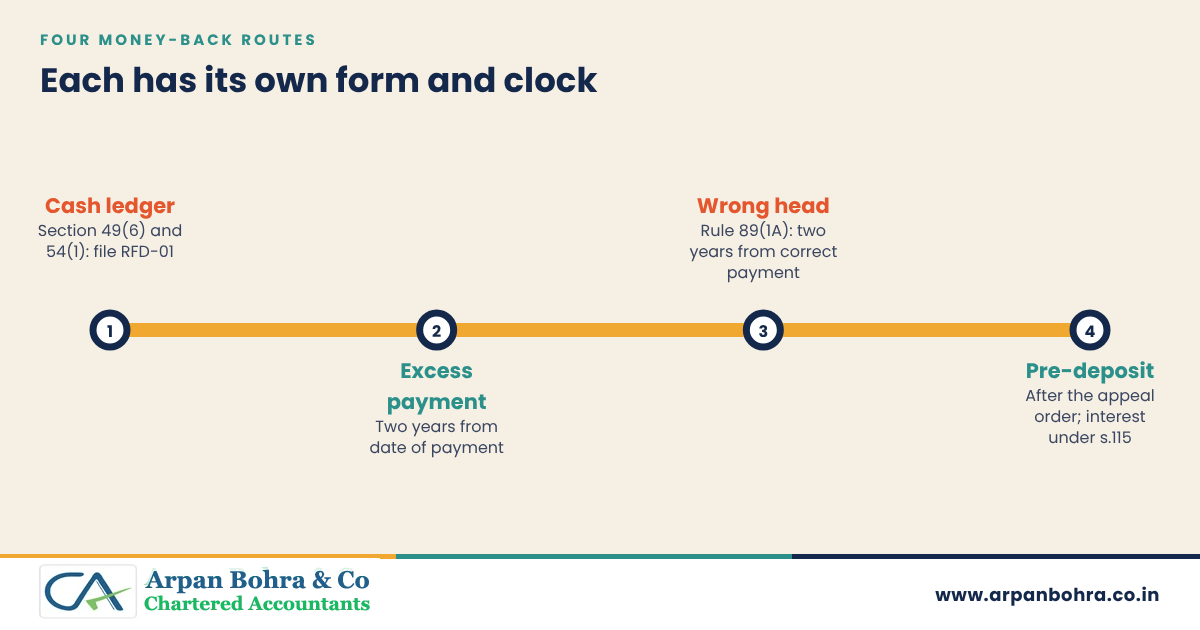
Refund of money paid by mistake or on account of litigation is claimed in Form GST RFD-01 under four distinct grounds. Cash ledger balance: section 49(6) with section 54. Excess payment of tax: two years from the date of payment (Explanation (2)(h) to section 54). Tax paid under the wrong head: section 77 CGST Act or section 19 IGST Act, with a two-year limit under Rule 89(1A) counted from payment of tax in the correct head. Pre-deposit: refund after a successful appeal under section 107(6) or 112(8), with interest under section 115 at the rate linked to section 56. The 57th GST Council has recommended automatic refund of excess cash ledger balances and a standalone section 115; neither is law yet.
Excess balance in the cash ledger
Section 49(6) of the CGST Act allows the balance in the electronic cash ledger or credit ledger, after payment of tax, interest, penalty, fee or any other amount, to be refunded in accordance with section 54. Section 54(1) separately provides that a registered person claiming a balance in the electronic cash ledger may do so in the prescribed form and manner. The claim is made in RFD-01 under the ground “excess balance in electronic cash ledger”. Whether the two-year relevant-date limit applies to a cash ledger balance is a point on which the text and practice are not uniform; file early and treat the late claim as litigative.
Excess payment of tax
Where output tax is paid in excess of the liability, for instance because of a keying error in GSTR-3B or a duplicate payment, the claim is under the ground “excess payment of tax”. The relevant date is the date of payment of tax (Explanation (2)(h) to section 54), and the claim must be made within two years. Because a filed GSTR-3B cannot be revised, the safe route is refund. Where tax was also deposited in cash for an assessed demand that is later set aside, the claim ground changes to the order-based ground (Part 1, routes 12 and 13).
Wrong head: section 77 and section 19
Section 77(1) CGST Act entitles a registered person who paid CGST and SGST (or UTGST) on a transaction treated as intra-State, later held to be inter-State, to a refund of those taxes. The mirror provision is section 19(1) of the IGST Act for IGST paid on a supply later held intra-State. Section 77(2) protects the person from interest on the CGST and SGST payable once the correct tax is paid.
- Time limit. Rule 89(1A), inserted by Notification 35/2021-Central Tax, requires the application within two years of paying the tax under the correct head. Circular 162/18/2021-GST (25 September 2021) explains the counting.
- Form. RFD-01, on the ground “tax paid on an intra-State supply which is subsequently held to be inter-State supply and vice versa”.
- No credit note route. The circular records that no refund is available where the tax was adjusted by issuing a credit note under section 34.
- Payment to the applicant. Refund under section 77 is paid to the applicant and not credited to the Consumer Welfare Fund (section 54(8)(d)).
Pre-deposit refund
An appeal to the Appellate Authority under section 107 must be filed within three months of communication of the order, extendable by one month on sufficient cause, after paying the admitted amount in full plus 10% of the tax in dispute, capped at ₹20 crore under the CGST Act (the cap was ₹25 crore before 1 November 2024). Payment under section 107(6) stays recovery of the balance under section 107(7). A second appeal to the Appellate Tribunal under section 112 requires a further pre-deposit under section 112(8); the percentage and caps were revised in 2024, so verify the current text and its commencement before computing.
If the appeal succeeds, the pre-deposit is refundable. Section 115 provides interest on the refund from the date of payment of the pre-deposit to the date of refund, at the rate specified under section 56. Section 56 caps that rate at 6%, and at 9% for refunds arising from final orders of an adjudicating authority, Appellate Authority, Tribunal or court that are not paid within 60 days of the application; the actual rate is fixed by notification. The claim is filed in RFD-01 under the “appeal” order-based ground, with the relevant date being the date of communication of the order (Explanation (2)(d)).
Worked examples
Order confirms tax of ₹60 lakh. The taxpayer admits ₹10 lakh and disputes ₹50 lakh. Pre-deposit under section 107(6) = ₹10 lakh + 10% × ₹50 lakh = ₹15 lakh, of which ₹5 lakh is the disputed-tax deposit. The appeal succeeds on the disputed portion, and the ₹5 lakh is refunded 400 days after payment.
Interest under section 115 = ₹5,00,000 × rate × 400 ÷ 365. At 6%, the figure is about ₹32,877; at 9%, about ₹49,315. These rates are the statutory ceilings in section 56 used for illustration only; the actual rate must be taken from the current notification.
A Hyderabad company paid CGST ₹90,000 and SGST ₹90,000 on a supply to a Bengaluru customer. The supply is inter-State. The company pays IGST ₹1,80,000 and, within two years of that payment, files RFD-01 for refund of the CGST and SGST of ₹1,80,000. Whether interest is payable on the IGST paid belatedly is a separate question; section 77(2) protects only the converse case, where IGST was paid and the supply is held intra-State.
Start-ups, pharma, IT and exporters
- Start-ups and IT. The commonest wrong-head error is CGST and SGST on an inter-State SaaS or services invoice. Check place of supply before invoicing and keep the section 77 clock in view.
- Pharma. Pre-deposits tie up working capital in long disputes; track refund of the deposit as an asset and claim interest under section 115.
- Exporters. A cash ledger balance created by mistake on a zero-rated supply is not an export refund; use the cash ledger ground, not Rule 89(4).
Litigation angle
| Issue | Taxpayer position | Departmental position | Risk |
|---|---|---|---|
| Time limit for cash ledger balance | No relevant date for ledger balance | Two years from payment | Moderate; litigative |
| Interest on pre-deposit refund | From date of deposit to date of refund (s.115) | Rate is fixed by notification within the s.56 ceilings | Moderate |
| Wrong head refund after two years | Section 77 itself prescribes no period (arguable) | Rule 89(1A) is explicit: two years from payment in the correct head | High once limitation has run |
| Set-off of pending demand | Demand stayed | Adjustment under s.54(10) | Moderate |
What the 57th GST Council recommended
The Council recommended automatic refund of excess electronic cash ledger balances without officer intervention, a standalone section 115 with a circular clarifying the applicable interest rate on pre-deposit refunds, and a reported pre-deposit cap for penalty-only appeals (verify the figure once notified). All are recommendations pending amendment. See our note on the refund reforms.
Back to Part 3. Next: Part 5: the refund process, RFD-01 to appeal.
Frequently asked questions
Can I get back GST paid under the wrong head?
How do I claim excess balance in the electronic cash ledger?
How much pre-deposit is needed to appeal under section 107?
Is interest payable on refund of pre-deposit?
Is there a time limit for a refund of excess tax paid?
Does the 57th GST Council change apply now?
Arpan Bohra & Co., Chartered Accountants, Himayat Nagar, Hyderabad.
This article is shared for general professional education. Readers may write to the firm for information about its practice areas.
General educational information as at 20 October 2026. It is not legal or tax advice and does not create a professional relationship. Provisions, rates and thresholds change; verify the current law and notifications before acting. References to the 57th GST Council (8 October 2026) are to recommendations that need amendments or notifications before they have legal effect.