
By CA Arpan Bohra (FCA, CS), Arpan Bohra & Co., Chartered Accountants, Hyderabad. Position of law as at 20 October 2026.
A pharma exporter in Hyderabad files a refund claim on the last day of the month and, two weeks later, receives a deficiency memo for a statement mismatch. A software exporter has filed a clean claim, but ninety days later nothing has been credited. Both ask the same question: where is the file, and what are my rights at each step? The answer lies in a short chain of forms, from RFD-01 to RFD-09, and a set of clocks that run from the date the acknowledgement reference number (ARN) is generated.
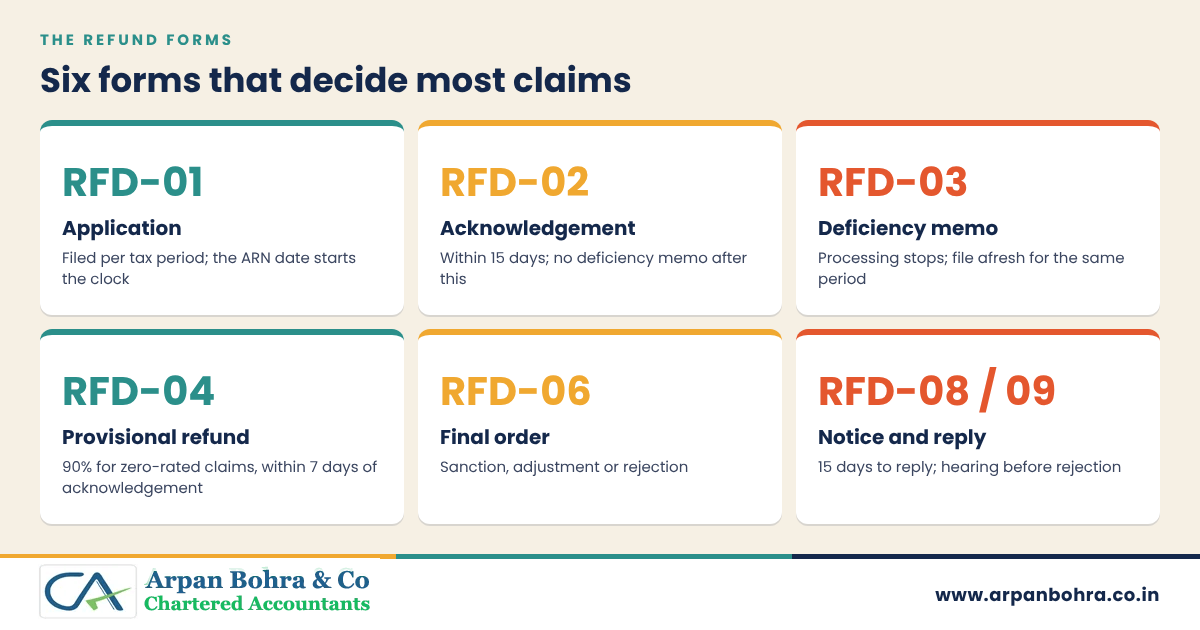
A refund claim is filed in Form GST RFD-01. The officer must issue an acknowledgement (RFD-02) or a deficiency memo (RFD-03) within 15 days of the ARN. The refund order is due within 60 days of receipt of a complete application (section 54(7)); if it is delayed, interest runs under section 56. Provisional refund of 90% (RFD-04) applies to zero-rated supplies within seven days of the acknowledgement. Before rejecting any part of the claim, the officer must issue a notice (RFD-08), allow 15 days for the reply (RFD-09) and give a hearing (Rule 92(3)). A rejection is appealable under section 107 within three months, with a further month on sufficient cause. The 57th GST Council has recommended a 10-day acknowledgement window and system-driven sanction; these are not yet law.
The forms and what each one does
| Form | Purpose | Timing |
|---|---|---|
| GST RFD-01 | Application for refund, filed on the portal for a tax period | Within the two-year limit from the relevant date |
| RFD-02 | Acknowledgement that the application is complete | Within 15 days of the ARN (Rule 90) |
| RFD-03 | Deficiency memo, which stops processing | Within the same 15 days |
| RFD-04 | Provisional refund order (90%) on zero-rated supplies | Within 7 days of acknowledgement (Rule 91) |
| RFD-05 | Payment order | With or after the sanction order |
| RFD-06 | Final order sanctioning or rejecting the refund | Within 60 days of the application (s.54(7)) |
| RFD-07 | Withholding of refund under s.54(10) or (11) | When the grounds arise |
| RFD-08 and RFD-09 | Notice of reasons for non-admissibility, and the applicant’s reply | Reply within 15 days of receipt (Rule 92(3)) |
The refund process, step by step
- Check the conditions. GSTR-1 and GSTR-3B for the period must be filed before the claim. A claim cannot span two financial years (Circular 125/44/2019-GST).
- Reconcile and compute. Prepare the statements for the ground you are claiming: Rule 89(4) for zero-rated supplies without tax, Rule 89(5) for inverted duty.
- File RFD-01 on the portal. The ledger is debited for the amount claimed, and the ARN generated is the filing date.
- Receive the acknowledgement or deficiency memo within 15 days. Once an acknowledgement is issued, no deficiency memo can be issued later for that application (Circular 125, para 9).
- Provisional refund. For eligible zero-rated claims, RFD-04 can follow within seven days, subject to the Rule 91 condition on prosecution above ₹250 lakh in the preceding five years.
- Final order. The officer issues RFD-06, sanctioning the refund, adjusting any outstanding demand, or rejecting all or part after the notice and hearing process. Payment is by RFD-05 to the registered bank account.
- Follow up on delays. The Circular treats a refund as paid only when credited to the bank account; interest under section 56 runs for delay beyond 60 days.
Timelines at a glance
| Event | Period | Source |
|---|---|---|
| Acknowledgement or deficiency memo | 15 days from ARN | Rule 90; Circular 125/44/2019 |
| Provisional refund order | 7 days from acknowledgement | Rule 91(2) |
| Departmental target for RFD-06 and RFD-05 | 45 days from ARN | Circular 125/44/2019, para 34 |
| Refund order due | 60 days from complete application | Section 54(7) |
| Interest on delay | From the day after the 60 days, until credit | Section 56; Circular 125 (6%) |
| Reply to RFD-08 | 15 days from receipt | Rule 92(3) |
| Appeal to Appellate Authority | 3 months from communication, plus 1 month if sufficient cause | Section 107(1), (4) |
Deficiency memos
An RFD-03 stops processing. The credit or cash debited is re-credited automatically, and the applicant files a fresh RFD-01 for the same period, which gets a new ARN. A further deficiency memo on the fresh application is permitted only if the earlier deficiencies remain, wholly or partly, or a new substantive deficiency is found. The rectified application is treated as fresh and must be filed within two years of the relevant date (Circular 125/44/2019, paras 10 to 12). Typical grounds in practice include mismatch between GSTR-1 and GSTR-3B, missing statements, wrong period or ledger shortfall; a memo issued merely because the application reached the wrong office is not permitted (para 4(d)).
Show cause notice, hearing and rejection
If the officer considers any part of the claim inadmissible, Rule 92(3) requires reasons in writing in RFD-08. The applicant has 15 days to reply in RFD-09, and the Rule provides that no application is to be rejected without an opportunity of being heard. The officer then sanctions in whole or part, or rejects, in RFD-06. Where credit is rejected, the Circular provides for re-credit of the rejected ITC by PMT-03 only on an undertaking not to appeal, or after the appeal is decided against the applicant (paras 20 to 23); consider the effect of that undertaking before giving it. Sanctioned amounts are adjusted against outstanding demands as shown in RFD-06.
Worked example: dates and interest
ARN generated on 5 November 2026 for a claim of ₹10 lakh.
- Acknowledgement or deficiency memo due by 20 November 2026.
- Refund order due within 60 days, that is by 4 January 2027.
- If the amount reaches the bank account on 5 February 2027, the delay is 32 days beyond 4 January. Interest at 6% (the ceiling in section 56 and the rate stated in Circular 125) = ₹10,00,000 × 6% × 32 ÷ 365 = about ₹5,260.
- If a deficiency memo had instead been issued on 18 November and a fresh claim filed on 25 November, a new ARN and new clock would start on 25 November. The two-year limit would still be counted from the original relevant date.
The notified interest rate must be confirmed from the current notification.

Appeal and next steps
- First appeal. To the Appellate Authority under section 107 within three months of communication of the order, with a month more on sufficient cause. Pre-deposit under section 107(6) is computed on the amounts arising from the order. An order that only rejects a refund creates no tax demand, but where the order also demands or adjusts amounts, check the computation (analysis, not settled by text).
- Second appeal. To the GST Appellate Tribunal under section 112, subject to its procedure and pre-deposit rules (verify the current framework and the status of benches).
- Writ. The High Court can be approached for jurisdictional errors or breach of natural justice, at its discretion; treat the statutory appeal as the primary remedy.
- Sector note. Start-ups with a first export claim, pharma units with inverted duty, and IT exporters under LUT should keep the statements, ledger snapshots and reconciliation files ready before the hearing.
What the 57th GST Council recommended
The Council recommended cutting the acknowledgement window from 15 days to 10 days, with a deemed acknowledgement if the system issues none; a system-readable RFD-01 without scanned uploads for zero-rated and inverted duty claims; provisional sanction of 90% for eligible zero-rated and inverted duty claims; and system-generated acknowledgement and automated sanction in a second phase. These need amendments to the Rules and notifications. See our note on the refund reforms.
Start of the series: Part 1, the 14 routes.
Frequently asked questions
How long does GST refund take?
What is a deficiency memo in GST refund?
Can a deficiency memo be issued after the acknowledgement?
What happens before a refund is rejected?
How can a refund rejection be challenged?
Is the 10-day acknowledgement period in force?
Arpan Bohra & Co., Chartered Accountants, Himayat Nagar, Hyderabad.
This article is shared for general professional education. Readers may write to the firm for information about its practice areas.
General educational information as at 20 October 2026. It is not legal or tax advice and does not create a professional relationship. Provisions, rates and thresholds change; verify the current law and notifications before acting. References to the 57th GST Council (8 October 2026) are to recommendations that need amendments or notifications before they have legal effect.