
By CA Arpan Bohra (FCA, CS), Arpan Bohra & Co., Chartered Accountants, Hyderabad. Position of law as at 20 October 2026.
A formulation manufacturer in Hyderabad’s pharma belt buys active ingredients and key starting materials at 18% and sells most of its medicines at 5%. Every month the credit ledger grows, because the tax on purchases is permanently higher than the tax on sales. The accounts team asks a precise question: how much of that credit can we get back in cash, and what will the officer exclude? The answer sits in section 54(3)(ii) of the CGST Act and Rule 89(5), and it is narrower than most taxpayers expect.
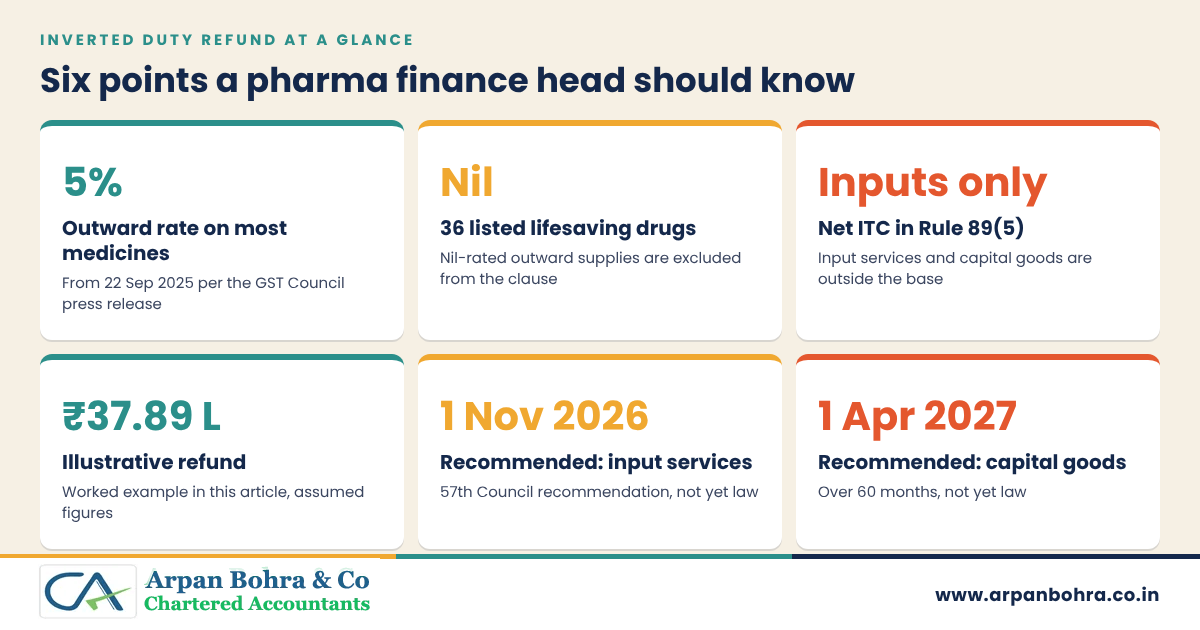
Section 54(3)(ii) of the CGST Act, 2017 allows refund of input tax credit that has accumulated because the rate of tax on inputs is higher than the rate on output supplies. Nil-rated and fully exempt outward supplies are excluded, as are goods and services the Government notifies. Rule 89(5) caps the refund by a formula in which “Net ITC” covers inputs only; input services and capital goods do not count. The Supreme Court upheld that exclusion in Union of India v. VKC Footsteps India Pvt. Ltd. (13 September 2021). The 57th GST Council has recommended extending the refund to input services and, later, capital goods; that is not yet law.
Legal basis and the four exclusions
The refund arises under section 54(3)(ii), read with Rule 89(5), and is claimed for a tax period. The relevant date is the due date for the return for the period in which the claim arises (Explanation (2)(e) to section 54). Four limits shape every claim:
| Limit | Position |
|---|---|
| Inputs only | Net ITC in Rule 89(5) is credit availed on inputs. Credit on input services and capital goods is not part of the refundable base. |
| Nil-rated and fully exempt outward supplies | Section 54(3)(ii) excludes them. If the output is nil-rated, accumulation caused by it is not refundable under this clause. |
| Notified goods and services | The Government can notify supplies on which inverted duty refund is not allowed. Certain goods in Chapters 15 and 27 were restricted for applications filed on or after 18 July 2022 (Notification 09/2022-CT(Rate)). Verify the current list for your HSN. |
| Rate must be inverted | Credit that accumulates for other reasons, such as pre-revenue purchases or blocked credit, is not refundable under this clause. |
Rule 89(5): the formula
The maximum refund is:
{ (Turnover of inverted rated supply of goods and services × Net ITC) ÷ Adjusted Total Turnover } − { Tax payable on such inverted rated supply of goods and services × (Net ITC ÷ ITC availed on inputs and input services) }
- Net ITC is the ITC availed on inputs during the relevant period.
- ITC availed on inputs and input services appears in the second term, so input-service credit still affects the deduction even though it is not refundable.
- Adjusted Total Turnover and relevant period have the meaning given in Rule 89(4).
- The refund cannot exceed the balance available in the electronic credit ledger.
Notification 14/2022-CT (5 July 2022) amended the formula. Circular 181/13/2022-GST (10 November 2022) clarifies that the amendment is not clarificatory: it applies to refund applications filed on or after 5 July 2022, while applications filed earlier, including those pending on that date, are decided under the pre-amendment formula.
Worked example
In a tax period a pharma unit has: turnover of inverted rated supplies ₹10 crore, all of it at 5%; adjusted total turnover ₹10 crore; ITC availed on inputs ₹80 lakh; ITC availed on input services ₹15 lakh.
- Net ITC = ₹80 lakh (inputs only).
- ITC availed on inputs and input services = ₹95 lakh.
- Tax payable on the inverted rated supply = 5% × ₹10 crore = ₹50 lakh.
- First term = (₹10 crore × ₹80 lakh) ÷ ₹10 crore = ₹80 lakh.
- Second term = ₹50 lakh × (₹80 lakh ÷ ₹95 lakh) = ₹42.11 lakh.
- Maximum refund = ₹80 lakh − ₹42.11 lakh = ₹37.89 lakh, subject to the balance in the electronic credit ledger.
The ₹15 lakh of input-service credit does not enter the first term, so it is not refunded; it stays in the ledger to be used against output tax.
Pharma after the September 2025 rate cuts
The GST Council press release on its 56th meeting (3 September 2025) records that GST on 33 lifesaving drugs moved from 12% to nil, three drugs moved from 5% to nil, and all other drugs and medicines moved from 12% to 5%, with effect from 22 September 2025. Professional alerts at the time noted that active pharmaceutical ingredients and key starting materials, generally taxed at 18%, were not reduced, so the cut to 5% widened the inversion (verify against the current rate notifications for your inputs).
- Goods at 5%. The inversion is refundable under section 54(3)(ii), within the exclusions above.
- Goods now nil-rated. Nil-rated outward supplies are excluded from the inverted duty refund clause. Credit attributable to them is also a reversal question under the exempt-supply rules; take a documented position before filing.
- Mixed portfolios. A unit selling both nil-rated and 5% medicines must separate turnover and credit carefully. Weak segregation invites a recomputation by the officer.
- Administrative provisional refund. The same press release records that CBIC would administratively begin 90% provisional refunds for inverted duty cases on risk-based data analysis, pending amendment of the Act. Confirm the current instruction before relying on it.
How the claim is filed
- Reconcile ITC availed in GSTR-3B with GSTR-2B and the books for the period; separate inputs, input services and capital goods.
- Compute turnover of inverted rated supplies and adjusted total turnover for the same period.
- File Form GST RFD-01 for the tax period, selecting the inverted tax structure ground, with the statements prescribed for inverted duty claims. The GST Council refund flyer indicates monthly claims and an undertaking for manual claims (verify current portal practice).
- Track acknowledgement or deficiency memo, and respond to any notice (see Part 5).
Litigation angle and risk
| Issue | Taxpayer position | Departmental position | Risk |
|---|---|---|---|
| Input services in Net ITC | Credit on all inputs and input services should count | Rule 89(5) excludes them; upheld in VKC Footsteps | High for taxpayers; treat as settled |
| Nil-rated products | Mixed claims should proceed on the inverted portion | Outward nil-rated supplies are excluded | Moderate: depends on segregation |
| Amended formula for old periods | Applies from the claim period | Applies to applications filed on or after 5 July 2022 (Circular 181/13/2022) | Moderate |
| Capital goods credit | Refund is available as part of accumulated credit | Rule 89(5) base covers inputs only | High until the law is amended |
A rejection order is appealable to the Appellate Authority, and onward to the GST Appellate Tribunal (verify current procedure). Where the formula is applied correctly, the strongest ground is usually computational: the denominators, the correct period and ledger balance.
What the 57th GST Council recommended
On 8 October 2026 the Council recommended refund of accumulated ITC on input services under inverted duty for credit availed on or after 1 November 2026, refund for capital goods (zero-rated and inverted duty) for credit availed on or after 1 April 2027 spread over 60 months, and 90% provisional sanction for eligible inverted duty claims. These need legislative amendment and notification, and the effective dates may change. See our note on the refund reforms and our earlier post on refund of ITC under inverted duty structure.
Back to Part 2: exports. Next: Part 4: refund of excess or wrongly paid tax.
Frequently asked questions
What is an inverted duty structure under GST?
Can input services be included in the inverted duty refund?
Are nil-rated medicines eligible for inverted duty refund?
Which period applies for the claim?
Is a provisional refund available for inverted duty claims?
Does the 57th Council change apply to my claims today?
Arpan Bohra & Co., Chartered Accountants, Himayat Nagar, Hyderabad.
This article is shared for general professional education. Readers may write to the firm for information about its practice areas.
General educational information as at 20 October 2026. It is not legal or tax advice and does not create a professional relationship. Provisions, rates and thresholds change; verify the current law and notifications before acting. References to the 57th GST Council (8 October 2026) are to recommendations that need amendments or notifications before they have legal effect.