
By CA Arpan Bohra (FCA, CS), Arpan Bohra & Co., Chartered Accountants, Hyderabad. Position of law as at 20 October 2026.
A salaried manager in Hyderabad earning ₹13 lakh opens the payroll declaration form for the first time under the Income-tax Act, 2025 and sees two regimes, a new vocabulary (“tax year” instead of previous year and assessment year) and new section numbers. The question is the same as every year: how much tax, and which regime? For tax year 2026-27, the answers are in section 202 (the default slabs), section 156 (the rebate) and section 19 (the standard deduction) of the 2025 Act.
For tax year 2026-27 the default (new) regime under section 202 of the Income-tax Act, 2025 charges nil up to ₹4 lakh, then 5%, 10%, 15%, 20%, 25% and 30% in ₹4 lakh bands, with 30% above ₹24 lakh. A resident individual with total income up to ₹12 lakh pays no tax after the section 156 rebate of up to ₹60,000, with marginal relief just above that. Salaried taxpayers get a standard deduction of ₹75,000 under the new regime and ₹50,000 otherwise (section 19). A salaried individual with salary up to ₹12.75 lakh therefore pays nil tax in the new regime on salary alone. The old regime remains available by opting out under section 202(4).
What changed: tax year and the 2025 Act
The Income-tax Act, 2025 replaces the 1961 Act for tax years beginning on or after 1 April 2026. Income earned in the twelve months from 1 April 2026 forms “tax year 2026-27”, and the return is filed under section 263(1). Provisions carry new numbers: the default regime slabs sit in section 202, the rebate that was section 87A is section 156, and the salary standard deduction is in section 19. Reports on the Finance Bill, 2026 state that slab rates, surcharge and cess were not changed for tax year 2026-27 (secondary source; the section 202 table, section 156 and section 19 text below were checked on the Income Tax Department site).
New regime slabs, tax year 2026-27
| Total income (₹) | Rate |
|---|---|
| Up to 4,00,000 | Nil |
| 4,00,001 to 8,00,000 | 5% |
| 8,00,001 to 12,00,000 | 10% |
| 12,00,001 to 16,00,000 | 15% |
| 16,00,001 to 20,00,000 | 20% |
| 20,00,001 to 24,00,000 | 25% |
| Above 24,00,000 | 30% |
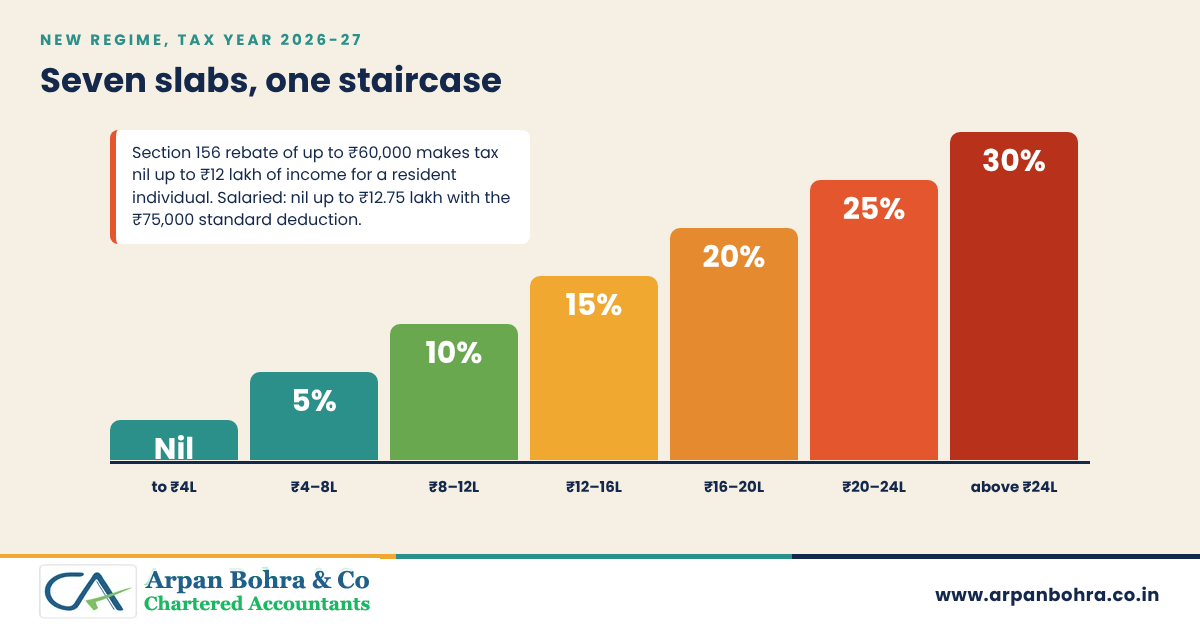
Section 202 applies to individuals, Hindu undivided families, associations of persons (other than co-operative societies), bodies of individuals and artificial juridical persons. It is the default: you are in this regime unless you opt out. The rates are marginal: each rate applies only to income within its band.
Rebate and marginal relief
Section 156 gives a rebate to resident individuals only. Where income is chargeable under section 202(1), the rebate is 100% of the tax or ₹60,000, whichever is less, if total income does not exceed ₹12 lakh. If income exceeds ₹12 lakh, the rebate is restricted so that the tax payable does not exceed the amount by which income exceeds ₹12 lakh (marginal relief). The rebate under section 156(2) cannot exceed the tax at section 202(1) rates; it does not shelter income taxed at special rates such as certain capital gains. Non-residents, HUFs, firms and companies do not get it.
Standard deduction
Under section 19, the standard deduction from salary is ₹75,000 (or the salary, if lower) where tax is computed under section 202(1), and ₹50,000 (or the salary, if lower) in any other case. It applies to salary and pension income, not to business or professional income.
Old regime slabs and the opt-out
An individual or HUF can opt out of section 202(1) under section 202(4). Where the person has no business or professional income, the option is exercised with the return under section 263(1) and can differ from year to year. Where there is business or professional income, the option must be exercised on or before the return due date, continues for later years, and can be withdrawn only once, after which it cannot be exercised again unless business or professional income ceases. Salaried taxpayers can switch each year, but TDS by the employer follows the regime declared to it.
| Category | Old regime slabs (reported unchanged for tax year 2026-27, verify) |
|---|---|
| Individual below 60, HUF | Nil to ₹2.5 lakh; 5% to ₹5 lakh; 20% to ₹10 lakh; 30% above |
| Senior citizen (60 or more) | Nil to ₹3 lakh; 5% to ₹5 lakh; 20% to ₹10 lakh; 30% above |
| Super senior citizen (80 or more) | Nil to ₹5 lakh; 20% to ₹10 lakh; 30% above |
Under section 156(1), a resident individual with total income up to ₹5 lakh gets a rebate of 100% of tax or ₹12,500, whichever is less, without marginal relief. The new regime has no separate slabs for senior citizens.
Surcharge and cess
Health and education cess is 4% of tax plus surcharge. Surcharge on individuals is 10% for income above ₹50 lakh up to ₹1 crore, 15% up to ₹2 crore and 25% above ₹2 crore; in the old regime it rises to 37% above ₹5 crore, while the new regime is capped at 25%. Surcharge on dividend income and on specified capital gains is capped at 15%, and marginal relief applies at each threshold. These rates are from the Income Tax Department’s tax rate page and reports on the Finance Bill, 2026; verify against the Finance Act, 2026.
Worked example: ₹13 lakh salary
New regime. Salary ₹13,00,000 less standard deduction ₹75,000 = ₹12,25,000.
- Tax on slabs: ₹4 lakh to ₹8 lakh at 5% = ₹20,000; ₹8 lakh to ₹12 lakh at 10% = ₹40,000; ₹12 lakh to ₹12.25 lakh at 15% = ₹3,750. Total ₹63,750.
- Income exceeds ₹12 lakh by ₹25,000, so marginal relief limits the tax to ₹25,000 (rebate ₹38,750).
- Cess at 4% on ₹25,000 = ₹1,000. Tax payable ₹26,000.
Old regime. Salary ₹13,00,000 less standard deduction ₹50,000 = ₹12,50,000. Assume deductions of ₹3,75,000 (₹1.5 lakh investments, ₹25,000 health insurance, ₹2 lakh home loan interest), so taxable income is ₹8,75,000.
- ₹2.5 lakh to ₹5 lakh at 5% = ₹12,500; ₹5 lakh to ₹8.75 lakh at 20% = ₹75,000. Total ₹87,500.
- Cess 4% = ₹3,500. Tax payable ₹91,000.
On these assumptions the new regime costs ₹65,000 less. Test your own deductions before choosing; the old regime wins only when deductions are large.
Zero-tax salary. Salary of ₹12,75,000 less ₹75,000 = ₹12,00,000. Tax before rebate = ₹60,000, fully rebated: nil.
Common mistakes
- Treating ₹12 lakh as a limit on all income. The rebate does not apply to special-rate income such as certain capital gains, and it is for residents only. See our note on tax rates on shares.
- Assuming the standard deduction applies to business income. It is a deduction from salary and pension.
- Wrong regime declaration to the employer. TDS follows the declaration; a mismatch with the return is corrected only in the return. Our TDS chart under the 2025 Act maps the new section numbers.
- Forgetting the one-time withdrawal rule for persons with business or professional income who opt out and later return.
- Using 1961 Act section numbers in tax year 2026-27 documents: 87A is now 156.
Frequently asked questions
What are the income tax slabs for tax year 2026-27?
Is income up to ₹12 lakh tax-free?
What is the standard deduction for tax year 2026-27?
Can I still choose the old regime?
What is the old regime rebate?
Which is better, the old or the new regime?
Arpan Bohra & Co., Chartered Accountants, Himayat Nagar, Hyderabad.
This article is shared for general professional education. Readers may write to the firm for information about its practice areas.
General educational information as at 20 October 2026. It is not legal or tax advice and does not create a professional relationship. Provisions, rates and thresholds change; verify the current law and notifications before acting.